

What Is CoinMarketCap and How Does It Work
CoinMarketCap (CMC) is a free website and app with crypto market data: prices, market cap, trading volume, exchanges and market indices. You can't buy, hold or withdraw coins there – it is a reference tool, not an exchange or a wallet. I check it before buying any coin I don't know.
Contents
What is CoinMarketCap used for
CoinMarketCap went live in May 2013 and has been pulling quotes from hundreds of exchanges into one table ever since. In April 2020 it was acquired by Binance Capital Mgmt. CMC says it runs independently and has no ownership relationship with the Binance.com exchange.
The scale, as of 27 October 2026: 984 active exchanges, over 110,000 market pairs and about 40,000 cryptocurrencies in the main ranking. Counting every token, including tiny ones from decentralised exchanges, the tracker shows over 64 million. The site is available in more than 30 languages, including Hindi.
How does CoinMarketCap make money
CMC earns from advertising, a paid API for developers and paid promotions. Boost, for example, is a paid promotion bought by a project or a user to temporarily push a token up the trending list. So Trending is partly advertising.
How CoinMarketCap collects its data
Exchanges send quotes and volumes through their APIs, and CMC combines them into a volume-weighted average price. Volume comes with a Confidence Indicator: CMC compares the volume an exchange reports against its own model and shows its confidence from 0% to 100%. Centralised exchange markets also get a Liquidity Score – usually 0 to 1,000 – based on slippage for orders of different sizes.
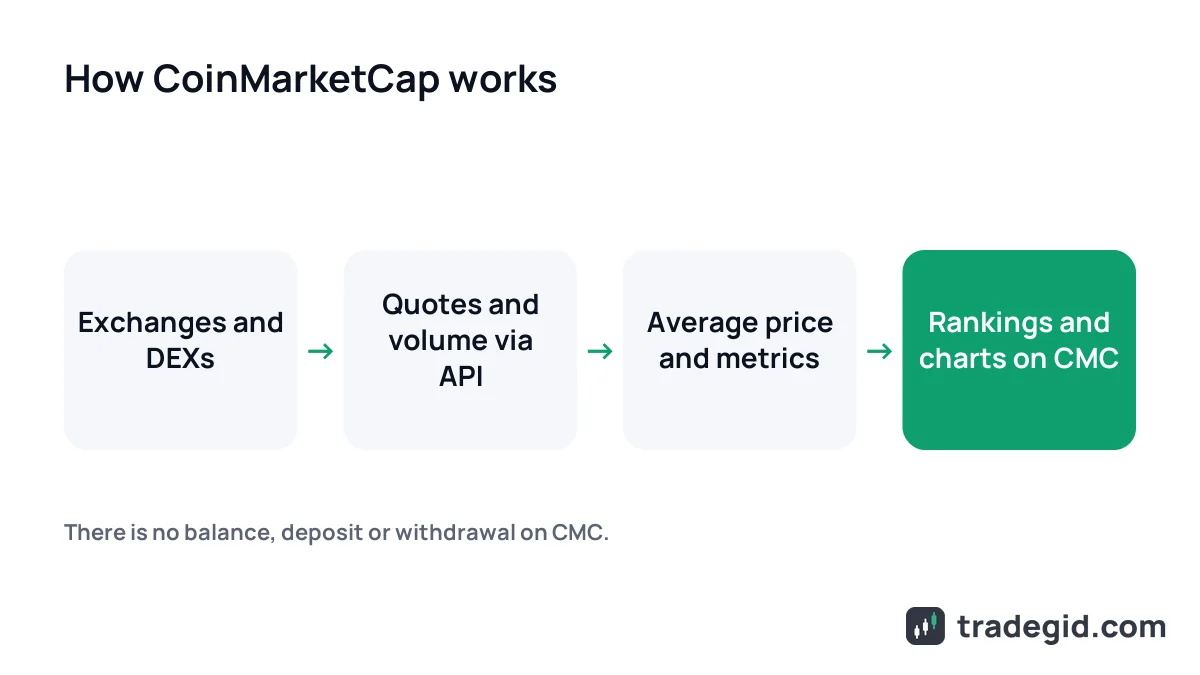
What you can see on CoinMarketCap
- Coin ranking – all coins and the top 100 by market cap, price in USD or your local currency (INR, NGN and PHP are in the list), change over 1 hour, 24 hours and 7 days.
- Coin page – chart, market cap, FDV, volume, supply, list of markets, token unlocks, links to the project website and block explorer.
- Exchange rankings – spot and derivatives, centralised (CEX) and decentralised (DEX) listed separately.
- New listings – Recently Added and Upcoming, plus fresh DEX pairs in DexScan.
- Categories – memecoins, Solana ecosystem, tokenised assets and other sectors with their combined market cap.
- Indices and charts – Fear and Greed Index, Altcoin Season Index, CoinMarketCap 100 and 20, Bitcoin dominance, funding rates, liquidations and a liquidation map.
- Portfolio, watchlist and community – track your holdings, keep a watchlist and see Community Sentiment, where users vote bullish or bearish on coins. The coins themselves are never stored on CMC.
CMC is a shop window for the market: everything you need for a first look at a coin sits in one place, but buying and selling happen on an exchange.
CMC indices: Fear and Greed, Altcoin Season, CMC100 and CMC20
The Fear and Greed Index measures market mood on a 0–100 scale – there is a full breakdown on its own page. The Altcoin Season Index takes the top 100 coins, excluding stablecoins and wrapped tokens, and counts how many beat Bitcoin over 90 days: 75% or more means altcoin season, 25% or fewer means Bitcoin season.
CoinMarketCap 100 and CoinMarketCap 20 track the top 100 and top 20 coins, weighted by market cap and rebalanced on the first day of every month. The CMC20 index has a tradable on-chain token, the CMC20 DTF, built with Reserve; the CMC100 itself cannot be bought. Bitcoin dominance is BTC's share of total crypto market cap – about 60% on 27 October 2026.
Key CoinMarketCap metrics explained
| Metric | How it is calculated | Why it matters |
|---|---|---|
| Price | Volume-weighted average across the coin's markets | A big price gap between exchanges points to weak liquidity |
| Market cap | Price × circulating supply | The coin ranking is based on it |
| FDV | Price × max supply; if there is no max – × total supply | If FDV is many times market cap, big unlocks are coming |
| Volume (24h) | All trades across the coin's markets in the last 24 hours | Compare it with market cap and with coins ranked nearby |
| Circulating supply | Coins in public hands | This is what is actually being traded now |
| Total supply | Coins created minus coins burned | The gap to circulating is team, foundation and investor coins |
| Max supply | The most coins that can ever exist | Bitcoin has 21 million, many tokens have no cap |
Formulas from the tooltips on coinmarketcap.com coin pages, as of October 2026.
Example: price $1, 100 million circulating, 1 billion max. Market cap is $100 million, FDV $1 billion – 90% of the coins are still to come, and every unlock adds supply someone will want to sell.
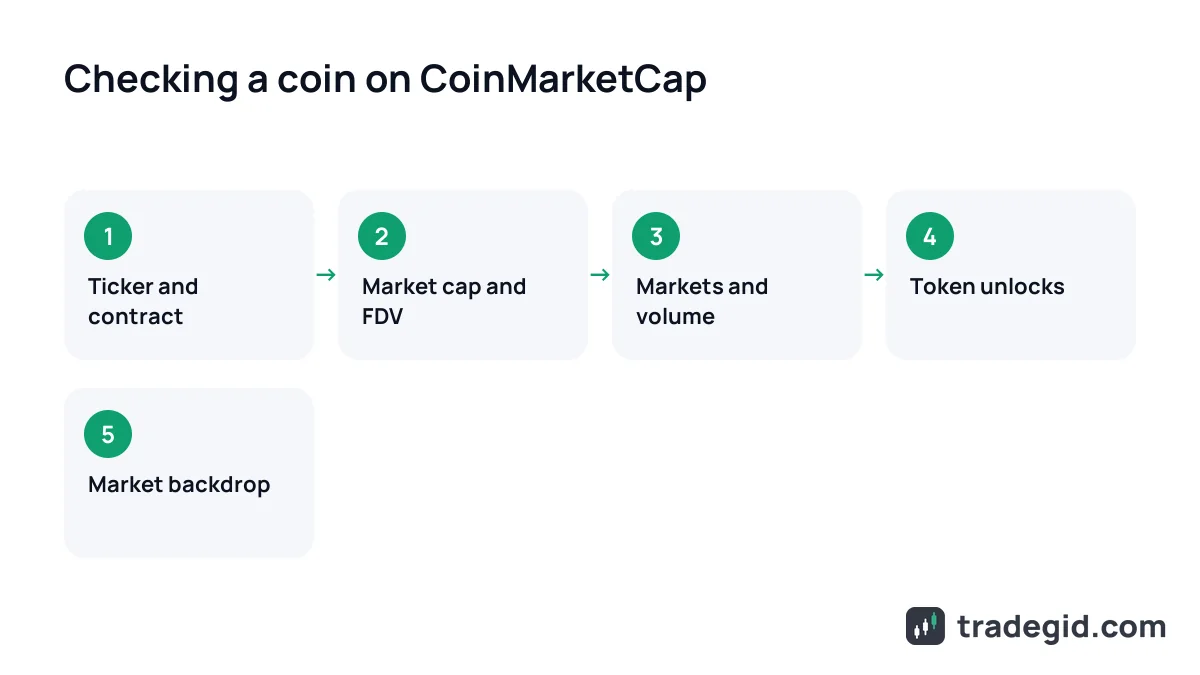
How to use CoinMarketCap before buying a coin
- Find the right coinSearch by name and ticker, then check the contract address against the project's official site.
- Check market cap and rankA top-100 coin and a coin worth a few million dollars carry very different risk, even if the charts look alike.
- Compare market cap with FDVThe bigger the gap, the more coins are still to come and the heavier the future selling pressure.
- Open the Markets tabSee where the coin trades, the volume on each exchange, the Liquidity Score and the Confidence Indicator. If almost all volume sits on one little-known venue, be careful.
- Check token unlocksToken Unlocks shows dates and the share of supply being released. A big unlock next week is a bad time to buy.
- Read the market backdropFear and Greed, Bitcoin dominance and Altcoin Season tell you what phase the market is in and whether buying altcoins makes sense right now.
These six steps take about ten minutes and filter out most of the coins people buy straight off the trending list.
Red flags in CMC data
- Low liquidity – daily volume is tiny compared with market cap and the Liquidity Score is low. You won't exit a large position without heavy slippage.
- Suspicious volume – huge volume on one or two unknown exchanges with a low Confidence Indicator. A common sign of wash trading.
- Wide FDV gap – only a small share of supply is circulating, the rest is waiting its turn.
- Large unlock coming – the team and early investors receive coins they bought far below the current price.
- Trending with no history – a Trending spot can be bought with Boost.
- Copycats and fakes – the same ticker on a different contract, especially on DEXs.
One flag means look closer, two or three at once mean walk away or keep the position very small.
How to withdraw money from CoinMarketCap
You can't, and that's by design. CoinMarketCap has no balance, deposits or withdrawals – it holds neither money nor coins. If someone on Telegram or WhatsApp offers to "release funds from your CMC account" for a fee, that is a scam.
The confusion usually comes from one of three things:
- You added coins to your CMC Portfolio. It's a tracker: the numbers show value, but the coins sit on an exchange or in a wallet, and that is where you withdraw from.
- You connected a wallet or exchange account to CMC. The connection only reads balances – the coins stay where they are.
- You collected Diamonds. These are loyalty points for daily check-ins and activity that you redeem for rewards and offers inside CMC. They are not money and cannot be cashed out.
Your money is always wherever the coins are – on an exchange or in your wallet – and CMC only shows what they are worth.
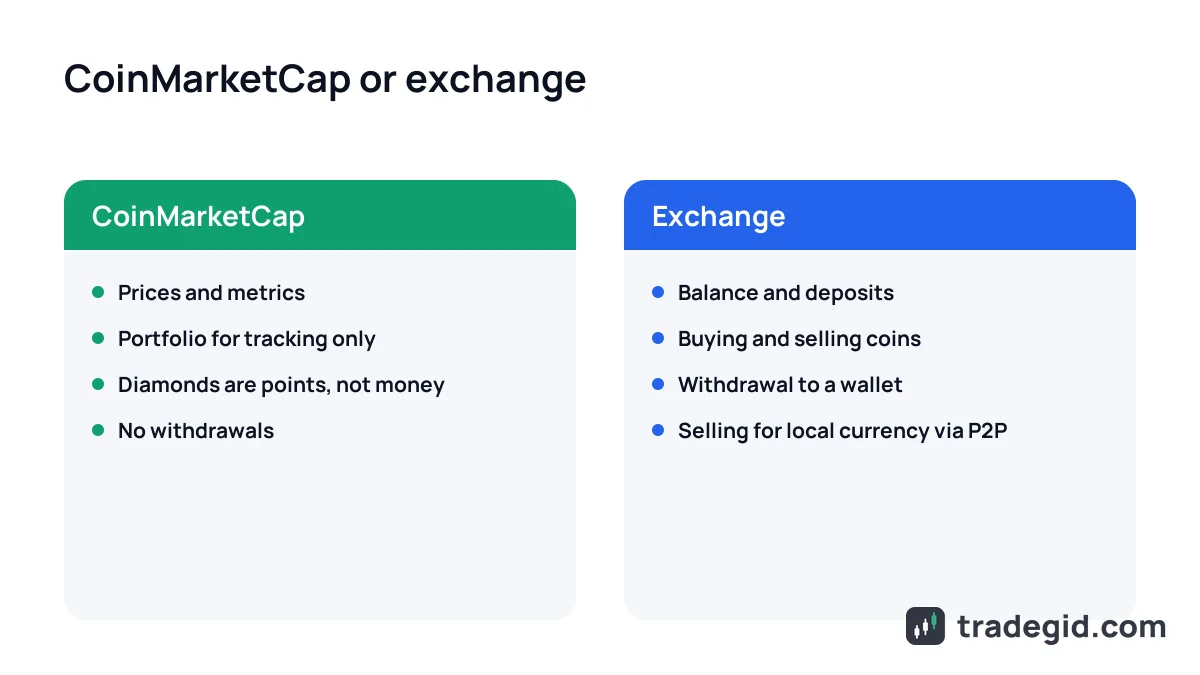
To get cash in your bank account, you sell the coin for USDT on an exchange and then sell the USDT to another user via P2P. The full route is in our guide on withdrawing USDT to a bank card, and venues are compared in the exchanges section. Check that an exchange serves your country before signing up – if it does, you can register through the links below.
CoinMarketCap API and app
CMC has a public API with a free Basic plan covering rankings, latest prices and listings; paid plans start at $29 a month (as of October 2026). Fear and Greed history is also available for free through the API. The iOS app launched in 2018 and the Android app in 2019.