

P2P crypto trading: how to buy and sell USDT with local currency
P2P is person-to-person crypto trading inside an exchange: you pay the seller by bank transfer or UPI, and the exchange holds their USDT in escrow until they confirm your payment. The main risks sit with your counterparty and your bank, not with the exchange.
Contents
What P2P on an exchange is and how escrow works
On a P2P marketplace the exchange does not sell you coins itself. It matches buyers and sellers, and the money moves directly between them: IMPS or UPI in India, a bank transfer in Nigeria, GCash or a bank transfer in the Philippines. The exchange only guarantees that the seller's crypto can't disappear while you pay.
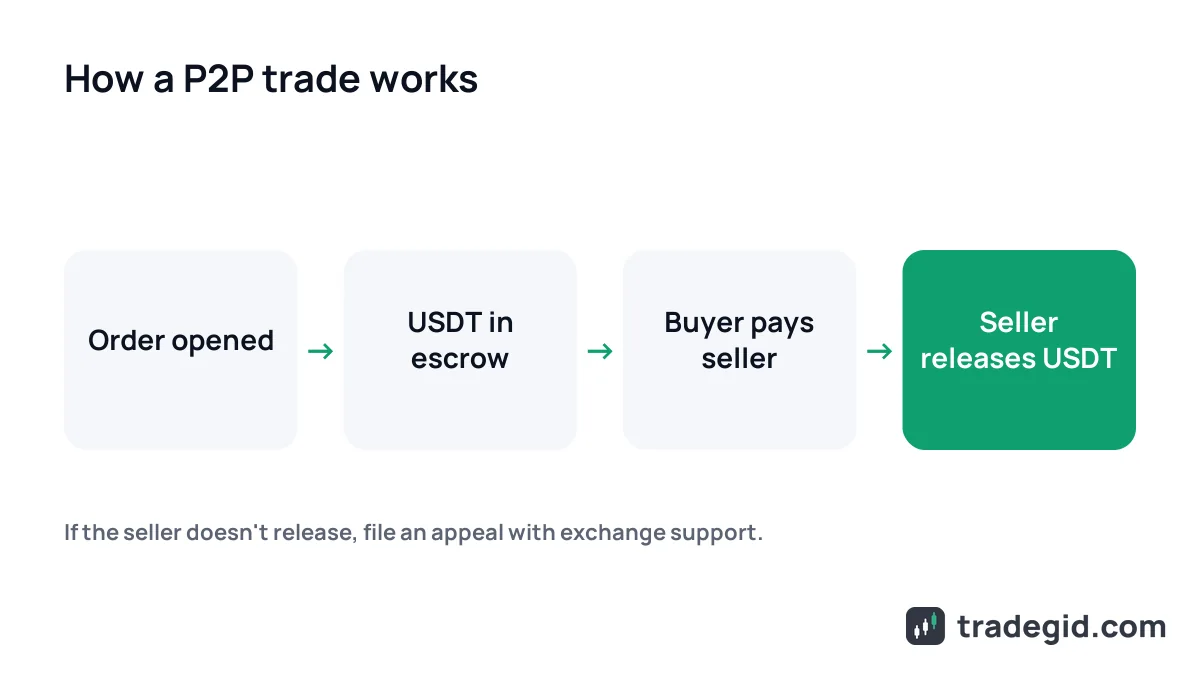
That is escrow. When you open an order, the exchange locks the seller's USDT. You send the money and tap "Paid" (Binance calls it "Transferred, Notify Seller"). The seller sees the funds in their bank and releases the coins. If they don't, you open an appeal, and support decides using receipts and the order chat.
Buying vs selling on P2P
Buying is the easier side: nothing is lost until you mark the order as paid. Selling is harder – money arrives from a stranger, and the seller is exposed to stolen funds and reversed payments.
- Buyer pays first but is protected by escrow – the seller's coins are already locked.
- Seller releases coins only after seeing the money in their own bank app, never based on a screenshot.
- Merchant – a user who posts ads and trades all day. You usually act as the taker and respond to their ad.
- Taker picks an existing ad; the maker posts it.
As a beginner, stay on the taker side and trade with established merchants: the ad sets the rules, you only need to watch the payment.
If you want to cash out rather than buy, the full walkthrough is here: how to withdraw USDT to a bank account.
How to choose a P2P merchant
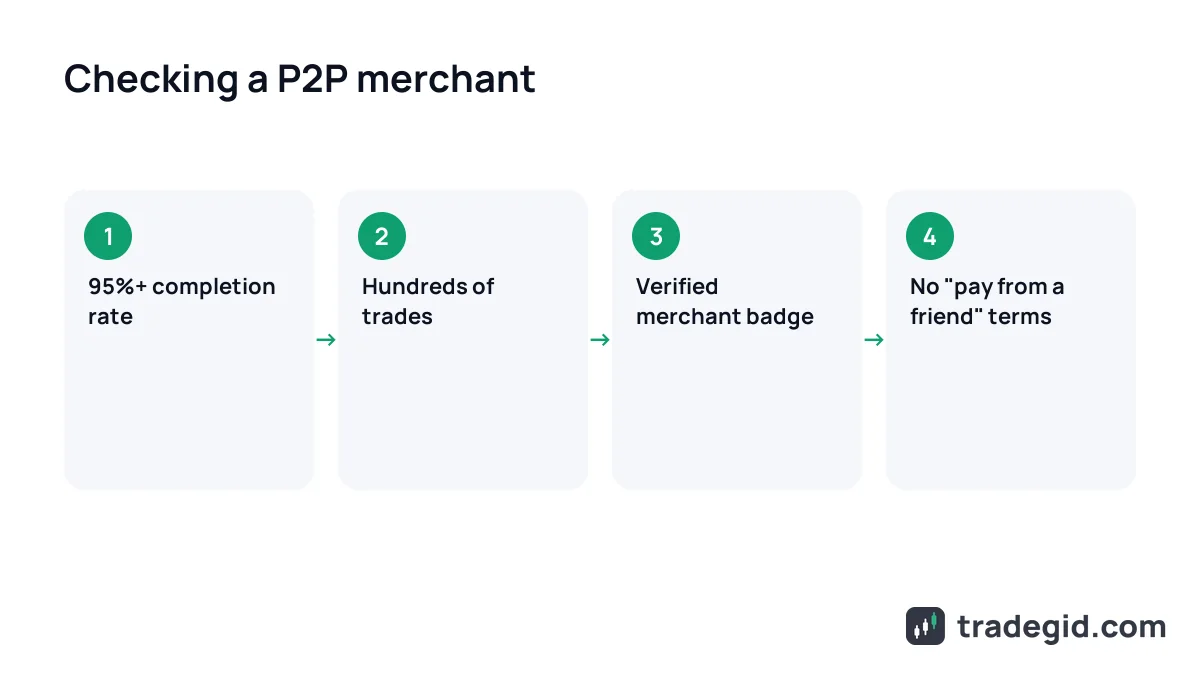
Half a percent better rate is not worth a frozen bank account. This is what I check before every trade:
- Completion rate over the last 30 days. Below 95% – move on.
- Number of trades. A fresh account with a dozen orders and the best price on the board is classic bait.
- Verified merchant badge. Granted after extra checks and a security deposit.
- Average release time. If yours is stuck far longer than usual, message them and keep your receipt ready.
- Ad terms. Anything like "pay from a friend's account" or "contact me on Telegram" is an instant no.
A good merchant shows a long history, a high completion rate and a badge – the best price on the list is not a quality signal.
Main P2P risks
Frozen bank accounts under AML rules
Banks treat frequent transfers from many strangers as a red flag. An account can also be frozen after a complaint about a single payment you received, even if your own trade was clean.
Triangle scams and chargebacks
A scammer sells something to a victim and gives them the P2P seller's bank details. The victim pays, the seller releases USDT to the scammer, and later the victim's complaint freezes the seller's account. That is why payment must come from the exact person named in the order.
Third-party payments
Binance P2P rules ban paying from anyone else's account: if a dispute shows third-party payment details, that user bears the loss alone,. If the sender's name doesn't match the order, return the money and cancel through support.
Which exchanges support INR, NGN and PHP on P2P
Availability depends heavily on the country – Binance, for example, dropped the naira in March 2024. Here is what I could confirm:
| Exchange | INR | NGN | PHP | Notes |
|---|---|---|---|---|
| Binance | Yes | No | Check in the P2P section | Naira services shut down 8 March 2024; Philippine SEC moved to block the site in March 2024 |
| Bybit | Yes | Yes | Yes | Per-order P2P limits published for all three currencies |
| OKX | Yes | Yes | Yes | Dedicated P2P market pages for INR, NGN and PHP |
| Bitget | Check in the P2P section | Yes | Check in the P2P section | Live NGN ads with bank transfer seen in October 2026 |
| Gate | Check in the P2P section | Check in the P2P section | Check in the P2P section | Supported fiat list changes – confirm in the app |
As of October 2026. Sources: Bybit Help Center "P2P Order Limits", OKX P2P market pages, Bitget P2P NGN page, Peoples Gazette / Wikipedia (Binance Nigeria and Philippines). Availability depends on your country – check the P2P section before trading. Not applicable to the US or UK.
Sanctions shape these lists too: Binance and OKX removed the Russian rouble from P2P (in January 2024 and August 2023) after Western sanctions on Russia, and Bybit does not accept cards of sanctioned Russian banks.
What about MEXC, BingX, KuCoin and WhiteBIT P2P
The mechanics are the same: escrow, merchant ratings, appeals. We don't review these exchanges, so check your currency, payment methods and country access yourself – the safety rules on this page apply everywhere.
Where to start
From our list, Bybit and OKX currently cover INR, NGN and PHP on P2P, and Binance is a strong option for INR. Registration guides: Bybit, OKX, Binance. Full comparison in Exchanges.