

Liquidation price in crypto futures: meaning, formula and how to avoid it
The liquidation price is the price at which the exchange force-closes your leveraged position because your losses have eaten almost all of the margin. It fires slightly before zero, when the margin left drops to the maintenance level. At 10x leverage, a move of roughly 9–10% against you is enough.
Contents
- What does liquidation price mean?
- Liquidation price formula for longs and shorts
- How leverage moves your liquidation price
- Perpetual futures liquidations and cascades
- How to avoid liquidation
- What liquidation actually costs you
- Where to find your liquidation price on the exchange
- Where to trade futures with proper risk tools
What does liquidation price mean?
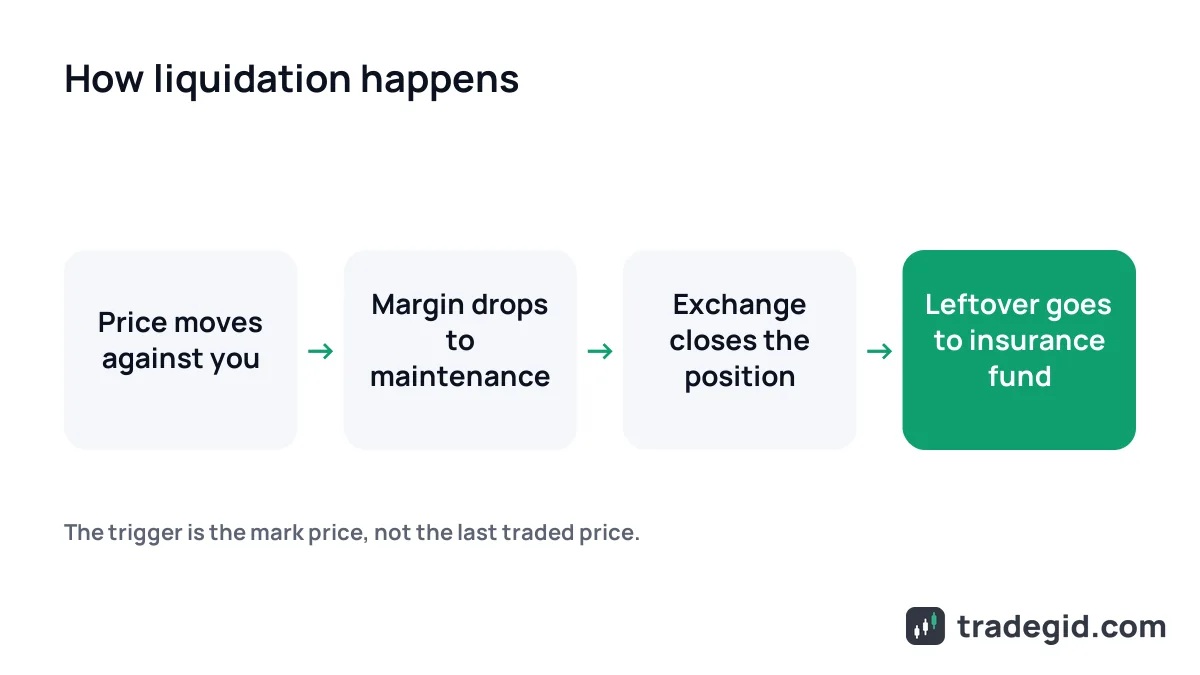
When you open a leveraged position, you only put up part of its value as margin. The exchange's job is to make sure your loss never gets bigger than the money you posted. So once the loss gets close to the size of your margin, the matching engine closes the position at market on its own.
From the trader's side it looks like this: the position is gone, the margin is debited and the trade history shows a liquidation tag. You can't undo it, even if the price turns around five minutes later. That's why you want to know the liquidation price before you enter, not after.
Initial margin vs maintenance margin
Initial margin is what you put in to open the trade: position size divided by leverage. A 10,000 USDT position at 10x needs 1,000 USDT.
Maintenance margin is the minimum that has to stay in the position for the exchange to keep it open. It equals position size × maintenance margin rate (MMR). At an MMR of 0.5%, that same position needs 50 USDT. As soon as margin plus unrealised PnL falls to those 50 USDT, liquidation starts.
The MMR isn't fixed. It depends on the contract and on the size of your position: the larger the position, the higher the rate and the lower the maximum leverage. These steps are called risk limit tiers, and every contract has its own table on the exchange.
Mark price vs last traded price
The chart usually shows the last traded price. Major exchanges calculate liquidation from a different number, the mark price. It's built from a spot price index across several venues and smooths out sharp wicks on a single exchange. Bybit's trading rules say directly that liquidation is triggered when the mark price hits the liquidation price, not the last traded price.
That cuts both ways. A quick wick on one exchange won't always liquidate you. But sometimes the chart never touched your level and the position is still gone, because the mark price did. Switch your futures chart to mark price to see what the liquidation engine sees.
Partial liquidation
Large positions aren't always closed in one go. On Bybit, for example, if the position sits above the lowest risk limit tier, the system first cancels orders that would increase it, then partially closes it down to the lower tier's size. If the margin is still short, the rest gets closed. At the lowest tier, the whole position is liquidated at once. Other exchanges follow similar logic with different details, so check the rules of the venue you trade on.
Insurance fund and auto-deleveraging
The liquidation order is filled at market, so the fill can be better or worse than the calculated price. If it's better, the leftover margin usually goes to the exchange's insurance fund, not back to you. If it's worse and the margin isn't enough, the insurance fund covers the gap. When even that isn't enough, the exchange uses auto-deleveraging (ADL) and partially closes profitable positions on the other side.
The part that matters for you: on isolated margin, the most you lose is that position's margin, and your balance doesn't go negative. But whatever maintenance margin was left after liquidation most likely won't come back either.
Liquidation price formula for longs and shorts
For an isolated position, ignoring fees and funding, the liquidation price works out like this:
- Long:
Liquidation price ≈ Entry × (1 − 1/Leverage + MMR) - Short:
Liquidation price ≈ Entry × (1 + 1/Leverage − MMR) - Distance to liquidation in percent ≈
100% / Leverage − MMR - MMR goes in as a fraction: 0.5% = 0.005
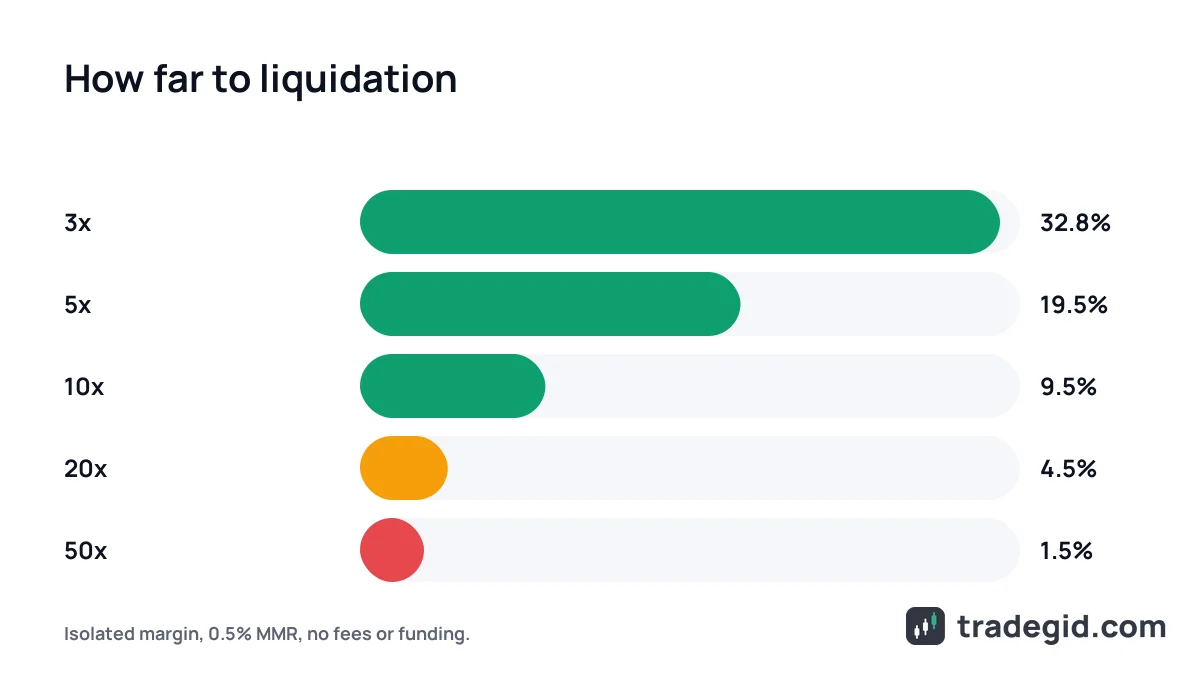
Leverage decides almost everything about how much movement the position can take: about 9.5% at 10x and about 4.5% at 20x.
The logic is simple. The 1/Leverage part is the share of the price your margin covers. The MMR trims that buffer a little, because the exchange closes you out before you hit zero.
The number in the exchange terminal will almost always differ slightly from your paper maths. The exchange includes the closing fee, accrued funding, your risk limit tier and any margin you added manually. Use the formula to understand the scale, and check the exact price in the order window before you enter.
Worked example: BTC liquidation price
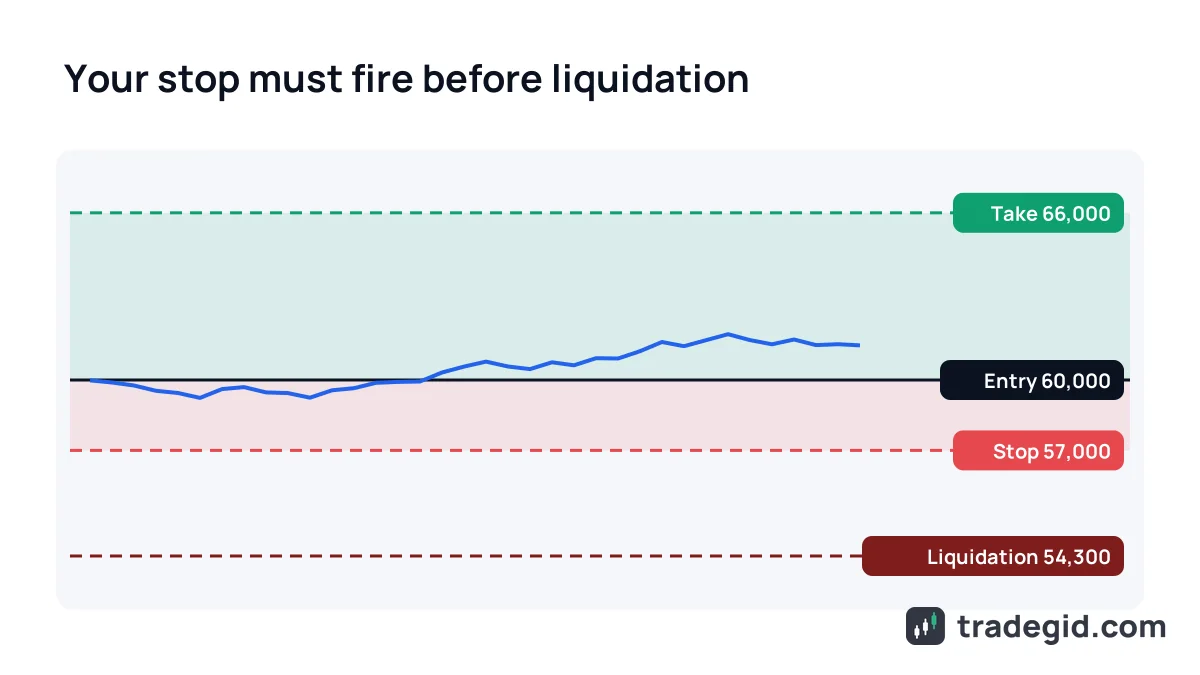
- Long BTC at 60,000 USDT with 1,000 USDT margin and 10x leverage. Position size is 10,000 USDT, about 0.1667 BTC.
- Maintenance margin at 0.5% MMR: 10,000 × 0.005 = 50 USDT.
- Long liquidation price: 60,000 × (1 − 0.1 + 0.005) = 54,300 USDT. That's 9.5% below entry.
- Check: at 54,300 the loss is 0.1667 × 5,700 ≈ 950 USDT, leaving 50 USDT in the position – exactly the maintenance margin.
- Same entry as a short: 60,000 × (1 + 0.1 − 0.005) = 65,700 USDT, also 9.5% away.
At 10x you lose the whole margin on a move just under 10%, and for Bitcoin that can be one bad day.
How leverage moves your liquidation price
| Leverage | Distance to liquidation | Long liquidated at | Short liquidated at | Margin for a 10,000 USDT position |
|---|---|---|---|---|
| 2x | 49.5% | 30,300 | 89,700 | 5,000 USDT |
| 3x | 32.8% | 40,300 | 79,700 | 3,333 USDT |
| 5x | 19.5% | 48,300 | 71,700 | 2,000 USDT |
| 10x | 9.5% | 54,300 | 65,700 | 1,000 USDT |
| 20x | 4.5% | 57,300 | 62,700 | 500 USDT |
| 50x | 1.5% | 59,100 | 60,900 | 200 USDT |
| 100x | 0.5% | 59,700 | 60,300 | 100 USDT |
Calculated with the formula above, no fees or funding. Real MMR depends on the contract and position size – check the exchange's risk limit table.
Look at the 50x row: Bitcoin can move 1.5% in a few minutes around a news release. At 100x, ordinary market noise will close you out. More on picking a multiplier in the guide to leverage.
Perpetual futures liquidations and cascades
When market recaps say hundreds of millions in longs were liquidated, that means thousands of positions force-closed in a short window. The mechanics: price drops, high-leverage longs get liquidated, their positions are closed with market sells, price drops further and hits the next batch. That's a cascade.
Shorts work the same way in reverse: a sharp rally knocks them out, their forced buys push price higher, and you get a short squeeze. A high funding rate across many coins at once often means the crowd is leaning hard one way and a cascade is possible.
Liquidation heatmaps on data sites show where liquidation prices are roughly clustered. They're estimates based on open interest and typical leverage, not exact exchange data. Fine as a hint, not as a guaranteed level.
How to avoid liquidation
- Put your stop-loss before the liquidation priceA stop closes the trade at a loss you planned. Liquidation takes the whole margin. The stop should sit well before it: above the liquidation price for a long, below it for a short.
- Use lower leverageAt 3x–5x a position can take a 20–30% move. That's enough to ride out normal volatility and leave calmly at your stop.
- Size the position from your riskDecide how much you're willing to lose first (say 1–2% of the account), then work out the size. The position size calculator does this for you.
- Add margin on purpose, not in panicAdding margin to an isolated position pushes the liquidation price away. Do it on every losing trade, though, and you're just making the loss bigger.
- Use isolated marginIt caps the loss at the amount you assigned to the position. See how it works in cross vs isolated margin.
- Account for funding and feesOn a long hold they slowly drain the position's margin and the buffer to liquidation shrinks. Check the liquidation price while you're in the trade, not only at entry.
Your main protection is a stop-loss combined with sensible leverage. Everything else adds buffer, but none of it replaces the stop.
What liquidation actually costs you
Liquidation is almost always more expensive than a stop, even when the exit price looks similar. You put a stop where the loss is acceptable to you. Liquidation takes the whole position margin, and on cross margin it can take more.
| Scenario | What you lose | Comment |
|---|---|---|
| Stop-loss hit | The planned loss plus fees | You chose the amount before entering |
| Liquidation, isolated margin | The full margin of that position | Leftover maintenance margin usually goes to the insurance fund |
| Liquidation, cross margin | Up to your entire free futures balance | The rest of the balance acted as a buffer and was used up |
| Partial liquidation | Part of the position and margin | Happens to large positions above the lowest risk limit tier |
Some exchanges also charge a liquidation fee. The amount is listed in each exchange's futures trading rules.
Where to find your liquidation price on the exchange
- Order window – many terminals show the estimated liquidation price for your chosen leverage and size before you open.
- Positions tab – the Liq. price column updates when you add margin or when funding is charged.
- Built-in calculator – Binance, Bybit, OKX, Bitget and Gate all have one inside the futures terminal.
- Risk limit table – shows the MMR for your position size.
Check the price in the order window before entry and in the position after: on cross margin it shifts along with your balance.
For a quick estimate outside the exchange, use the standalone liquidation calculator. Profit and loss at different exit prices is easier in the PnL calculator.
Where to trade futures with proper risk tools
All exchanges below offer isolated and cross margin, stop-losses triggered by mark price and a built-in liquidation calculator. Availability depends on your country, so check the exchange's terms before signing up. You can register via the link, with the referral code shown next to it.