

Crypto futures trading explained: how perpetuals work
A crypto futures contract tracks a coin's price without you owning the coin. You can profit either way – a long gains when price rises, a short when it falls – and leverage multiplies both gains and losses.
Contents
What is futures trading in crypto
Buy bitcoin on spot and the coin lands in your account. Open a futures position and you hold only a contract whose value moves with the price. When you close it, the profit or loss settles in USDT.
I've traded futures since 2020, and in my first months I kept confusing position size with margin. That mistake costs more than any other – see the margin section below.
Perpetual futures vs dated futures
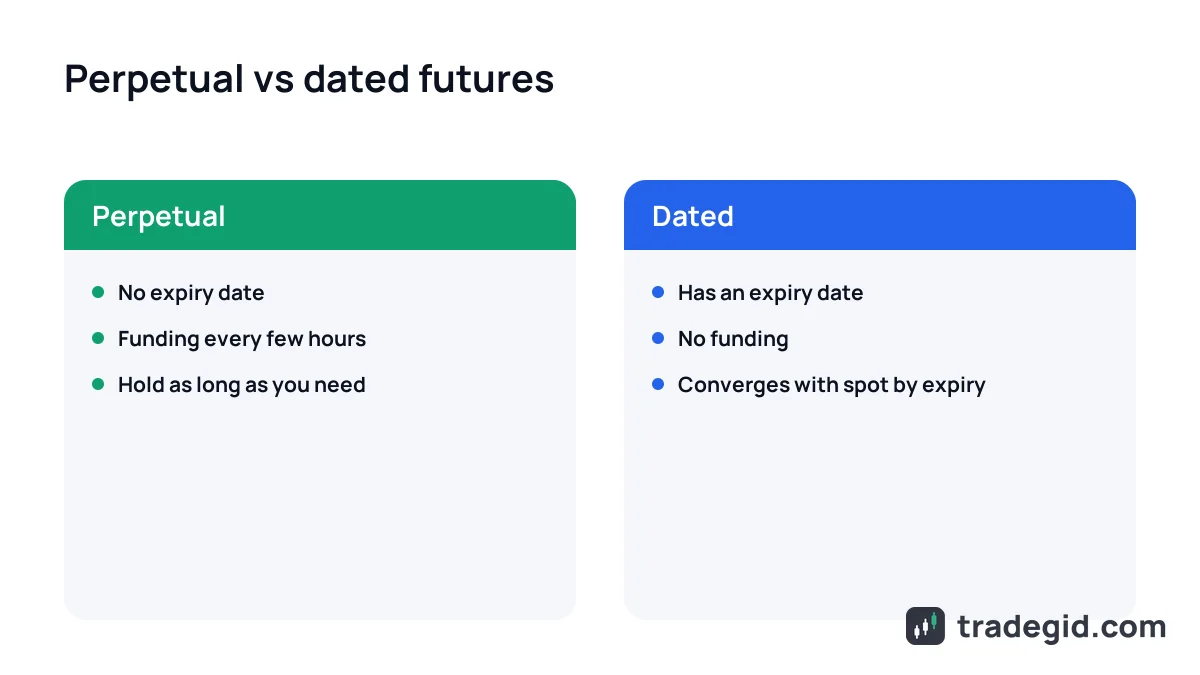
A dated (quarterly) contract has an expiry date when the position closes automatically at the settlement price. A perpetual never expires. What keeps its price near spot is the funding rate – a regular payment between longs and shorts.
| Feature | Perpetual | Dated (quarterly) |
|---|---|---|
| Expiry | None, hold as long as you need | Yes, the position closes on expiry day |
| How price stays near spot | Funding every few hours | Converges with spot by expiry |
| Recurring payments | Funding: you pay or receive | None |
| Typical use | Retail traders' main instrument | Hedging, long holds without funding |
"I trade futures" almost always means USDT-margined perpetuals.
Margin, leverage, long and short
Margin is your own money locked for the trade. Leverage shows how many times bigger the position is: 100 USDT at 10x is a 1,000 USDT position, so a 1% price move changes your margin by 10%.
A long is a bet on price going up, a short on it going down. On futures a short is one click, no borrowing. More in the guides on long and short and leverage.
Try 50x: a 2% move against you wipes out the margin. On altcoins that can take a couple of minutes or a single wick.
Funding and liquidation: what drains the account
Funding applies only to perpetuals. A rate like 0.01% per interval looks tiny, but it's charged on the full position several times a day – the math is in the funding rate guide.
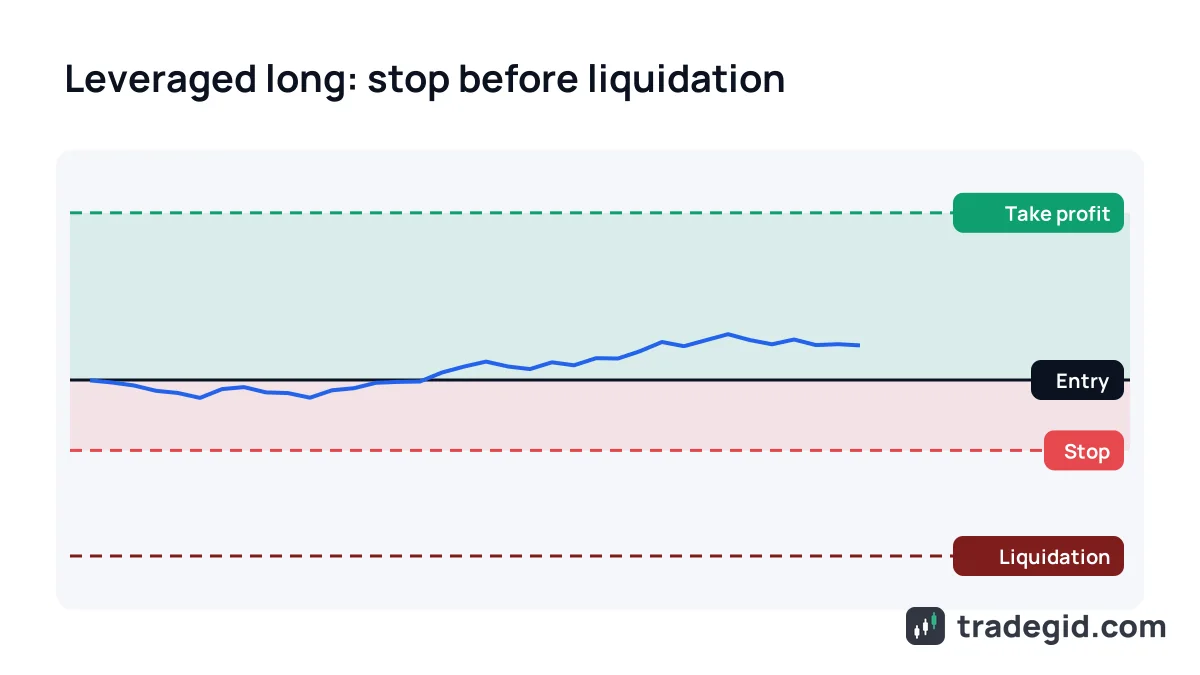
Liquidation is the forced close of a position once margin can't cover the loss. In isolated mode you lose that trade's margin; in cross mode the whole futures balance is at risk (cross vs isolated margin). The liquidation price is visible before entry – see the liquidation guide.
Crypto futures glossary
| Term | What it means | Example |
|---|---|---|
| Perpetual | A contract with no expiry date | BTCUSDT Perpetual |
| Margin | Your money locked for the position | 100 USDT |
| Leverage | How many times bigger the position is than the margin | 10x – a 1,000 USDT position |
| Long | A position that profits when price rises | Entry 60,000, exit 62,000 |
| Short | A position that profits when price falls | Entry 3,000, exit 2,850 |
| Funding rate | Payment between longs and shorts every few hours | 0.01% of position size |
| Mark price | Fair price used for unrealised PnL and liquidation | Ignores random wicks |
| Liquidation | Forced close of a position due to lack of margin | At 10x – just under 10% against entry |
| Isolated / cross margin | At risk: the trade's margin / the whole balance | Chosen before entry |
| PnL and ROE | Result in USDT and as a % of margin | +50 USDT, ROE +50% |
Numbers in the examples are illustrative.
A beginner's path: what to read in order
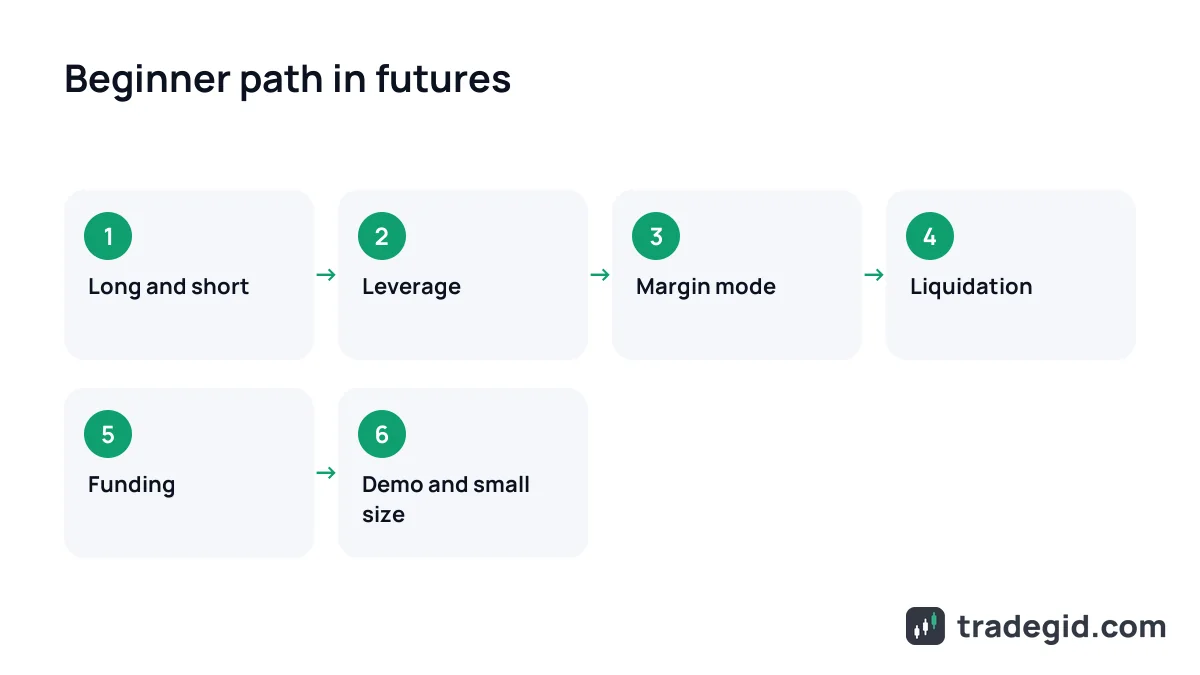
- Long and short – profiting from rising and falling prices.
- Leverage – how leverage changes risk and why 5x is often smarter than 50x.
- Cross vs isolated margin – which mode to switch on before your first trade.
- Liquidation – how the liquidation price is calculated and how to stay clear of it.
- Funding rate – what it costs to hold a position for more than a day.
- First trades – in demo mode or with money you can afford to lose, low leverage and a stop-loss every time.
Mechanics and risk first, costs second. Skip liquidation and margin modes, and the market will teach them on the first sharp wick – at a far higher price.
Calculators to use before a trade
- Liquidation calculator – the price at which the exchange closes your position.
- Position size calculator – how big to go so your stop costs 1–2% of the account at most.
- PnL calculator – profit, loss and ROE with leverage and fees.
Three quick checks before entry: where's the stop, how big is the position, where's liquidation. All tools are in the calculators section.
Where to trade crypto futures
USDT perpetuals are available on every exchange we review: Binance, Bybit, OKX, Bitget and Gate. The big ones also offer a futures demo mode with a virtual balance. Availability depends on your country – check before you sign up. Reviews are in the exchanges section.
In this section
- Long and shortBetting on a rise vs betting on a fall: USDT examples, how a short works and beginner mistakes.
- Funding rateWho pays funding, how it's calculated and what it costs to hold a position for a week.
- LeverageHow leverage changes position size and distance to liquidation, and why beginners need only 2–5x.
- LiquidationWhy the exchange closes your position, how to calculate the liquidation price and how to stay away from it.
- Cross vs isolated marginThe two futures margin modes: what each one puts at risk and which a beginner should pick.