

How to withdraw USDT to a bank account: INR, NGN and PHP
The most common way to withdraw USDT to a bank account is a P2P sell: you sell your coins to another user on an exchange and they send rupees, naira or pesos to your bank. The exchange holds your USDT in escrow until you confirm the money has arrived. Direct fiat withdrawal exists only where the exchange has a local banking partner, and over-the-counter dealers are faster but riskier.
Contents
Can you withdraw USDT to a bank account?
Not directly. USDT is a token on a blockchain, and your bank only handles local currency. Someone has to buy your USDT and pay you in fiat. The only question is who that is and how much you trust them.
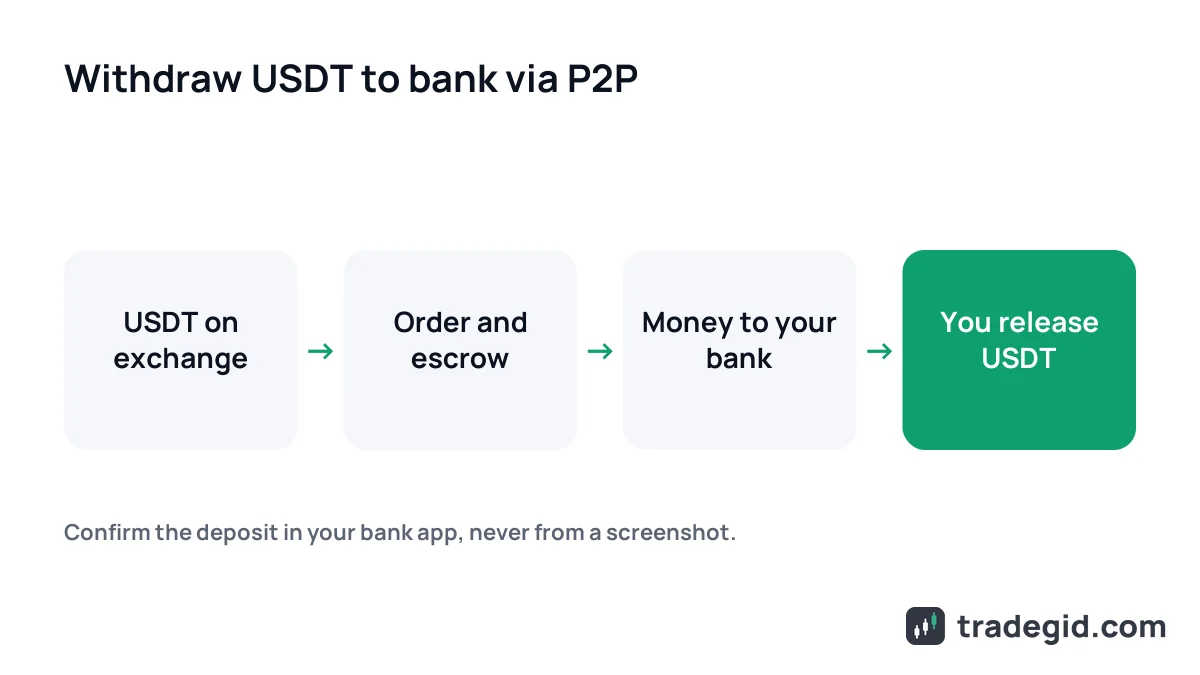
- P2P sell on an exchange – you sell USDT to a person, they pay to your account, you release the coins after the money lands.
- Fiat withdrawal from the exchange – sell USDT for local currency on the exchange and withdraw to your bank. Works only where the exchange has a licensed local channel.
- OTC dealers and exchangers – you send USDT to a service or a person, they pay you. Websites, Telegram bots, local desks.
- Exchange crypto card – spend USDT with a card issued by the exchange. Available in some countries only.
For India, Nigeria and the Philippines the workhorse is P2P; use an OTC dealer only for small amounts when P2P isn't an option.
| Method | Pros | Cons | Best for |
|---|---|---|---|
| P2P sell | Escrow, you pick the price and buyer, no taker fee on many exchanges | Risk of receiving tainted funds, many incoming transfers from strangers | Most users in India, Nigeria, Philippines |
| Exchange fiat withdrawal | Money comes from the exchange or its bank partner, not a stranger | Not available in many countries, withdrawal fee may apply | Where your exchange offers local fiat rails |
| OTC dealer / exchanger | Fast, no exchange account needed | No escrow, worse rate, lots of scams | Small one-off amounts |
| Exchange crypto card | Spend USDT without selling manually | Limited country coverage, card fees | Check availability in your country |
As of October 2026. Fiat rails and card availability depend on the exchange and your country – check in the app.
How to withdraw USDT to a bank account via P2P, step by step
I'll use Bybit and OKX as examples, since both list INR, NGN and PHP P2P markets. Binance works the same way for INR, but it shut down its naira services in March 2024, so Nigerian users won't find NGN there. Rouble P2P is gone from Binance and OKX for a different reason: both dropped it after Western sanctions on Russia.
- Move USDT to the exchangeIf your coins are in Trust Wallet, a Telegram wallet or another exchange, send them to your deposit address. Match the network: TRC20 to TRC20, BEP20 to BEP20.
- Transfer USDT to the P2P (Funding) accountP2P on Bybit and Binance works from the Funding account. If your USDT sits in a trading account, make a free internal transfer.
- Add your payment methodIn P2P settings add your bank account, UPI ID or e-wallet. The account holder name must match your KYC name.
- Pick a buyerSell tab, USDT, your currency, your method, your amount. Choose a merchant with 95%+ completion and hundreds of trades, not just the top price.
- Open the orderYour USDT is locked in escrow. The buyer sees your payment details and sends the money.
- Check your bank appOpen your actual bank or wallet app, not a screenshot in the chat. Exact amount, and the sender's name matches the buyer's name in the order.
- Release the USDTOnly after the funds have actually landed. If the name doesn't match or the amount is off, don't release – contact support.
Step 6 is the one that protects you: confirm the money in your own bank app and match the sender's name to the order before releasing anything.
How to withdraw USDT to a bank account in India
INR P2P is available on Binance, Bybit and OKX, with UPI and IMPS the usual methods in ads. Both Binance and Bybit have faced FIU-IND compliance orders, and Bybit completed its registration in 2025 after paying a penalty. India has a 1% TDS on crypto sales under Section 194S and taxes gains at 30% plus cess, so expect the exchange to report your sells.
Nigeria and the Philippines
For naira, Binance is out since March 2024, while Bybit, OKX and Bitget show NGN P2P markets. For pesos, Bybit and OKX list PHP, and ads usually include bank transfer and e-wallets – check which methods the buyer accepts. Binance's status in the Philippines has been under SEC pressure since March 2024, so confirm access from your account before relying on it.
From Trust Wallet or a Telegram wallet
Self-custody and Telegram wallets can't pay out to a bank directly. Send your USDT to an exchange with P2P, then follow the steps above. Some wallets have a built-in P2P market, but availability depends on your country.
USDT withdrawal fees and limits
The P2P trade itself is usually free for takers on major exchanges. You lose money in three places: the ad price, the network fee to get USDT onto the exchange, and any bank charge. The sell price on P2P is almost always below the market rate.
| Currency | Min per order | Max per order | Block trade (USDT) |
|---|---|---|---|
| INR | ₹100 | ₹4,000,000 | ₹850,000 – ₹17,000,000 |
| NGN | ₦4,500 | ₦23,000,000 | ₦15,000,000 – ₦300,000,000 |
| PHP | ₱100 | ₱2,700,000 | ₱600,000 – ₱12,000,000 |
As of October 2026, Bybit Help Center "P2P Order Limits". These are platform bounds – each merchant sets narrower limits in their ad, and your bank has its own caps.
- Network fee when moving USDT to the exchange depends on the chain and the sending platform.
- P2P spread is the real cost. Compare the ad price with the market USDT rate for your currency.
- Bank charges on incoming transfers are usually zero, but some banks and e-wallets cap free transfers.
- Fiat withdrawal fee applies only if you use the exchange's own fiat rails – it's shown in the withdrawal window.
- Tax withholding like India's 1% TDS reduces what you receive at the time of sale.
Judge a cash-out by the final amount in your bank, not by the fee line: on P2P the spread does most of the damage.
How to avoid a frozen bank account
A frozen account is the most common P2P cash-out problem. Your bank doesn't know you're selling your own USDT. It sees transfers from dozens of strangers and applies anti-money-laundering rules. A single complaint about one incoming payment can be enough for a bank to freeze the whole account.
- Accept money only from the person named in the order. A third-party payment means refund and cancel via support.
- Don't split one sale into dozens of tiny orders from different buyers.
- Use a separate bank account for P2P, not the one your salary lands in.
- Keep records: exchange statements, order history, receipts. That's your answer if the bank asks about the source of funds.
- Don't write "USDT" or "crypto" in payment notes and don't ask buyers to.
- Never let anyone else use your account for a cut.
Banks act on patterns that look like someone else's money flowing through you – clean, documented trades make an unfreeze much easier.
Cashing out through an OTC dealer: when it's OK
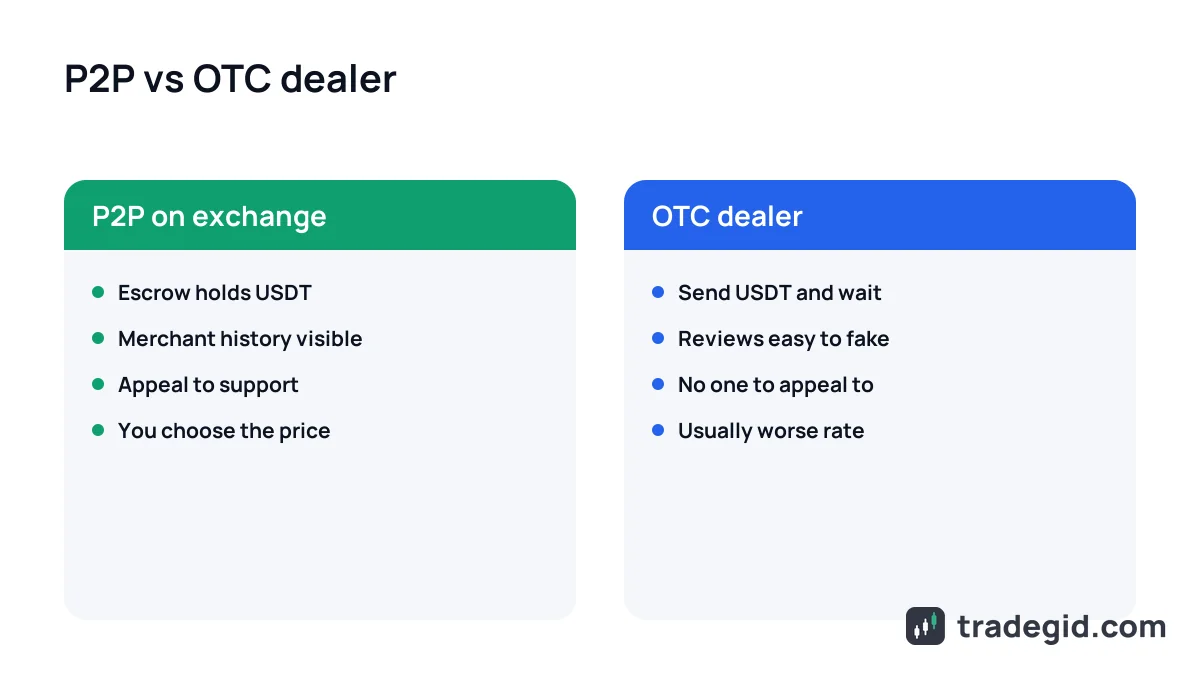
A dealer is handy for a small one-off amount or when you don't have an exchange account. But the flow is reversed: you send USDT first and hope the money arrives. No escrow, no appeal.
When a dealer makes sense
- Small one-off amount
- No exchange access in your currency
- Dealer with a long public track record
What you risk
- Clone sites and fake Telegram bots
- Worse rate than P2P
- Payout may come from a tainted source
- Stuck order with no support
Treat a dealer as a backup for small sums: double-check the site address and start with a test amount.
Taxes when you cash out USDT
Selling USDT for local currency can be a taxable event, and the rules depend on your country of tax residence. India withholds 1% TDS and taxes gains at a flat rate, and Nigeria introduced crypto tax reporting rules in 2026. This isn't tax advice: check the current rules with your tax authority or an adviser, and keep your trade history so you can calculate what you owe.
Where to cash out: Bybit and Binance
Bybit covers INR, NGN and PHP on P2P; Binance is strong for INR. For how P2P works in general and how to vet merchants, see the P2P guide. Registration walkthroughs: Bybit, Binance.
P2P with INR, NGN and PHP, escrow and appeals. Sign up via the link.
Sign up on BybitJ8NKMGThe code can only be entered during sign-up.
Large P2P market for INR. Sign up via the link.
Sign up on Binance58328288The code can only be entered during sign-up.