

Tokenized stocks: how to trade Tesla and Nvidia on a crypto exchange
A tokenized stock is a crypto token whose price tracks a real share, such as Tesla or Nvidia. The issuer buys the share and keeps it with a custodian, while you buy the token with USDT on a crypto exchange and can trade it even at midnight on a Sunday. You do not become a shareholder of the company.
Contents
What are tokenized stocks
I have traded crypto since 2020, and for years stocks lived in a separate world for me: a broker account, dollars, and a session that runs 9:30 to 16:00 New York time. That is 7 pm to 1:30 am in India and 9:30 pm to 4 am in Manila during US summer time. Tokenized stocks removed that wall. Now TSLAx sits in the same account as bitcoin, is bought with the same USDT and can be sold at any moment.
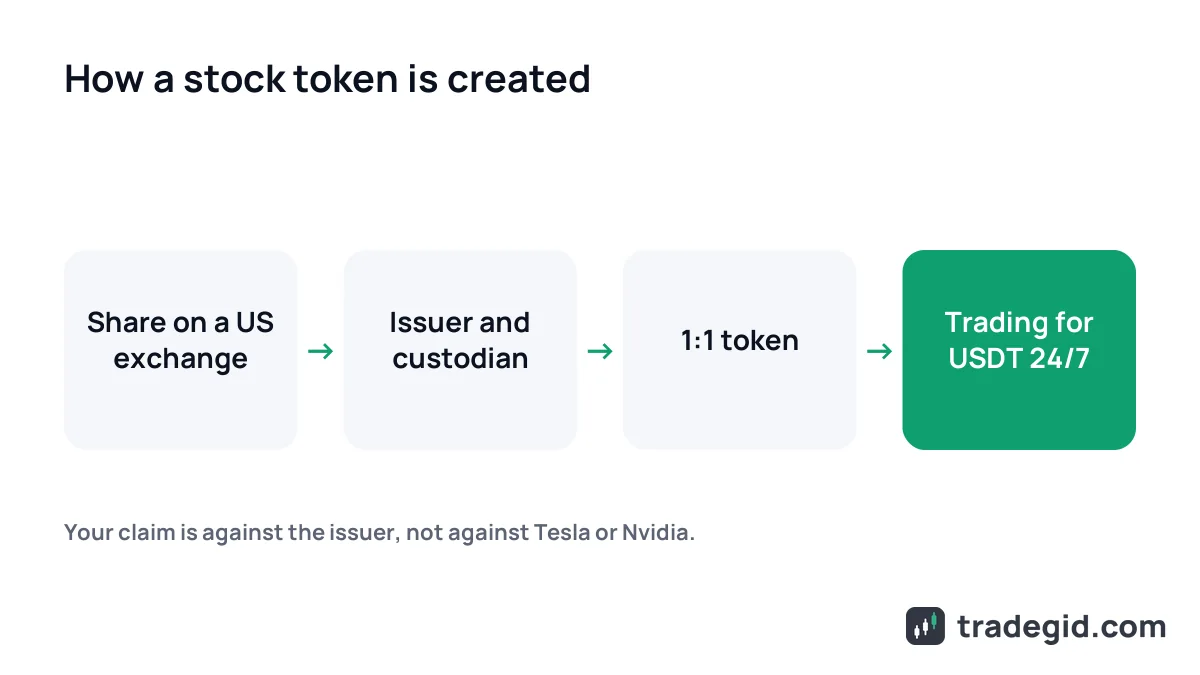
How do tokenized stocks work? The model is similar across issuers. The issuer buys real shares through a broker, holds them with a regulated custodian and mints one token per share. The token trades on crypto exchanges and on-chain, and its price follows the stock on the US exchange. If the issuer is honest, tokens in circulation never exceed shares in reserve.
Tokenized stock vs a share at a broker
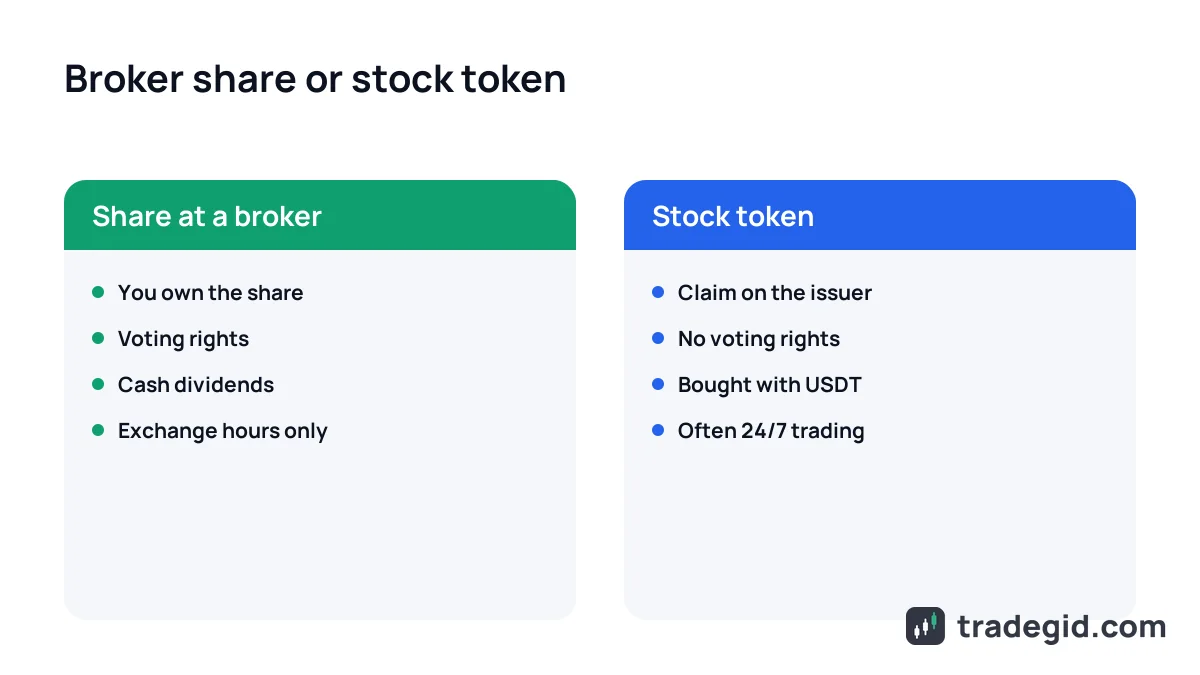
The main difference is legal. At a broker you own the share, even if through a chain of intermediaries. With a token you hold a claim on the issuer, who promises to keep the share in reserve. For short-term trading you barely notice it. For long-term investing the gap is large.
| Feature | Share at a broker | Tokenized stock |
|---|---|---|
| What you buy | The share itself | An issuer token backed 1:1 by the share |
| Voting rights | Yes | No (stated explicitly for xStocks and rTokens) |
| Dividends | Cash to your account | Depends on issuer: reinvested into the token for xStocks, paid in USDT for Bitget rTokens |
| Trading hours | US session plus pre- and after-market | Often 24/7, some assets 24/5 |
| Paid with | Dollars | USDT, USDC and other stablecoins |
| Withdrawal | Transfer to another broker | Token can be withdrawn to an on-chain wallet |
| Extra risk on top of the market | Broker | Issuer, custodian, exchange and smart contract |
As of October 2026, based on Kraken (xStocks), Bitget (rTokens) and Binance (bStocks) documents.
A word on weekends. When the US market is closed the token keeps trading, but nobody is trading the underlying share at that moment. The price rests on expectations and on the exchange's own liquidity, so Monday opens can gap.
The three main tokenized stock product lines
xStocks by Backed (Kraken)
The most widespread standard. Issued by Backed Assets (JE) Limited; in December 2025 Kraken's parent Payward agreed to acquire Backed. The ticker is the normal ticker plus x: TSLAx, NVDAx, AAPLx. xStocks trade on Bybit, Gate and Kraken, and since July 2026 on OKX, where tickers look like XTSLA. Full breakdown in what xStocks are.
Binance bStocks
Binance's own line, launched on 11 June 2026. The issuer is BTech Holdings Limited, a Binance group company, with prospectuses approved by the ADGM regulator in Abu Dhabi. Tokens are BEP-20 on BNB Chain with a B suffix: TSLAB, NVDAB. Five names at launch grew to more than 46 by late July, and bStocks crossed $500M in assets under management.
Bitget Stocks 2.0: rTokens and Stock+
Bitget runs two different products. rTokens (rAAPL, rNVDA) are tokens issued by Reality, more than 500 of them, some tradable 24/7. Stock+ gives you real shares through licensed US brokers: more than 10,000 securities, 24/5 trading, paid in USDC. Stock+ shares cannot be withdrawn to a crypto wallet, but dividends arrive as cash.
Stock perpetual futures
The fourth option is USDT-margined perpetual futures on stocks. You hold neither the share nor a token, just a price contract with leverage, funding and liquidation. Bitget, Binance, OKX, Bybit and Gate all list such contracts. Leverage varies: up to 10x on Gate's xStocks perpetuals, up to 100x on selected Bitget contracts.
| Exchange | Product | What you get | Notes |
|---|---|---|---|
| Bybit | xStocks on Spot, Bybit Alpha, spot grid bots and Dual Asset | Backed token 1:1, traded for USDT | Standard KYC required; not available in Australia, Japan or the EEA |
| Binance | bStocks (TSLAB, NVDAB and more) | Spot pairs against USDT, BEP-20 tokens on BNB Chain | Launched 11.06.2026; 46+ names by late July; not for US persons |
| OKX | Unified tokenized stocks built on xStocks | One market per stock against USDT, 24/7 | 40+ names at launch in July 2026; not for the US or EU |
| Bitget | rTokens, Stock+, stock futures | Reality token or a real share at a broker | 500+ rTokens, 10,000+ in Stock+; rTokens not for US persons |
| Gate | xStocks on spot and perpetuals, own gStocks | Tokens against USDT, contracts up to 10x | xStocks spot fee 0.2% (Gate data as of April 2026) |
As of October 2026, from official exchange pages and press releases. Asset and country lists change, so check the product page before buying.
Who can't buy tokenized stocks
Every issuer sells only outside the United States, and each exchange adds its own list on top. Here is what the official documents say:
- xStocks on Kraken – not available in the US, Canada, the UK or Australia; EEA users must pass a questionnaire, buy with fiat only and trade 24/5.
- xStocks on Bybit – not for Australia, Japan, any EEA member state or jurisdictions Bybit does not serve.
- OKX – launched for Southeast Asia, Northeast Asia, the CIS, MENA and Türkiye; not for the US or Europe.
- Binance bStocks – eligible users in permitted jurisdictions only, US persons excluded; the full country list is not published in the announcement.
- Bitget rTokens – not offered in the US or to US persons; Stock+ has its own restricted list.
No exchange guarantees access for a specific country, including India, Nigeria or the Philippines: the eligibility screen in your verified account is the final answer.
Popular tokenized stocks to start with
Most people start with S&P 500 giants and crypto-related companies. They have the deepest liquidity on crypto exchanges and the tightest spreads, so you overpay less on entry and exit.
| Stock | Company | xStocks (Bybit, Gate, Kraken) | OKX | Sector |
|---|---|---|---|---|
| NVDA | Nvidia | NVDAx | XNVDA | Chips and AI |
| TSLA | Tesla | TSLAx | XTSLA | EVs |
| AAPL | Apple | AAPLx | XAAPL | Tech |
| MSFT | Microsoft | MSFTx | XMSFT | Tech |
| AMZN | Amazon | AMZNx | XAMZN | Tech |
| GOOGL | Alphabet (Google) | GOOGLx | XGOOGL | Tech |
| META | Meta | METAx | XMETA | Tech |
| COIN | Coinbase | COINx | XCOIN | Crypto companies |
| MSTR | Strategy | MSTRx | XMSTR | Crypto companies |
| SPY | S&P 500 ETF | SPYx | XSPY | Index ETF |
As of October 2026. Bybit writes the x in capitals (TSLAX). Binance uses a B suffix (NVDAB, TSLAB), Bitget an r prefix (rNVDA, rTSLA).
A habit worth building: place larger orders while the main session is open. That is when the token stays closest to the share and the spread is tightest. At night and on weekends the order book is thinner and you can easily overpay a few tenths of a percent.
Tokenized stocks risks
- Issuer risk. If the issuer or custodian fails, you are a creditor, not a shareholder.
- Price drift. At night and on weekends the token can move away from the stock's last close.
- Liquidity. Lesser-known names have thin books and wide spreads.
- Access. An exchange can close the product for your country, leaving you only the option to sell.
- Leverage. Stock perpetuals follow the same leverage and liquidation rules as crypto.
Stock tokens lower the barrier to entry but add layers of intermediaries on top of market risk, so large long-term positions are usually safer at a broker.
How to get started
If you already trade on one of the exchanges below, there is nothing new to open: stock tokens are bought from your spot account with USDT. The step-by-step with menu names for each exchange is in how to buy stocks with USDT. If you want to short or use leverage, first read how long and short work.
In this section
- How to buy stocksStep by step: buying stock tokens with USDT on Bybit, Binance, OKX, Bitget and Gate, selling and fees.
- xStocksIssuer, 1:1 backing, dividends, chains and exchanges for xStocks, plus how they differ from bStocks and rTokens.