

Funding rate explained: who pays, how it's calculated, what it costs
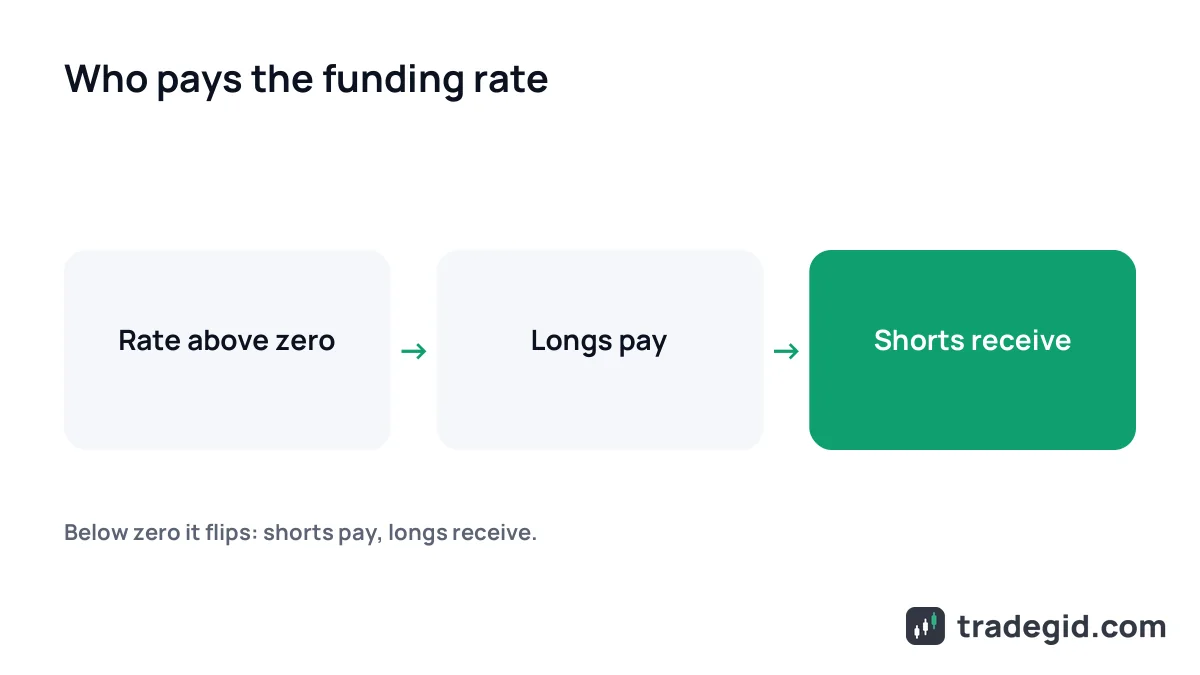
The funding rate is a recurring payment between longs and shorts on perpetual futures. The exchange doesn't keep it – the money moves from one side of the market to the other. A positive rate means longs pay shorts; a negative rate means shorts pay longs.
Contents
- Why perpetual futures need a funding rate
- Positive vs negative funding rate: who pays whom
- Funding rate formula: how the payment is calculated
- What funding costs in practice
- Where to check live funding rates and history
- How funding affects your strategy
- Can you make money from funding
- Where to trade perpetual futures
Why perpetual futures need a funding rate
A regular futures contract has an expiry date, and as that date approaches its price converges with spot on its own. A perpetual contract never expires, so it needs another mechanism to stop its price drifting away from the coin's spot price. That mechanism is funding.
The logic is simple. When everyone piles into longs, the contract trades above spot, the rate turns positive and longs have to pay extra. Holding a long gets more expensive, some traders close, and shorting becomes more attractive. The contract price is pulled back toward spot.
Positive vs negative funding rate: who pays whom
| Funding rate | Long | Short | What it tells you about the market |
|---|---|---|---|
| Positive (e.g. 0.01%) | Pays | Receives | More leveraged buyers, contract trades above spot |
| Negative (e.g. −0.02%) | Receives | Pays | Market leans short, contract trades below spot |
| Close to zero | Almost nothing | Almost nothing | Market is balanced |
Only positions open at the moment of settlement pay or receive funding.
One detail matters a lot: you pay or receive funding only if your position is open at the settlement timestamp. Open a trade a minute before settlement and you're in. Close it a minute before and you're not.
Funding rate formula: how the payment is calculated
The formula is the same on every exchange: payment = position size × funding rate. Position size means the full leveraged position, not your margin. This is where beginners get it wrong most often.
- Take the position size in USDT. 500 USDT of margin at 10x is a 5,000 USDT position.
- Check the current rate on the contract page, for example 0.01%.
- Multiply: 5,000 × 0.01% = 0.5 USDT per settlement.
- Multiply by the number of settlements while you hold. With an 8-hour interval that's 3 times a day.
Funding is always charged on the full position size, so with high leverage it hits your margin many times harder than the rate suggests.
Most contracts settle every 8 hours, but on volatile coins exchanges switch to 4, 2 or even 1 hour – automatically, without a separate announcement. The exact interval and the time of the next settlement are always shown above the order book, next to the rate. Before trading an altcoin, look there first.
What funding costs in practice
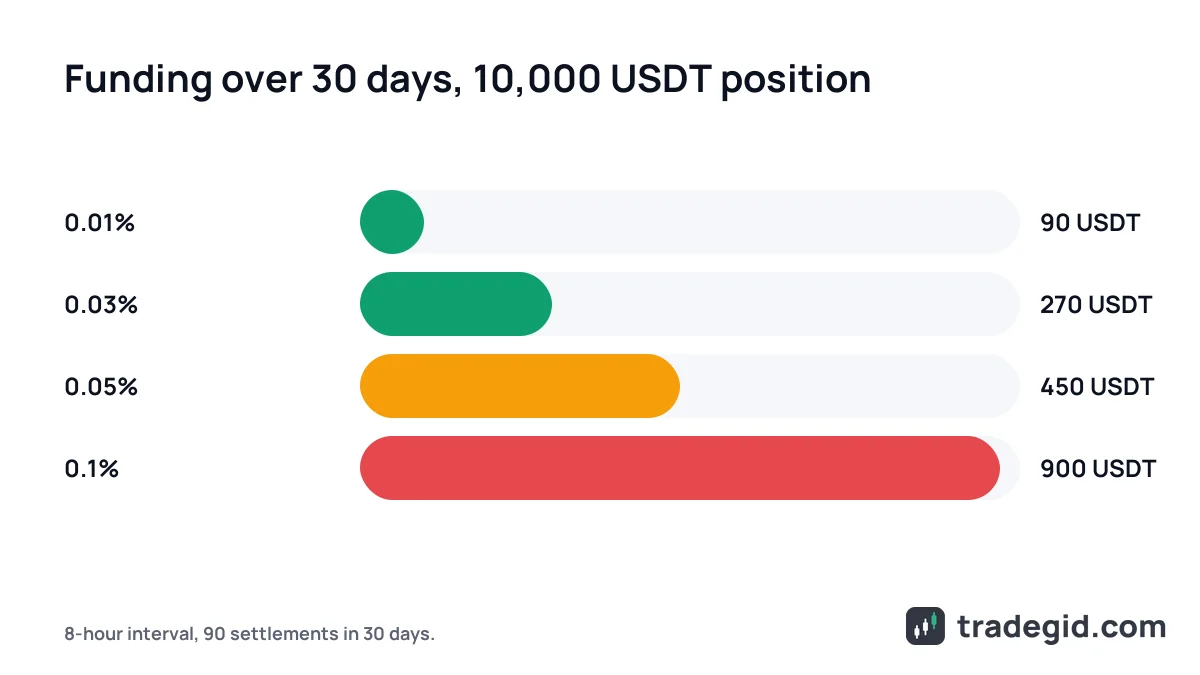
A 0.01% rate looks like nothing until you add up a month. Here's what happens to a 10,000 USDT position with an 8-hour interval:
| Rate | Per settlement | Per day | Per week | Per 30 days |
|---|---|---|---|---|
| 0.01% | 1 USDT | 3 USDT | 21 USDT | 90 USDT |
| 0.03% | 3 USDT | 9 USDT | 63 USDT | 270 USDT |
| 0.05% | 5 USDT | 15 USDT | 105 USDT | 450 USDT |
| 0.1% | 10 USDT | 30 USDT | 210 USDT | 900 USDT |
| −0.02% | +2 USDT to the long | +6 USDT | +42 USDT | +180 USDT |
Calculation: 10,000 × rate × number of settlements. In reality the rate changes every interval; the table shows the order of magnitude.
Now add leverage. If that 10,000 USDT position is opened with 1,000 USDT of margin (10x), a 0.05% rate costs 450 USDT a month – almost half the margin. Price can go nowhere while your account slowly bleeds.
Where to check live funding rates and history
- On the exchange itself – above the futures chart: the current rate and a countdown to the next settlement. There's usually a link to the contract's funding history nearby.
- In the funding history section – Binance, Bybit, OKX, Bitget and Gate all have dedicated pages archiving rates for every contract.
- In aggregators and funding rate trackers – handy for comparing one coin's rate across exchanges at once, if you're looking for the cheapest place to hold a long.
- In your own trade history – the futures account transaction log shows how much funding you paid or received on each position.
Before entering, check the rate and countdown on the exchange; after the trade, check the transaction log to see exactly what funding cost you.
How funding affects your strategy
Scalping and intraday trades
If you hold for minutes or a couple of hours, funding barely matters. One rule: don't open a position against a high rate a few minutes before settlement. You'll pay for 8 hours after holding for five minutes.
Swing trades and multi-day positions
Here funding becomes a cost line, just like fees. I estimate it upfront: if a coin's rate sits at 0.03% or higher, a one-week long costs roughly 0.6% of the position. That has to be built into the profit target.
A signal that the market is overheated
A high positive rate across many coins at once means the market is crowded with leveraged longs. It's not a short signal, but it's a reason not to add longs at the highs: on a sharp drop those longs start liquidating in a cascade.
When funding works for you
- You're short while the rate is positive
- You're long while the rate is negative
- You use the rate as a gauge of crowd positioning
When it works against you
- Holding a long on a hyped coin at 0.05% or more
- Entering minutes before settlement against the rate
- High leverage: funding is charged on the whole position
Funding isn't a tax – it's the price of being on the crowded side. The more one-sided the crowd, the more it costs to stand with it.
Can you make money from funding
There's a strategy called funding rate arbitrage: buy a coin on spot and open a short of the same size on futures. Price moves barely affect the result, and with a positive rate the short collects funding. In bull markets large players use it a lot. The catches:
- The rate can flip negative, and then you're the one paying.
- Entry and exit fees on spot and futures eat the income from several settlements.
- A leveraged short can still be liquidated on a sharp rally if the futures account is low on margin.
- Your money is split between two accounts, and without spare margin the strategy turns risky.
Funding arbitrage works when the rate is steadily high and fees are low, but it isn't free money: the main risk is the short getting liquidated on a sudden pump.
Where to trade perpetual futures
All five exchanges we cover trade USDT perpetuals and show the funding rate and countdown right in the trading screen. They differ in altcoin liquidity and in settlement intervals on individual contracts. Availability depends on your country, so check before signing up. If you haven't yet, read about leverage and liquidation first.