

Long and short in crypto: what they mean and how they work
A long is a bet that the price goes up, a short is a bet that it goes down. In a long you buy and profit if the coin gets more expensive. In a short you sell first and profit if it gets cheaper, and on futures you don't even need to own the coin to do that.
Contents
- What long and short mean in crypto trading
- Long trade example in USDT
- Short trade example: how to profit when crypto falls
- How a short works on futures
- Long vs short position in crypto: one table
- Common beginner mistakes with longs and shorts
- Long/short ratio in crypto: what it means
- Where to long and short crypto futures
What long and short mean in crypto trading
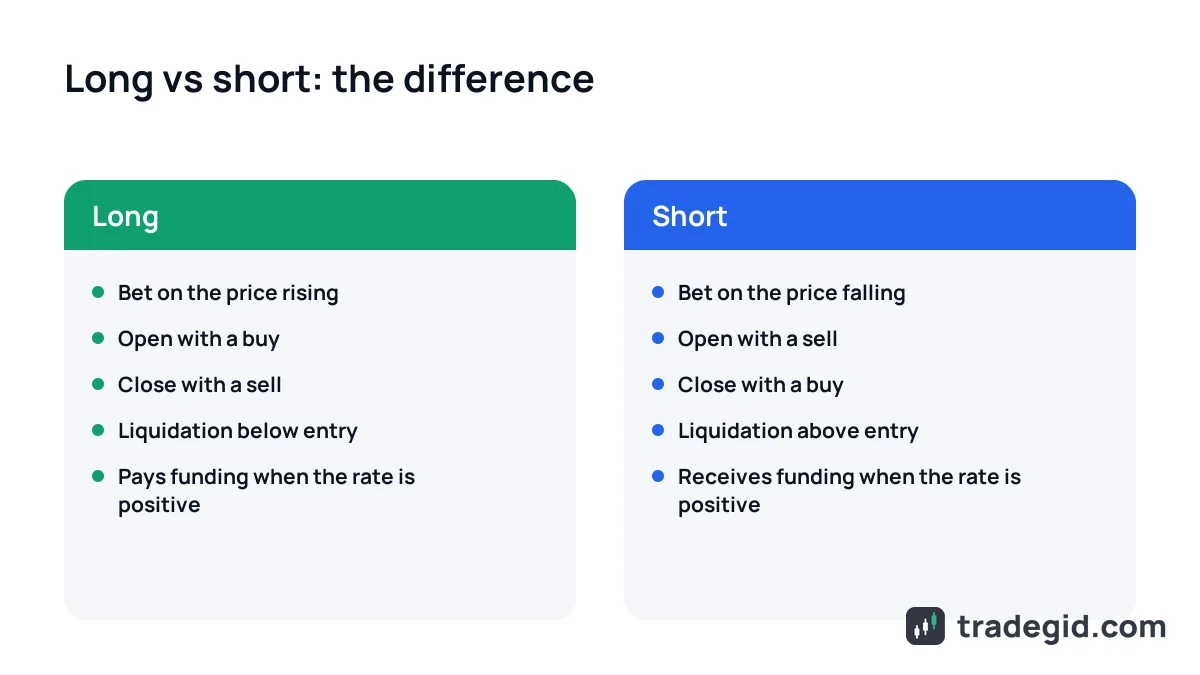
Being "long" traditionally meant holding an asset and waiting for it to rise. A "short" position meant selling something you don't own so you could buy it back cheaper later. On a crypto exchange today these are simply the two directions of a trade: up and down.
Long: betting on a rise
Opening a long means buying. You buy bitcoin or a bitcoin future at 80,000 USDT, the price reaches 84,000 and you are up by the difference. If the price drops, you are down. Any coin purchase on spot is effectively a long, just without leverage.
Short: betting on a fall
Opening a short means selling first and buying later. Sell at 80,000, buy back at 76,000, and the difference is yours. If the price rises instead, you have to buy back higher and the difference becomes a loss.
That gives the key asymmetry. A long's profit on the way up has no ceiling, while its loss without leverage is capped at what you paid: a coin can't go below zero. A short is the opposite: the best case is the price going to zero, while the loss on a rally is theoretically unlimited. In practice a stop-loss or liquidation closes you out long before that.
Long trade example in USDT
Let's use the BTCUSDT perpetual and an illustrative price of 80,000 USDT. Round numbers make it easy to check the math in your head.
- Margin 200 USDT, leverage 5x. Position size: 200 × 5 = 1,000 USDT.
- In bitcoin that is 1,000 / 80,000 = 0.0125 BTC.
- Price rises to 84,000 (+5%). Profit: 0.0125 × 4,000 = 50 USDT, or +25% on margin.
- Price falls to 76,000 (−5%). Loss: the same 50 USDT, or −25% of margin.
PnL is based on the full position, not on your margin: a 5% price move at 5x becomes a 25% gain or loss.
Fees and funding are left out here. In a real trade they take a bit more, especially if you hold for several days – see the funding rate guide. You can run your own numbers through the PnL calculator.
Short trade example: how to profit when crypto falls
Same setup, but now we expect a drop. Margin 200 USDT, leverage 5x, a 1,000 USDT short, which is 0.0125 BTC at 80,000.
| Exit price | Move | Long result | Short result |
|---|---|---|---|
| 88,000 | +10% | +100 USDT (+50%) | −100 USDT (−50%) |
| 84,000 | +5% | +50 USDT (+25%) | −50 USDT (−25%) |
| 80,000 | 0% | 0 | 0 |
| 76,000 | −5% | −50 USDT (−25%) | +50 USDT (+25%) |
| 72,000 | −10% | −100 USDT (−50%) | +100 USDT (+50%) |
Position 0.0125 BTC, entry 80,000 USDT, margin 200 USDT, leverage 5x. Brackets show the result as a percentage of margin, excluding fees and funding.
The table is a mirror: whatever the long makes, the short loses. That's not a coincidence – on futures every long has a counterparty on the short side, and the money simply moves from one to the other.
How traders make money in a falling market
On spot, when the market drops, all you can do is sell your coins and wait in USDT. That protects capital, it doesn't earn anything. To profit from the decline itself you need a short, either on futures or through margin trading. Futures are simpler for a beginner: one "Sell/Short" button, no borrowing coins.
I mostly short in two situations: when price rejects a strong level after a long rally, and when I need a hedge to protect a spot portfolio for a while without selling the coins.
How a short works on futures
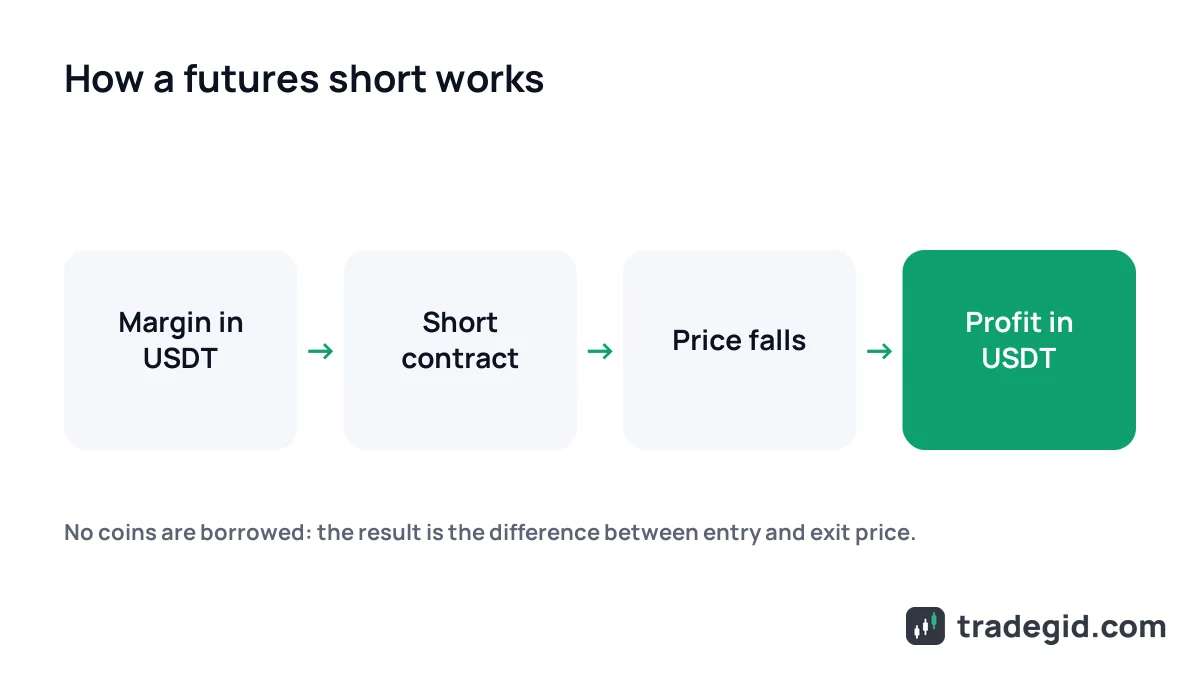
In margin trading a short is literal: you borrow the coin from the exchange, sell it, later buy it back and repay the loan plus interest. On futures nobody borrows anything – you enter a contract on the price difference.
- Deposit marginYou move USDT to your futures account. It's collateral, not a purchase: you don't end up holding any bitcoin.
- Open the contractYou press "Sell/Short". The exchange matches you with a buyer – someone opening a long or closing their own short at that moment.
- PnL in USDTEvery price tick is converted into unrealized profit or loss. Price below entry is a gain for the short, above entry is a loss.
- Funding on scheduleOn perpetual futures longs and shorts pay each other funding at set intervals. With a positive rate, the short receives it.
- Close with an opposite tradeTo exit you buy the same size back. The difference between your sell and buy price is credited to your account.
A futures short is a contract on the price difference, not a sale of borrowed coins, which is why it opens as easily as a long.
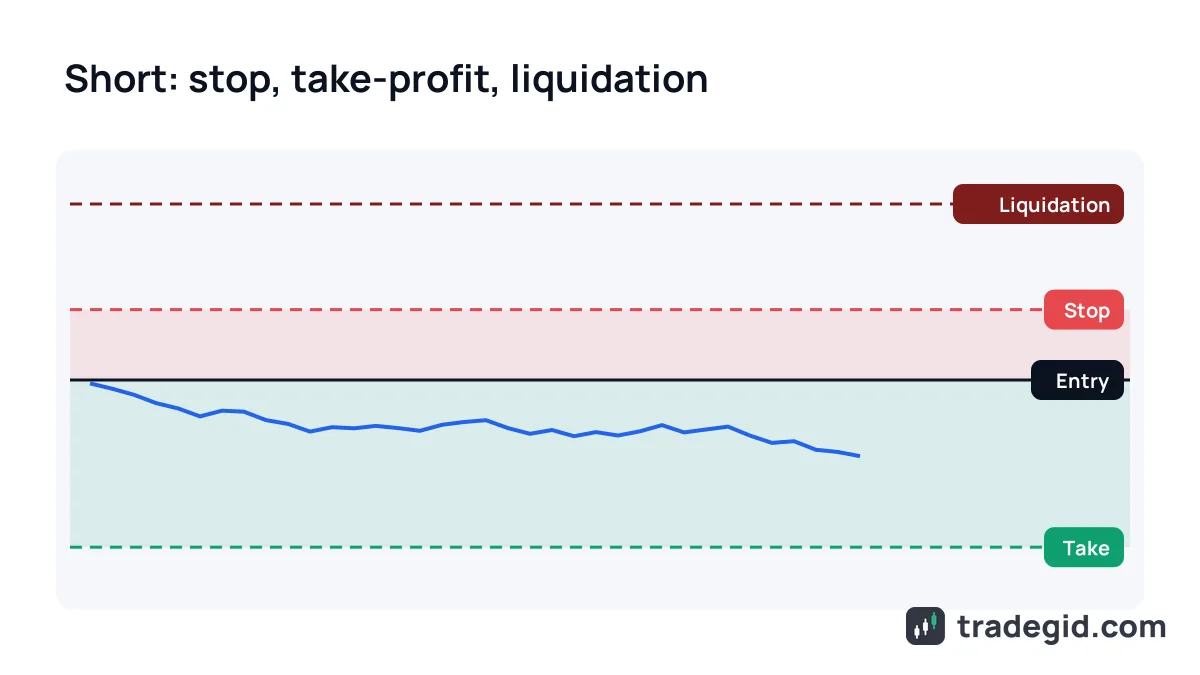
The flip side of that simplicity is liquidation. If price moves against the short and the loss approaches your margin, the exchange force-closes the position. At 5x that takes roughly a 20% rally, at 20x around 5%.
Long vs short position in crypto: one table
| Parameter | Long | Short |
|---|---|---|
| Bet on | Price rising | Price falling |
| Button in the terminal | Buy / Long | Sell / Short |
| Closed by | Selling | Buying |
| Maximum profit | Unlimited | Price going to zero |
| Maximum loss without leverage | Amount paid | Theoretically unlimited |
| Liquidation price | Below entry | Above entry |
| Funding at a positive rate | Pays | Receives |
| Possible on spot | Yes, a regular buy | Only via margin trading |
Funding only exists on perpetual futures. Spot and dated futures don't have it.
Shorting is harder psychologically. Bullish headlines and the crowd's habit of buying the dip work against you, and bounces after a sharp drop can be violent. That's why a stop on a short is non-negotiable, even when it feels like the only way is down.
Set leverage to 20x and move the price −5% on a long. The margin is wiped out, even though 5% is an ordinary move for crypto. It shows better than anything that position size matters more than trade direction.
Common beginner mistakes with longs and shorts
- Mixing up position modes. In hedge mode, pressing "Open Short" while holding a long doesn't close it – it opens a second position. Close trades with the close button in the positions list.
- Shorting because "it's already too high". High can get higher. A short against a strong trend with no level and no stop is the fastest route to liquidation.
- Using big leverage. At 50x liquidation is about 2% away, and normal intraday noise knocks the position out.
- Skipping the stop-loss. Without a stop, the only exit from a bad trade is liquidation, which means losing the whole position margin.
- Ignoring funding. A long in an overheated market with a high rate can go nowhere for a week and still bleed money.
- Averaging into a losing short. Adding to a short on the way up means increasing size exactly where the market is telling you you're wrong.
Almost every mistake boils down to two things: a position that's too large and no exit plan. The direction of the trade is secondary.
Long/short ratio in crypto: what it means
Many exchanges and analytics sites publish a long/short ratio – the share of accounts or volume in longs versus shorts for a coin, for example the BTC long/short ratio. A value above 1 means more traders are long, below 1 means more are short.
I don't treat it as a direct signal. A crowd leaning heavily long often means the market is loaded with leverage and vulnerable to a cascade of liquidations, but that imbalance can last for weeks. I read the ratio together with the funding rate: when both say "everyone is long", I don't add longs at the highs.
Where to long and short crypto futures
All five exchanges we cover let you go long and short on USDT perpetual futures with adjustable leverage and margin mode. Availability depends on your country, so check the exchange's terms for where you live. If you're new, read about leverage and cross vs isolated margin first – it's cheaper than learning from liquidations.