

Leverage trading in crypto: how it works and how much to use
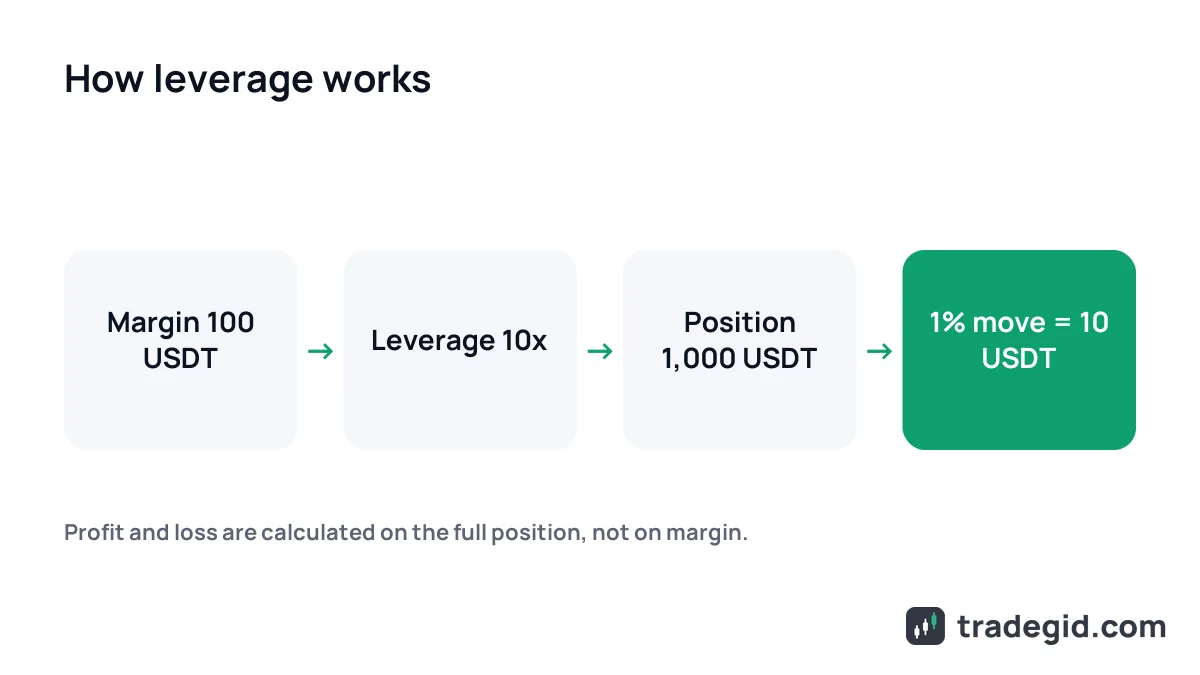
Leverage is a multiplier that lets you open a position larger than your margin. With 10x on 100 USDT you control a 1,000 USDT position. Leverage by itself doesn't make a trade riskier: it changes the position size and how close to your entry the liquidation price sits.
Contents
- What is leverage in crypto trading
- Leverage trading crypto example
- Leverage changes position size, not risk
- Leverage and liquidation: how far price can move
- Leverage trading crypto for beginners: how much to use
- Maximum leverage on crypto exchanges
- Futures without leverage and margin vs leverage trading
- Where to trade crypto with leverage
What is leverage in crypto trading
On futures you don't buy the whole coin, you post collateral called margin. Leverage shows how many times larger the position is than that collateral. 100 USDT margin at 10x is a 1,000 USDT position. 100 USDT margin at 1x is a 100 USDT position, exactly like buying on spot.
People often picture leverage as a loan. On perpetual futures the exchange doesn't lend you anything and charges no interest for leverage. You simply open a contract larger than your collateral, and the collateral guarantees you can cover a loss. Borrowing with interest is spot margin trading, which I cover further down.
Leverage trading crypto example
Bitcoin trades at 80,000 USDT. You have 100 USDT of margin and open a long. Here's what a 5% move in either direction does at different leverage.
| Leverage | Position size | Price +5% | Price −5% |
|---|---|---|---|
| 1x | 100 USDT | +5 USDT (+5%) | −5 USDT (−5%) |
| 3x | 300 USDT | +15 USDT (+15%) | −15 USDT (−15%) |
| 5x | 500 USDT | +25 USDT (+25%) | −25 USDT (−25%) |
| 10x | 1,000 USDT | +50 USDT (+50%) | −50 USDT (−50%) |
| 20x | 2,000 USDT | +100 USDT (+100%) | Liquidated, −100 USDT |
Brackets show the result as a percentage of margin. Fees and funding not included.
The multiplier is plain to see: the percentage price move is multiplied by leverage. At 20x a 5% drop wipes out the margin before price even reaches −5%, because the exchange closes the position earlier, as soon as maintenance margin is hit.
Leverage changes position size, not risk
This is the one thing I wish I'd understood back in 2020. The risk of a trade is how many USDT you lose if your stop is hit. It depends on position size and stop distance, not on the leverage number in the terminal.
Example. Account 1,000 USDT, you're willing to risk 1%, which is 10 USDT. Stop is 2% from entry. So the position should be 500 USDT: 2% of 500 is exactly 10 USDT. You can open that position with 500 USDT margin at 1x or with 50 USDT margin at 10x. If the stop is hit, you lose the same 10 USDT either way.
- What leverage changes: how much margin is locked in the position and where the liquidation price sits.
- What it doesn't change: the loss at your stop for the same position size.
- Where it gets dangerous: when it's used to open a position 10–20 times larger than your risk rules allow.
- Where it helps: you don't need your whole account on the exchange in one position, and free margin stays available for other trades.
People lose money not because of leverage as such, but because of oversized positions without a stop. Size the position from risk first, then pick leverage to fit.
You can size a position from risk in the position size calculator: enter account size, risk percentage, entry and stop, and it tells you what leverage you'll need.
Leverage and liquidation: how far price can move
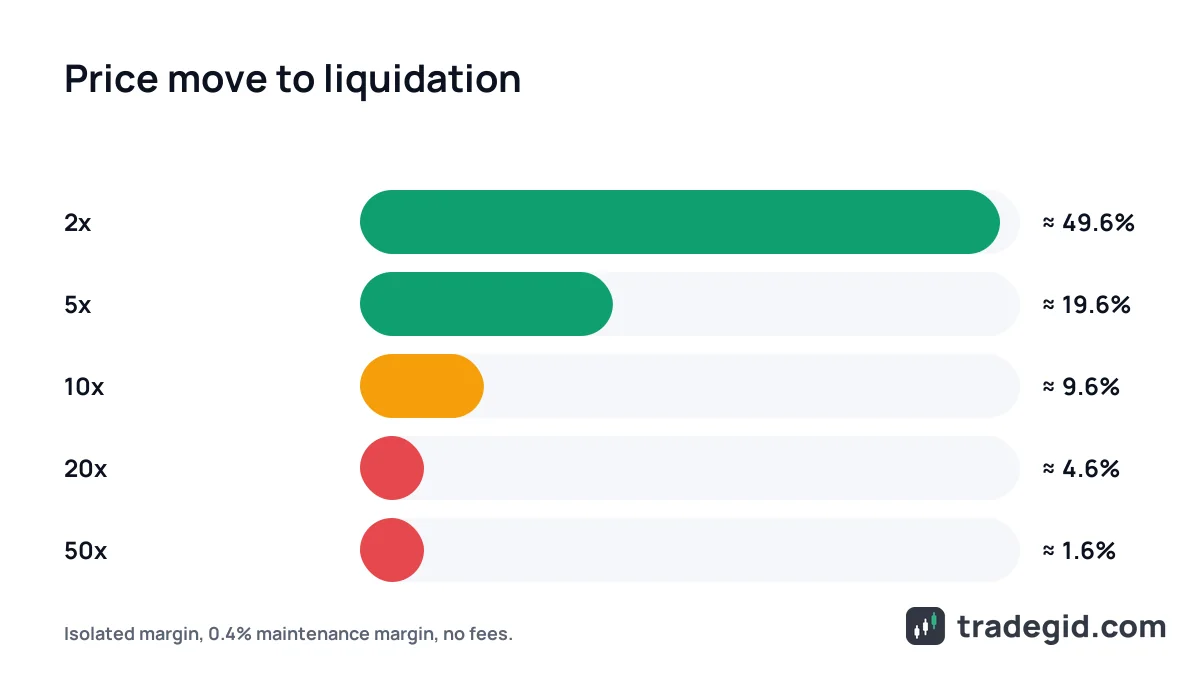
The higher the leverage, the smaller the adverse move that eats your margin. A rough formula for isolated margin: distance to liquidation ≈ 100% / leverage − maintenance margin rate. For BTCUSDT on small positions the maintenance margin at major exchanges is a fraction of a percent; the table uses 0.4%.
| Leverage | Move to liquidation | Long liquidation | Short liquidation |
|---|---|---|---|
| 2x | ≈ 49.6% | ≈ 40,300 | ≈ 119,700 |
| 3x | ≈ 32.9% | ≈ 53,650 | ≈ 106,350 |
| 5x | ≈ 19.6% | ≈ 64,300 | ≈ 95,700 |
| 10x | ≈ 9.6% | ≈ 72,300 | ≈ 87,700 |
| 20x | ≈ 4.6% | ≈ 76,300 | ≈ 83,700 |
| 25x | ≈ 3.6% | ≈ 77,100 | ≈ 82,900 |
| 50x | ≈ 1.6% | ≈ 78,700 | ≈ 81,300 |
| 100x | ≈ 0.6% | ≈ 79,500 | ≈ 80,500 |
Isolated margin, 0.4% maintenance margin, no fees or funding. The real liquidation price on an exchange will be slightly closer to entry because it accounts for the closing fee and its own margin tiers.
For context, bitcoin's daily range on calm days often stays within 2–3%, and on news it can easily exceed 5%. At 25x and above, ordinary intraday noise can liquidate you even if you end up right about the direction.
For how exchanges calculate liquidation and why in cross mode it depends on your whole balance, see the liquidation guide and cross vs isolated margin. For a precise number on your own position there's a separate liquidation calculator.
Leverage trading crypto for beginners: how much to use
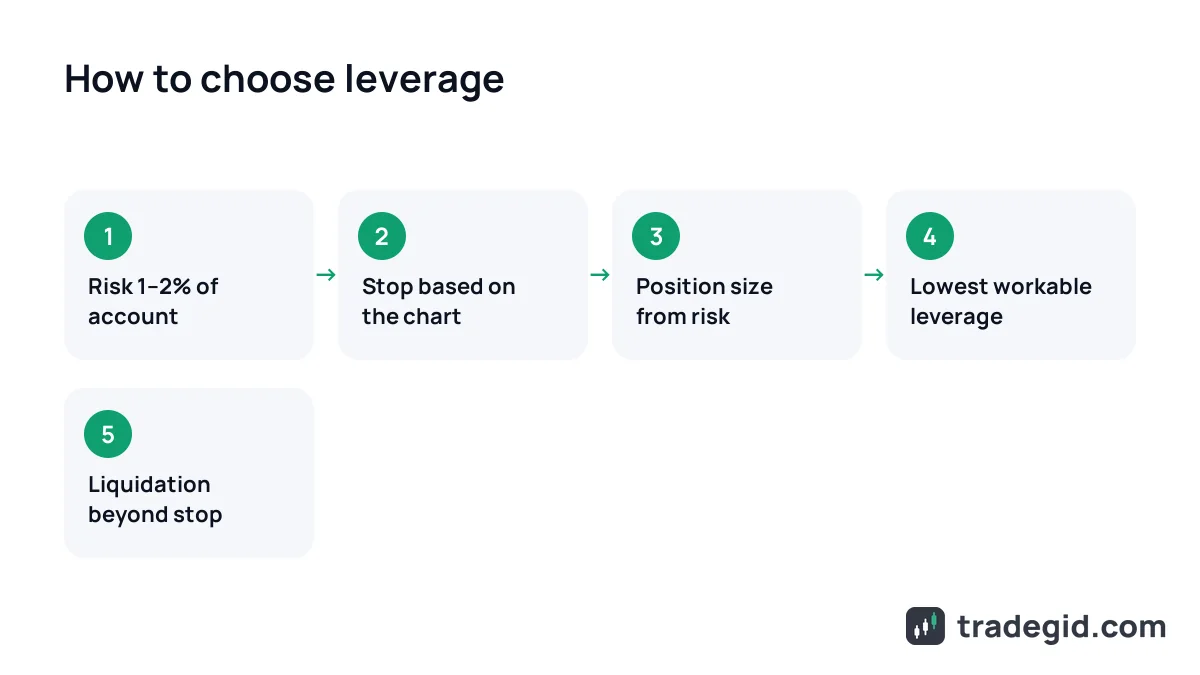
My answer: 2–5x on bitcoin and ether, no more than 3x on altcoins. Not because high leverage is forbidden, but because at the start you can't yet place stops that survive noise, and you don't have a feel for position size.
- Set risk per trade1–2% of your account. With 500 USDT that's 5–10 USDT per trade.
- Find a place for the stopBased on the chart, beyond a level – not "1% away so I can use more leverage".
- Calculate position sizeRisk in USDT divided by stop distance in percent. 10 USDT with a 2% stop gives a 500 USDT position.
- Pick leverageThe lowest that leaves enough margin. The liquidation price should be well beyond your stop.
- Check liquidationBefore entering, look at the estimated liquidation price in the order window. If it's near your stop, lower the leverage.
Leverage is the last step of the calculation, not the first. Risk and stop come first, then position size, and only then the leverage number.
Maximum leverage on crypto exchanges
Exchanges offer far more leverage than makes sense to use. Here's what official public data shows for the BTCUSDT perpetual:
| Exchange | Max leverage | Comment |
|---|---|---|
| Binance | 150x | Only for positions up to 300,000 USDT; above that the cap drops to 100x, 75x and lower |
| OKX | 100x | Cap decreases as position size grows |
| Bitget | 150x | Cap decreases as position size grows |
| Gate | 200x | Cap decreases as position size grows |
| Bybit | See the contract specification | We couldn't verify the current value from our region |
Data as of October 2026 from the exchanges' public APIs. The cap depends on position size (risk tiers); exchanges may also restrict leverage for new accounts and in certain countries.
Altcoins usually have lower maximum leverage than bitcoin and higher maintenance margin. Before a trade, open the exchange's risk tier table for that contract: it shows what leverage is available at your position size.
Crypto futures with leverage are also restricted by local rules. Major offshore exchanges generally don't serve the US or the UK, and some countries limit retail leverage, so check whether leverage trading is available where you live before registering.
Futures without leverage and margin vs leverage trading
Can you trade futures without leverage
Yes, 1x is a normal setting. The position equals your margin, and a long behaves almost like a spot buy, just with funding. A 1x short is a way to profit from a drop or hedge a spot portfolio without selling coins. A 1x long on isolated margin can only be liquidated if the price falls nearly to zero.
Margin vs leverage trading on spot
Spot margin trading means the exchange lends you USDT or coins, you buy or sell on spot, and hourly interest accrues on the loan. Leverage there is usually several times lower than on futures, and the mechanics are more involved because you have to manage the loan and repay it. For betting on a rise or fall with leverage, futures are simpler for a beginner.
Pros of leverage
- Only part of your capital needs to sit on the exchange
- Free margin stays available for other trades
- Shorting and hedging without borrowing coins
Cons of leverage
- Easy to open a position bigger than your risk allows
- Liquidation moves closer to entry
- Funding and fees are charged on the full position
Leverage is a capital management tool. Used as a way to "grow" a small account fast, it usually wipes that account out.
Where to trade crypto with leverage
All five exchanges we review offer USDT perpetual futures with manual leverage, isolated and cross margin. If you're not yet clear on trade direction, start with long and short explained.