

Cross margin vs isolated margin: the difference and which to use
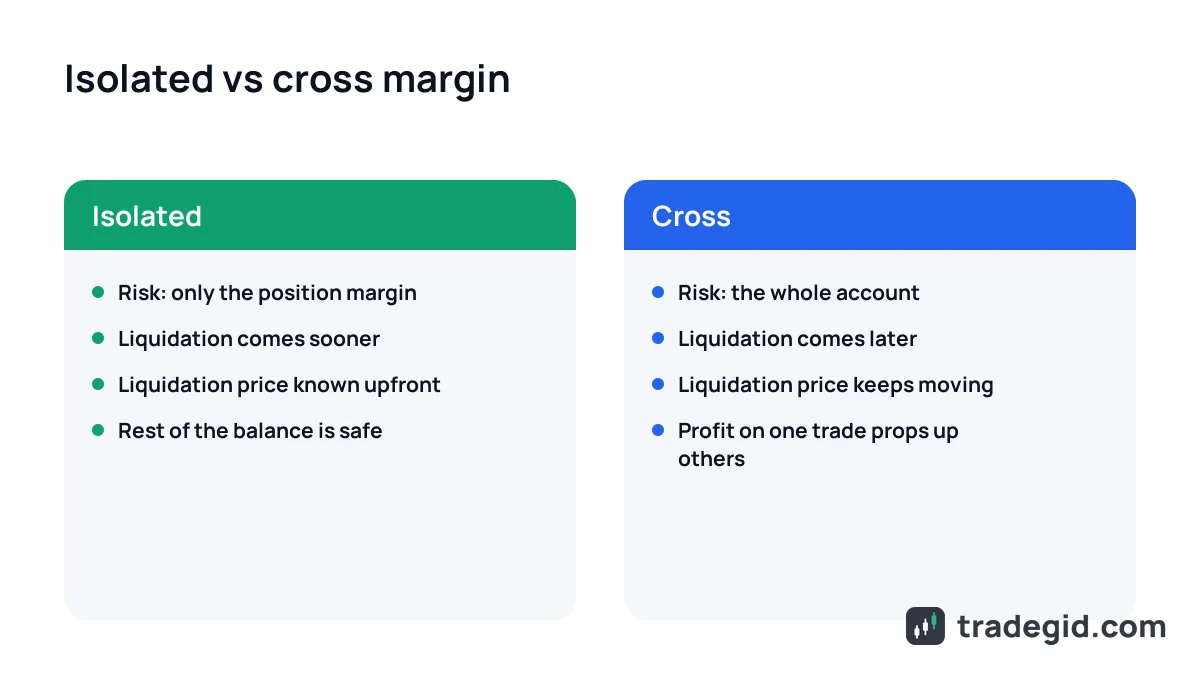
Isolated margin assigns a fixed amount to one position, and if it gets liquidated you lose only that amount. Cross margin uses your whole free futures balance as a shared buffer for every position: liquidation comes later, but when it does it can take everything.
Contents
- What is isolated margin?
- What is cross margin?
- What is the difference between cross margin and isolated margin?
- Cross margin vs isolated margin example with two positions
- Cross margin vs isolated margin: which is better?
- Cross margin and liquidation
- How to switch between cross and isolated margin mode
- Common beginner mistakes
- Where to trade with cross and isolated margin
What is isolated margin?
Think of it as putting money for one trade into a separate envelope. The position lives only on what's in that envelope. If price moves against you, the loss comes out of the envelope, and when it's nearly empty the position is liquidated. The rest of your account isn't touched.
In practice: you have 1,000 USDT, and you open a BTC long with 200 USDT margin at 10x. The position is 2,000 USDT. Only those 200 USDT determine the liquidation price, and in the worst case that's exactly what you lose. The other 800 USDT stay in the account.
You can add margin to an isolated position manually, which pushes the liquidation price away. But it never pulls money from your balance on its own – that's the whole point of isolation.
What is cross margin?
Cross mode has no envelopes. Your whole free futures balance is one shared pot that covers losses on every position in that mode. As long as there's money in the account, the position stays open, even if its own margin went negative long ago.
Same trade: 1,000 USDT balance, a 2,000 USDT BTC long. In cross mode, the loss can run to almost 1,000 USDT before the position is liquidated. That's a huge buffer, but the loss on liquidation is the whole account, not 200 USDT.
One more thing: unrealised profit on one position supports another. If your BTC long is in profit and your ETH short is losing, the BTC gain pushes the ETH liquidation further away. That's handy for hedges and pairs, and dangerous when all your positions point the same way.
What is the difference between cross margin and isolated margin?
| Parameter | Isolated | Cross |
|---|---|---|
| What's at risk | Only that position's margin | Your entire free futures balance |
| When liquidation hits | Sooner: the buffer is the position margin | Later: the buffer is the whole balance |
| Liquidation price | Fixed unless you add margin | Moves with your balance and other positions' PnL |
| Profit on other positions | Doesn't help | Supports losing positions |
| Risk control | Simple: max loss known upfront | Harder: you watch the whole account |
| Who it suits | Beginners, high leverage, altcoins | Experienced traders, hedges, linked positions |
Details depend on the exchange and account type. In Bybit's Unified Trading Account the margin mode applies to the whole account, while on Binance and OKX it's set per contract (as of October 2026).
Cross margin vs isolated margin example with two positions
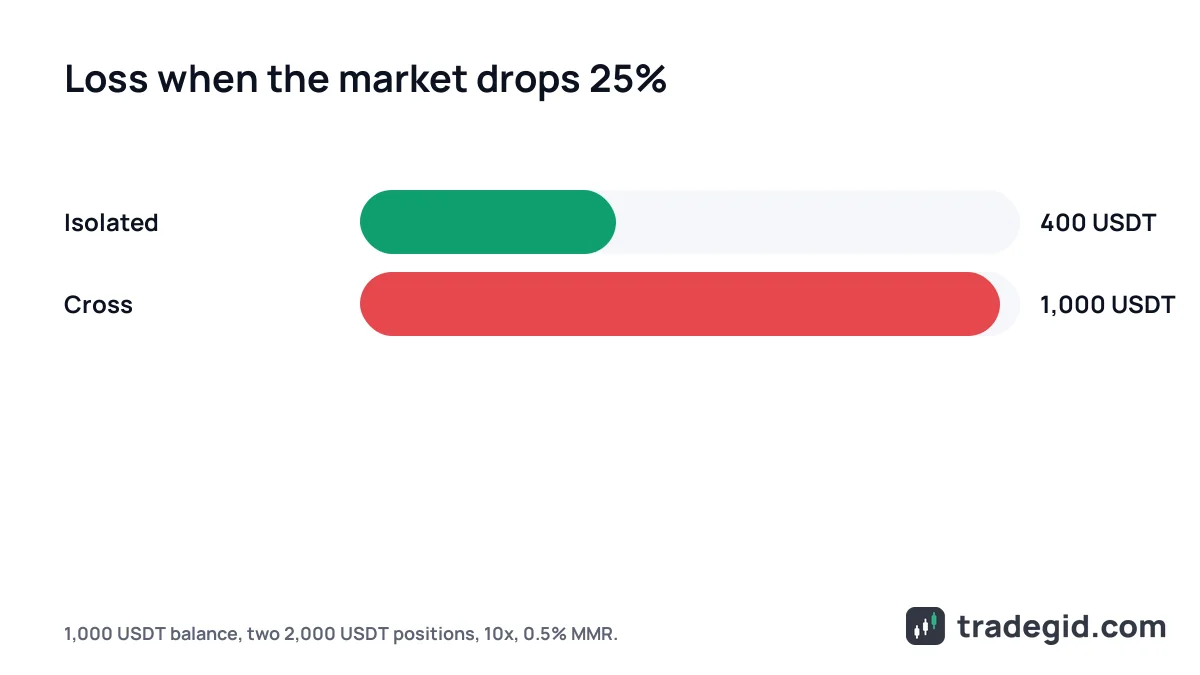
Same starting point for both modes. Futures balance: 1,000 USDT. Two positions at 10x: a 2,000 USDT BTC long (200 margin) and a 2,000 USDT ETH long (200 margin). Maintenance margin is 0.5% for simplicity, fees and funding left out.
Scenario 1: BTC drops 10%, ETH stays flat
- Isolated: the BTC loss is 200 USDT, the entire position margin. The BTC long is liquidated at around −9.5%. ETH survives, and about 800 USDT is left in the account.
- Cross: the same 200 USDT loss is covered from the shared balance. Both positions stay open, and account equity is around 800 USDT. BTC would need to fall nearly 50% on its own to liquidate.
On an isolated dip, cross margin wins: the position survived a move that would have liquidated it in isolated mode.
Scenario 2: the market drops 25%, both coins together
- Isolated: both positions are liquidated, each at its own −9.5%. You lose 400 USDT of margin, and 600 USDT stays in the account.
- Cross: total position size is 4,000 USDT, so a 25% drop is a 1,000 USDT loss. Liquidation hits around −24.5%, when the loss reaches 980 USDT. The account is wiped.
When positions fall together, cross margin turns two bad trades into a wiped account, while isolation turns them into a 40% loss.
The second scenario is the one beginners run into most. In a big sell-off, altcoins move with Bitcoin, so "different" positions in cross mode turn out to be one large bet.
Cross margin vs isolated margin: which is better?
There's no universal answer, but for most retail traders isolated is the more sensible default. It makes the risk on every trade clear: you know your maximum loss before you enter.
When to use isolated margin
- You're new to futures and still learning risk management.
- You're using more than 5x, or trading volatile altcoins that can move 15–20% in an hour.
- You don't want one bad trade dragging down the rest.
- You trade signals or take short-term breakout trades.
Isolated margin is for trades where you've already agreed to lose a specific amount and nothing more.
When cross margin makes sense
- You run a hedge – long one coin, short another – and want the winning leg to support the losing one.
- Your leverage is low (1x–3x) and the futures account only holds money you're prepared to risk.
- You're doing funding rate arbitrage and don't want the short knocked out by a sudden spike.
- Every position has a stop-loss, and cross is just a cushion against wicks.
Cross margin works when the whole futures balance is your risk budget, not money you'd hate to lose.
Cross margin and liquidation
In cross mode the liquidation price doesn't stay put. It moves away when other positions are in profit or you top up the account, and it moves closer when funding is charged, new positions are opened or neighbouring trades lose money. So the number you saw at entry can be different an hour later.
Withdrawals are another trap. Moving part of the balance out of a cross-margin futures account shrinks the buffer for every position at once. The maths behind the liquidation price itself is covered in the guide to liquidation price.
How to switch between cross and isolated margin mode
- Open the futures terminalPick the contract you want, for example the BTCUSDT perpetual.
- Find the margin mode toggleIt's usually above the order form next to leverage, a button labelled Cross or Isolated.
- Close the position and cancel ordersOn Binance and OKX you can't change the mode while the contract has an open position, and on Binance open orders block it too.
- Pick the mode and confirmOnce confirmed, the new mode applies to your next trades on that contract.
- Check leverage and liquidation priceBefore the next trade, make sure the order window shows the right mode and leverage.
Choose the mode before you enter: on most exchanges you can't switch it in the middle of a trade.
There are exceptions. In Bybit's Unified Trading Account the margin mode covers the whole account, and you can move between cross and isolated with positions open as long as Bybit's conditions are met – for example, no outstanding borrowings and no position ending up past its liquidation price after the switch. Read the prompt in your exchange's switch dialog before changing modes.
| Exchange | Mode is set for | Can you switch with an open position? |
|---|---|---|
| Binance (USDⓈ-M) | Each contract | No, and not with open orders on the contract either |
| OKX | Each trading pair | No, an open position can't be moved to another mode |
| Bybit (Unified Trading Account) | The whole account | Yes, if the exchange's conditions are met |
As of October 2026, based on OKX help, Bybit help and Binance API documentation. Rules change, so confirm in the terminal.
Other platforms such as KuCoin, Delta Exchange or Hyperliquid also offer both modes, but switching rules and per-asset limits differ. Check the platform's help page before you rely on any of the above.
Common beginner mistakes
- Leaving cross mode on by default without realising the whole account is at risk.
- Opening several altcoin longs in cross mode and calling it diversification.
- Topping up a losing isolated position again and again instead of using a stop.
- Withdrawing from a cross-margin futures account without checking how it moves liquidation.
Two habits fix almost all of these: check the margin mode before every entry and set a stop-loss straight away.
If you haven't worked out how leverage drives risk yet, start with the guide to leverage, and size your trades with the position size calculator.
Where to trade with cross and isolated margin
Every exchange below offers both modes, with the toggle right in the futures terminal. Availability depends on your country, so check the exchange's terms first. You can register via the link, with the referral code shown next to it.