

Crypto position size calculator: how much to trade at 1–2% risk
Position size comes from your stop-loss, not from leverage: position = account × risk% ÷ stop distance %. Enter your account size, risk per trade, entry and stop, and the calculator returns the size in USDT and in coins plus the minimum leverage you need to open it.
Contents
- How the position size calculator works
- The 1–2% risk rule
- Position size formula for crypto
- Position size examples with leverage
- Table: account, risk and stop distance → position size
- Why leverage does not change risk when size is fixed
- Position size with fees and average entry
- Common position sizing mistakes
- Where to place the trade
How the position size calculator works
You decide how much you are willing to lose if the stop is hit and where that stop sits. The calculator picks a size so that the loss at the stop equals exactly that amount. You get four numbers back.
- Loss at stop – account × risk. With 1,000 USDT and 1% that is 10 USDT.
- Position, USDT – the full trade size including leverage. This is what you type in the terminal if the exchange accepts size in USDT.
- Position, coins – the same size in BTC, ETH or another coin, for exchanges where you enter contracts or coin quantity.
- Leverage needed from – the minimum leverage that lets you open this size with your account. If the position is smaller than the account, it shows 1x.
Risk in money first, then size, and leverage last: in that order your position size does not depend on your mood.
It works for shorts too: a short's stop is above entry and the calculator takes the stop distance as an absolute value. Fees are not included, more on them below.
The 1–2% risk rule
The rule says: on any single trade you risk no more than 1–2% of your account. Not a position of 1–2%, but a loss of 1–2% if the stop is hit. The position itself can be 50% or 200% of the account, depending on how far away the stop is.
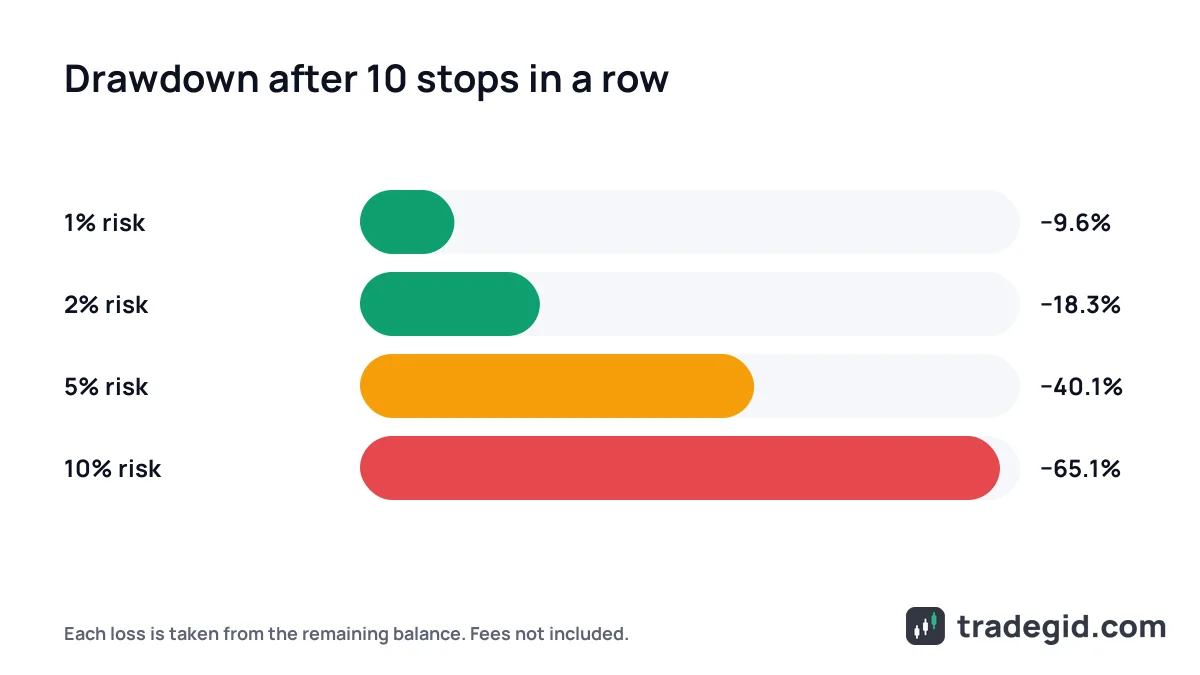
Why so little becomes obvious with a losing streak. Ten stops in a row happen to every trader. The only question is how much of the account survives them.
| Risk per trade | Drawdown after 10 stops | Gain needed to recover |
|---|---|---|
| 1% | −9.6% | +10.6% |
| 2% | −18.3% | +22.4% |
| 5% | −40.1% | +67% |
| 10% | −65.1% | +187% |
Each loss is taken from the already reduced balance. Fees not included.
I trade with 1% risk per trade, and after three stops in a row I cut it to 0.5% until I get a winner. Boring, but the account survives the bad weeks everyone has.
Position size formula for crypto
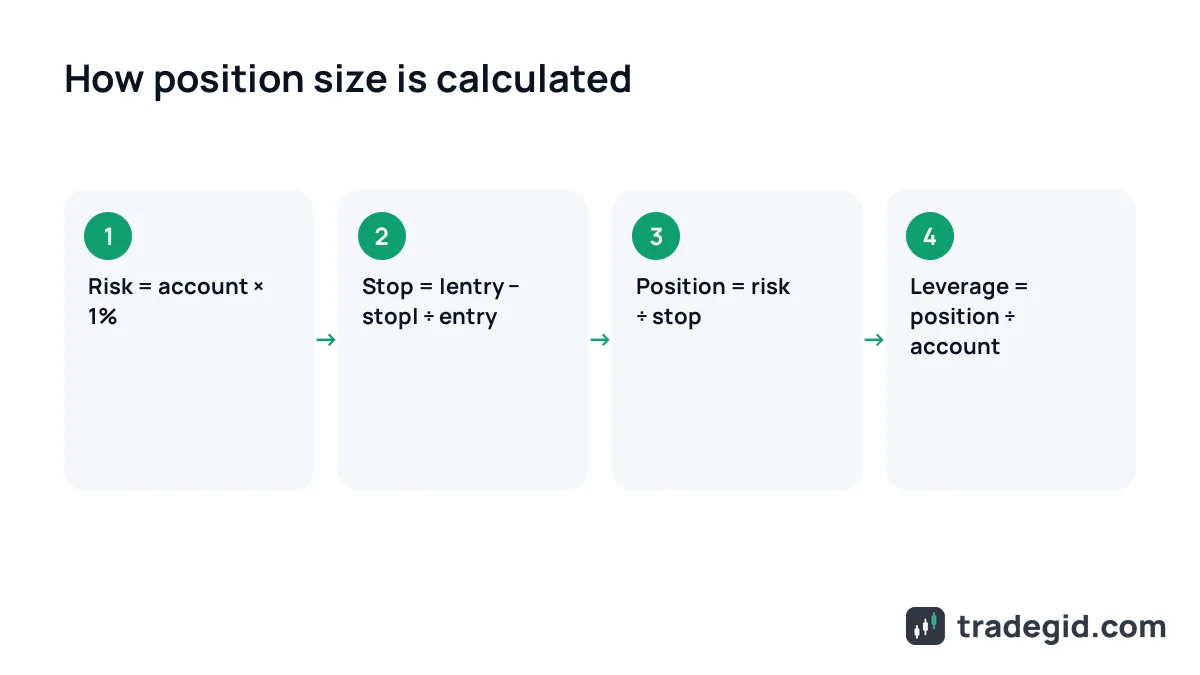
Position (USDT) = Account × Risk% ÷ Stop distance%, where stop distance = |Entry − Stop| ÷ Entry. The other numbers follow: coins = position ÷ entry, leverage needed = position ÷ account.
Check it against the calculator defaults: risk 1,000 × 1% = 10 USDT, stop distance (60,000 − 58,800) ÷ 60,000 = 2%, position 10 ÷ 0.02 = 500 USDT, or 0.00833 BTC. No leverage needed: the position is smaller than the account.
Position size in Excel, MT5 or TradingView
The formula fits in one spreadsheet cell: =A1*B1/ABS(C1-D1)*C1, where A1 is the account, B1 the risk as a decimal, C1 the entry and D1 the stop. In MT5 the logic is the same but in lots: divide the money at risk by the loss per lot at the stop, using the tick value from your broker's contract specs. On TradingView the long and short position drawing tools show stop distance in percent, which you can plug straight into the calculator.
Position size examples with leverage
ETH long, 2,000 USDT account
1% risk is 20 USDT. Entry 3,000, stop 2,940, distance 2%. Position 20 ÷ 0.02 = 1,000 USDT, or 0.333 ETH. Technically no leverage is needed, but many traders open it at 5x with 200 USDT margin to keep the rest of the account free.
BTC short, 1,000 USDT account
1.5% risk is 15 USDT. Entry 60,000, stop 61,500, distance 2.5%. Position 15 ÷ 0.025 = 600 USDT, which is 0.01 BTC. If price hits the stop you lose 15 USDT plus fees.
Scalp with a tight stop
500 USDT account, 1% risk is 5 USDT. Entry 60,000, stop 59,760, only 0.4%. Position 5 ÷ 0.004 = 1,250 USDT, and now leverage is needed: at least 2.5x. A tight stop gives a large position, and fees on it start to matter.
Table: account, risk and stop distance → position size
| Account | Risk | Risk in USDT | Stop from entry | Position | Leverage from |
|---|---|---|---|---|---|
| 1,000 | 1% | 10 | 2% | 500 USDT | 1x |
| 1,000 | 1% | 10 | 0.5% | 2,000 USDT | 2x |
| 1,000 | 2% | 20 | 1% | 2,000 USDT | 2x |
| 5,000 | 1% | 50 | 3% | 1,667 USDT | 1x |
| 5,000 | 2% | 100 | 1.5% | 6,667 USDT | 1.3x |
| 10,000 | 1% | 100 | 0.8% | 12,500 USDT | 1.3x |
| 500 | 2% | 10 | 0.4% | 2,500 USDT | 5x |
Formula: risk in USDT ÷ stop distance. Fees and slippage not included.
The pattern is simple: the closer the stop, the bigger the position for the same risk. That is why "what leverage should I use" has no answer without a stop.
Why leverage does not change risk when size is fixed
Take the ETH long from above: position 1,000 USDT, entry 3,000, stop 2,940. The loss at the stop is 20 USDT at any leverage. Leverage changes only two things: how much margin is locked and where liquidation sits.
| Leverage | Margin | Loss at stop 2,940 | Liquidation (0.5% MMR) | Stop before liquidation? |
|---|---|---|---|---|
| 2x | 500 USDT | 20 USDT | 1,515 | Yes |
| 5x | 200 USDT | 20 USDT | 2,415 | Yes |
| 10x | 100 USDT | 20 USDT | 2,715 | Yes |
| 50x | 20 USDT | whole margin | 2,955 | No, liquidated at 2,955 |
Isolated margin, fees not included.
Risk grows with position size, not with leverage. Leverage becomes dangerous when liquidation lands closer than the stop, as in the 50x row, or when high leverage tempts you to open a bigger position than you calculated. More in how leverage works in futures, and you can check a specific trade in the liquidation price calculator.
Position size with fees and average entry
Fees are charged on the notional at entry and at exit. At a 0.055% taker rate a 1,000 USDT position costs about 1.1 USDT round trip, so the real loss at the stop is about 21 USDT, not 20. For the scalp above fees come to about 1.4 USDT, more than a quarter of the 5 USDT risk. Check your own rate on the exchange's fee page: it depends on your account tier and order type.
Average entry price
If you scale in, average entry = sum of (quantity × price) ÷ total quantity. Buy 0.01 BTC at 60,000 and 0.01 at 58,000 and your average is 59,000. Measure stop distance from that average.
Common position sizing mistakes
- Confusing price move with account loss. A 2% stop on a position ten times your account is a 20% hit to the account.
- Moving the stop further as price approaches it. Your risk stops being 1% the moment you do.
- Ignoring fees and slippage on tight stops.
- Counting your whole net worth as the account, including spot coins that are not part of the trade.
- Rounding coin quantity up to the exchange's lot step. Round down and risk stays within plan.
Almost every mistake comes down to the money at risk changing after you calculated it. Calculate once, then leave the stop and the size alone.
Where to place the trade
On all three exchanges below you can enter size in USDT or in coins and set the stop-loss right in the order form. Check that the exchange serves your country before registering.