

Bybit Fees: Spot, Futures, Withdrawals and How to Pay Less
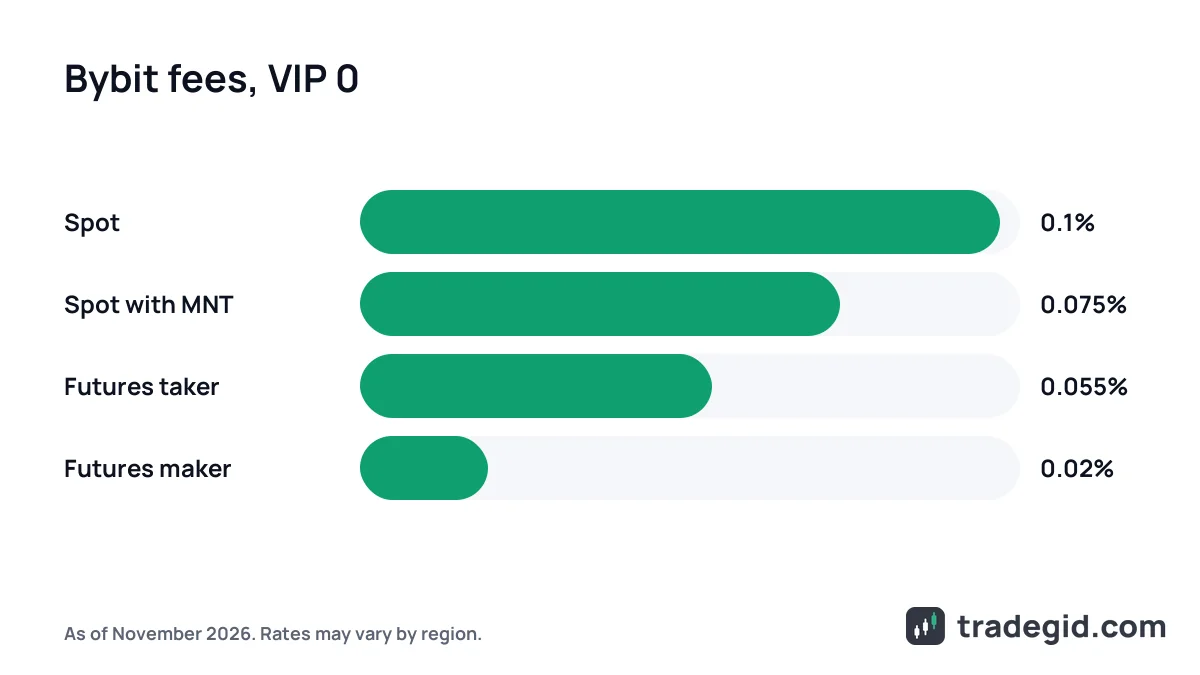
A regular Bybit account pays 0.1% on spot (crypto-to-crypto pairs) and 0.02% maker / 0.055% taker on perpetual futures. Crypto deposits and transfers between Bybit accounts are free; on-chain withdrawals cost a fixed amount that depends on the coin and network. Rates checked against Bybit's Help Center on 1 November 2026.
Contents
I've traded since 2020, mostly futures on Bybit. Per trade the fee looks tiny; over a month of active trading it becomes a real line item. So besides the tables, here's the USDT math and the few legit ways to pay less.
Bybit spot trading fees
Bybit splits spot pairs into three groups with different rates. Most people trade USDT pairs like BTC/USDT – that's the crypto-to-crypto group at 0.1% for both maker and taker. Fiat pairs, Adventure Zone coins and xStocks (tokenized US stocks) cost more.
| Pair type | Maker | Taker | Buying 1,000 USDT worth |
|---|---|---|---|
| Crypto-to-crypto (BTC/USDT, ETH/USDT, etc.) | 0.1% | 0.1% | 1 USDT |
| Same, paying the fee in MNT (−25%) | 0.075% | 0.075% | 0.75 USDT |
| Fiat pairs (under 100,000 USD 30-day volume) | 0.15% | 0.2% | 1.50–2 USDT |
| Adventure Zone and xStocks | 0.2% | 0.2% | 2 USDT |
As of November 2026, per Bybit's Trading Fee Structure (updated 2 Sep 2026) and FAQ on paying fees with MNT. Bybit says rates may vary by region – check the My Fee Rate page after KYC.
Spot fees are taken in the coin you receive. Buy 1,000 USDT of BTC at market and you get roughly 999 USDT worth of BTC. Sell it back and 0.1% comes off the USDT. A full round trip costs 0.2%, or 2 USDT per 1,000.
Bybit stocks fees
xStocks are spot tokens and pay the 0.2% rate. Stock perpetuals (US stocks, ETFs, gold, oil) follow the regular USDT perpetual schedule, 0.02% / 0.055% for VIP 0, per Bybit's TradFi perpetuals guide (updated 29 Oct 2026). More in the xStocks guide.
Bybit futures fees
On perpetual and dated contracts the formula is simple: fee = order value × fee rate. It's charged on position size, not on your margin. Put up 100 USDT at 10x and you hold a 1,000 USDT position, so a taker pays 0.55 USDT just to get in.
| Market | Maker | Taker | 1,000 USDT position, entry |
|---|---|---|---|
| Perpetual and dated futures (USDT, USDC, inverse) | 0.02% | 0.055% | 0.20 USDT limit, 0.55 USDT market |
| Same, paying in MNT (−10%, USDT and USDC contracts) | 0.018% | 0.0495% | 0.18 / 0.495 USDT |
| Stock, ETF and commodity perpetuals | 0.02% | 0.055% | Same as USDT perpetuals |
| Pre-Market perpetuals | 0.04% | 0.1% | 0.40 / 1 USDT |
| Innovation Zone | 0.04% | 0.11% | 0.40 / 1.10 USDT |
| Options | 0.02% | 0.03% | Based on index price, capped at 7% of option price |
As of November 2026, per Bybit's fee structure and futures fees explained. No MNT discount on inverse contracts, bots, copy trading or API orders.
Bybit options trading fees
You pay the smaller of fee rate × index price or 7% of the option price, times size. Example: BTC index at 100,000 USDT, taker 0.03% gives 30 USDT per contract. If the option itself costs 300 USDT, the 7% cap is 21 USDT, and that's what you pay. On exercise there's a delivery fee of 0.015% for BTC and ETH, capped at 12.5% of the option's value (Bybit options fees, updated 19 Aug 2026).
Funding isn't a Bybit fee, but you still pay it
Funding moves between longs and shorts; Bybit doesn't keep it. The interval is set per contract – often 8 hours, sometimes shorter, and hourly once the rate hits its cap – and shown in the contract details. More in funding rate explained.
Worked example: a month of futures trading in USDT
A normal month for me: 20 futures trades of 2,000 USDT, each one an entry plus an exit. Market vs limit orders is almost a 3x difference.
| How you enter and exit | Per trade | Per month | Per year |
|---|---|---|---|
| Market in, market out (taker) | 2.20 USDT | 44 USDT | 528 USDT |
| Limit in, stop-loss out (maker + taker) | 1.50 USDT | 30 USDT | 360 USDT |
| Limit in, limit out (maker) | 0.80 USDT | 16 USDT | 192 USDT |
VIP 0 rates as of November 2026: 0.055% taker, 0.02% maker. Funding and slippage not included.
The middle row is the realistic one: limit entries are easy, but a stop-loss almost always fills at market. To see fees inside your actual profit, use the PnL calculator.
India: 18% GST on top of fees
If your KYC or address is in India, Bybit adds 18% GST to trading and service fees, withdrawal fees and spreads (funding is excluded). So spot effectively costs 0.118% and a futures taker 0.0649%. On top of that, 1% TDS is withheld on crypto sells and crypto-to-crypto trades under Section 194S. Source: Bybit's GST and TDS FAQ for India, updated 19 Oct 2026. For tax filing, talk to a local adviser.
Bybit withdrawal and deposit fees
Crypto deposits are free – you only pay the sending network – and so are transfers between Bybit accounts. On-chain withdrawals cost a fixed fee per coin and network, the same for 20 or 20,000 USDT.
| Operation | Bybit fee | What to know |
|---|---|---|
| Crypto deposit from another wallet | 0 | You pay only the sender's network fee |
| Internal transfer to another Bybit account | 0 | Instant, off-chain |
| On-chain withdrawal of USDT and other coins | Fixed, per coin and network | Fee and minimum shown in the withdrawal window before you confirm |
| Buying crypto by card via a provider | Provider's fee | Shown at checkout; the rate is usually worse than P2P |
| Fiat deposits and withdrawals | Depends on currency and method | Methods depend on your country |
As of November 2026, per Bybit's Fees You Need to Know (updated 8 Apr 2026).
There's no exact USDT TRC20 or BEP20 figure here on purpose. Bybit lists them on a dynamic deposit and withdrawal fees page, adjusts them with network load, and I couldn't verify the live numbers on 1 November. Go to Assets → Withdraw → USDT → pick a network, and Bybit shows the fee and minimum before you confirm.
- Check which networks the receiver supports: exchange, wallet or P2P counterparty.
- In the withdrawal window, switch between the shared networks and compare fees. Historically ERC20 is the most expensive of the popular ones.
- If the receiver is on Bybit too, use an internal transfer by UID or email – it's free.
- Withdraw less often and in bigger chunks: a fixed fee hurts more on small amounts.
- Before a large amount, send a small test and confirm it arrived.
Nearly all withdrawal savings come from the network choice and not splitting transfers. Picking the wrong network costs more than any fee, because the coins can be lost.
Bybit P2P fees
For NGN, a taker who trades against someone else's ad pays nothing; only makers posting buy ads pay 0.25–0.3% depending on status. Currencies not listed on Bybit's P2P fees page (updated 28 Jul 2026), INR included, have no Bybit P2P fee. Your bank, UPI app or mobile money provider may still charge its own. Cashing out is covered in how to withdraw USDT to a card.
How to lower your Bybit fees
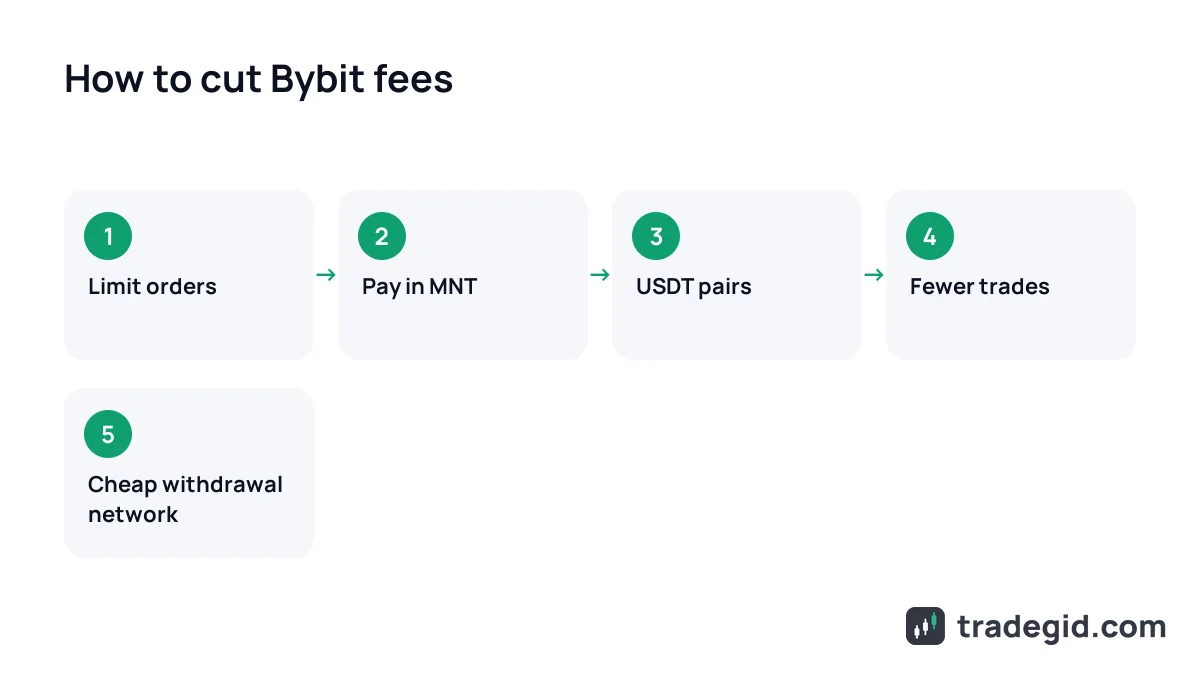
The legit levers, roughly in order of impact for a normal trader:
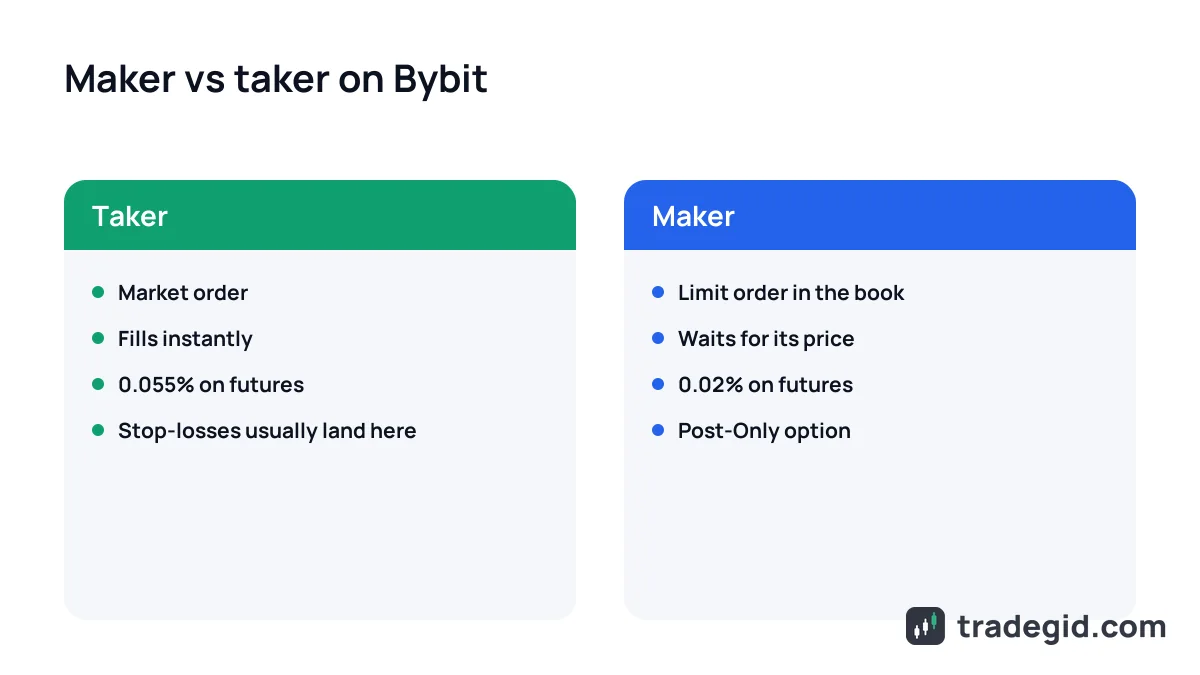
- Limit orders instead of market orders. On futures that's 0.02% vs 0.055%. Post-Only makes sure a limit order never fills as a taker.
- Pay fees in MNT. 25% off spot and spot margin, 10% off USDT and USDC contracts. Toggle it under Fee Rate on the trading page; MNT must sit in your Unified Trading Account. MNT's price moves, and that risk is yours.
- USDT pairs instead of fiat pairs. 0.1% vs 0.15–0.2%.
- Fewer pointless trades. The most underrated one: ten impulse entries a day cost more than any discount saves.
- A VIP tier – only if your volume or balance is genuinely large, see below.
- Fee Saver vouchers from the Rewards Hub. They offset trading fees but can't be withdrawn and they expire.
For most people the first two are enough: limit orders plus MNT cut futures costs by roughly two thirds. VIP is for traders moving millions a month.
Bybit VIP tiers: when they matter
| Tier | Any one of | Spot maker / taker | Derivatives maker / taker |
|---|---|---|---|
| VIP 0 | Default | 0.1% / 0.1% | 0.02% / 0.055% |
| VIP 1 | Balance 100,000 USD+, or spot 1M USD+ in 30 days, or derivatives 10M USD+ | 0.0675% / 0.08% | 0.018% / 0.04% |
| VIP 2 | Balance 250,000 USD+, or spot 5M USD+, or derivatives 25M USD+ | 0.065% / 0.0775% | 0.016% / 0.0375% |
| VIP 3 | Balance 500,000 USD+, or spot 10M USD+, or derivatives 50M USD+ | 0.0625% / 0.075% | 0.014% / 0.035% |
As of November 2026, per Bybit's fee structure; one condition is enough. Under the MNT Program, MNT counts 1.5x toward the VIP 1 balance.
Reality check: 10M USD of derivatives volume a month is over 300,000 USD a day. Chasing volume for a lower tier is a reliable way to overtrade.
Bybit vs Binance trading fees
On spot they're level: both charge 0.1% for a regular account, and both drop to 0.075% when you pay in the house token (MNT on Bybit, BNB on Binance, per Binance's fee page). On futures, Bybit's 0.02% maker is standard and the 0.055% taker isn't the cheapest out there. Full breakdowns: Binance fees, OKX fees, Bitget fees and Gate fees.
Availability matters more than a few basis points: Bybit works in India (with GST) and Nigeria, has halted new sign-ups from the Philippines since November 2025, and is closed to the US. Bybit Card fees depend on your region – see card fees and limits. Country details are in the Bybit review.
No account yet? Sign up on Bybit through the link – code J8NKMG fills in automatically.
Sign up on BybitJ8NKMGThe code can only be entered during sign-up.