

Bitget Fees: Spot, Futures, Withdrawals and How to Pay Less
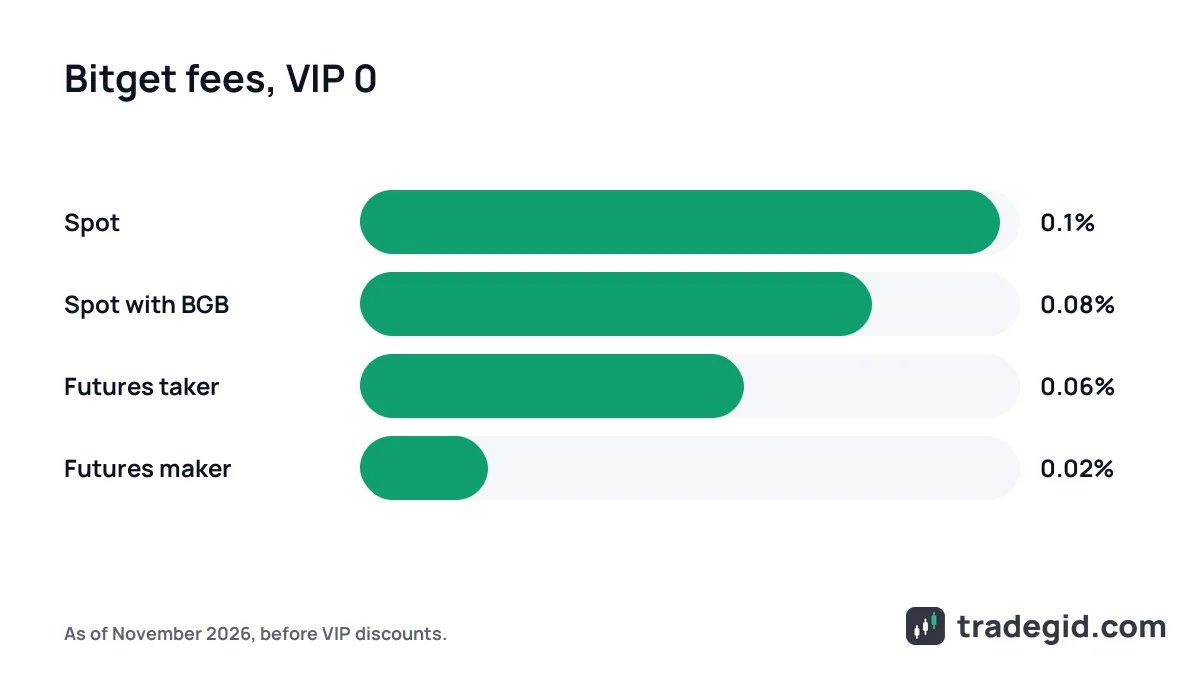
Bitget's base fees as of November 2026 are 0.1% maker and taker on spot and 0.02% / 0.06% on USDT-M futures. Paying spot fees in BGB cuts the rate to 0.08%, and withdrawing USDT costs anywhere from 0.01 USDT on BEP20 to 2 USDT on ERC20. Below are the tables, a calculator and a worked example in USDT.
Contents
Bitget spot trading fees
On spot, Bitget charges one flat rate: 0.1% for limit orders (maker) and market orders (taker) alike. Buy 1,000 USDT of BTC and you pay 1 USDT; sell it and you pay another 1 USDT. A full round trip on spot costs 0.2% of the trade size.
| Market | Maker | Taker | On a 1,000 USDT trade |
|---|---|---|---|
| Spot | 0.1% | 0.1% | 1 USDT |
| Spot, fees paid in BGB | 0.08% | 0.08% | 0.8 USDT |
| USDT-M futures | 0.02% | 0.06% | 0.2 USDT limit, 0.6 USDT market |
| Convert (one-click swap) | 0 | 0 | No fee, but the quote includes a spread |
| P2P | 0 | 0 | No Bitget fee, except NGN advertisers (0.1%) |
As of November 2026: Bitget's Trading Fees help article (updated 20 Aug 2026) and Bitget's public API for contract and VIP fee data. Live schedule at bitget.com/fee.
The spot discount comes from Bitget's own token, BGB. Turn on the option to pay fees with BGB in your fee settings, keep some BGB in the spot account, and fees are deducted in BGB at 20% off: 0.1% becomes 0.08%. The discount stacks on top of VIP rates.
I keep a small BGB balance on spot just for fees. Buying BGB only for the discount makes little sense on small volume, though: at 5,000 USDT of trades a month you save 1 USDT, while BGB itself can move several percent either way in that month.
Bitget futures trading fees
On USDT-M perpetuals a limit order costs 0.02% and a market order 0.06%, three times as much. The rate was identical across all 868 USDT-M contracts listed on 1 November 2026; I checked it through Bitget's public API.
The trap is that the fee is charged on the position size, not your margin. 200 USDT of margin at 10x leverage is a 2,000 USDT position. Entering and exiting at market costs 2,000 × 0.06% × 2 = 2.4 USDT, or 1.2% of your margin on a single trade. At 50x the same 200 USDT pays 12 USDT. More on that in our guide to leverage.
Funding: a cost that does not go to Bitget
Hold a position and every few hours you pay or receive funding. Longs and shorts pay each other; Bitget does not keep it. BTCUSDT settles every 8 hours with a cap of ±0.3% per interval. Not every contract works that way: per the API on 1 November 2026, 491 contracts settle every 8 hours, 375 every 4 hours and two every hour.
- Market orders – every market trade on futures costs three times a limit trade.
- High leverage – fees grow with position size, not with your deposit.
- Overtrading – ten market entries a day cost more than an average stop-loss.
- Holding through high funding – altcoins on a 4-hour interval charge twice as many payments as BTC.
- Re-entering after a stop – the new position pays the entry fee again.
On Bitget futures the rate itself is not the expensive part; habits are: market orders, big leverage and constant re-entries.
Bitget VIP fee tiers
Bitget grants a VIP tier when you meet any one condition: 30-day trading volume or total account assets. Volume thresholds differ for spot and futures; the asset threshold is shared.
| Tier | Condition (any one) | Spot maker / taker | Futures maker / taker |
|---|---|---|---|
| VIP 0 | All new accounts | 0.1% / 0.1% | 0.02% / 0.06% |
| VIP 1 | Assets from 30,000 USDT, or 500,000 USDT spot, or 5M USDT futures volume in 30 days | 0.08% / 0.08% | 0.019% / 0.06% |
| VIP 2 | Assets from 50,000 USDT, or 2M spot, or 10M USDT futures | 0.065% / 0.07% | 0.016% / 0.04% |
| VIP 3 | Assets from 250,000 USDT, or 8M spot, or 20M USDT futures | 0.05% / 0.06% | 0.014% / 0.0375% |
| VIP 7 | Assets from 10M USDT, or 100M spot, or 1B USDT futures | 0% / 0.03% | 0% / 0.02% |
As of 1 November 2026, from Bitget's public API (spot and futures VIP schedules). Tiers 4–6 and BGB-holding conditions are on bitget.com/fee.
For most retail traders VIP 1 is only realistic through assets: 30,000 USDT on the account. Even then futures barely change, because the taker stays at 0.06%. A real cut on market orders starts at VIP 2, where the taker falls to 0.04%.
Bitget deposit and withdrawal fees
Bitget does not charge for crypto deposits; you only pay the network fee on the sending side. Withdrawals carry a flat fee that depends on the coin and network, and the gap between networks is large, so pick the network before you copy the address.
| Coin and network | Withdrawal fee | Minimum | When to use it |
|---|---|---|---|
| USDT, BEP20 (BNB Chain) | 0.01 USDT | 5 USDT | Cheapest, if the receiver accepts BEP20 |
| USDT, Polygon | 0.07 USDT | 5 USDT | Receiving wallet on Polygon |
| USDT, Arbitrum One | 0.1 USDT | 5 USDT | DeFi on Arbitrum |
| USDT, TON | 0.15 USDT | 5 USDT | Telegram wallets |
| USDT, Solana | 0.5 USDT | 5 USDT | Solana wallets |
| USDT, TRC20 (Tron) | 1.5 USDT | 5 USDT | Only if the receiver accepts TRC20 alone |
| USDT, ERC20 (Ethereum) | 2 USDT | 5 USDT | Only when you need Ethereum mainnet |
| BTC, Bitcoin network | 0.00002 BTC | 0.0005 BTC | Moving coins to your own cold wallet |
| ETH, Arbitrum One | 0.000002 ETH | 0.002205 ETH | Cheaper than ETH mainnet (0.00004411 ETH) |
As of 1 November 2026, from Bitget's public API (coin and network list). Fees move with network load; the withdrawal form shows the final amount. VIP 0 has a 24-hour withdrawal limit of 3M USDT.
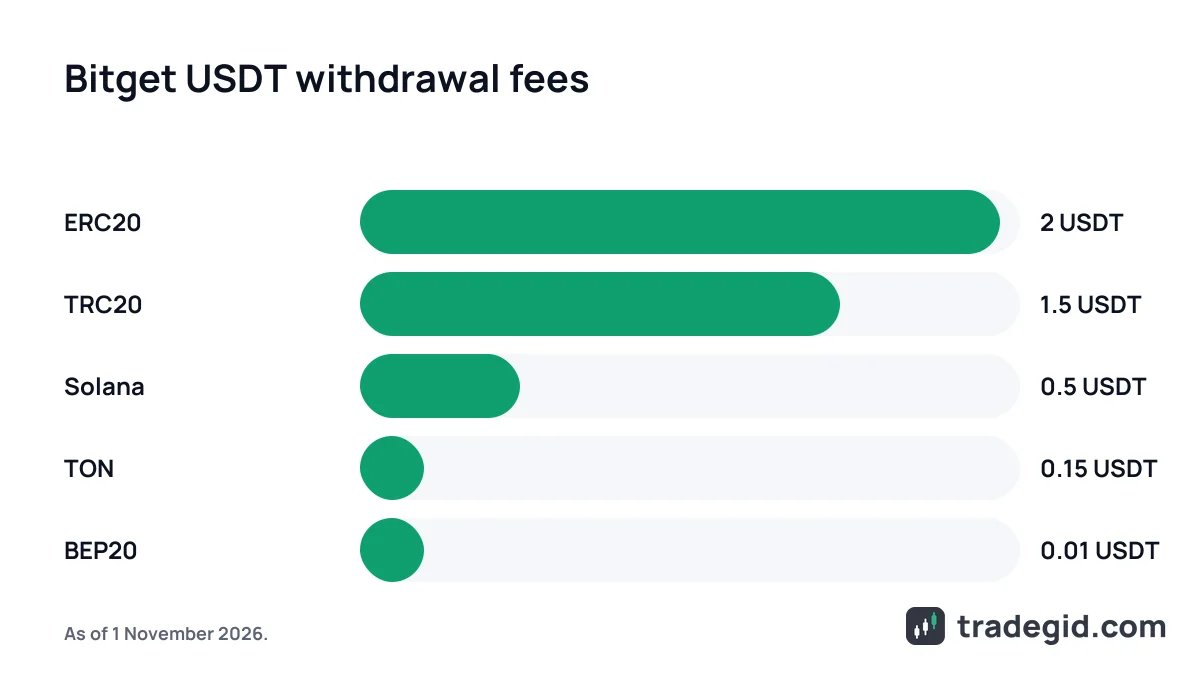
In practice, withdrawing 100 USDT on TRC20 costs 1.5% of the amount, on BEP20 0.01%. The "always use TRC20" habit dates from when Tron was the cheapest option; it is not anymore. The network still has to be supported on the receiving side, or the coins can be lost. For cashing out, see our guide on withdrawing USDT to a card.
P2P, Convert, copy trading and bots
- P2P – no Bitget fee for buyers or sellers. The exception is the Nigerian naira market: NGN advertisers (makers) pay 0.1%, and takers who respond to an ad pay nothing. Your bank or mobile money provider may still charge its own fee.
- Convert – swaps with no fee, but the quote includes a spread. For larger amounts a limit order on spot is usually cheaper.
- Copy trading – no separate fee. The elite trader takes a share of profits only, capped by their tier: per Bitget's help center, from 10% at entry tiers up to 20% at the top. You still pay normal trading fees.
- Bots – no subscription, only trading fees on the bot's orders. A grid bot trades a lot, so fees eat a visible slice of the result.
Outside spot and futures Bitget charges almost nothing directly; the costs hide in the Convert spread, the copy trader's profit share and the number of bot trades.
Bitget fee calculator
With the defaults – a 1,000 USDT position, 20 trades a month, 30% limit orders – the blended rate is 0.048%. A round trip costs 0.96 USDT, a month 19.2 USDT and a year about 230 USDT. Slide limit orders to 100% and the yearly figure drops by more than half.
Worked example: what a month on Bitget costs in USDT
Here is a typical beginner's month with a deposit of around 1,200 USDT: some spot, one futures trade and a withdrawal. All numbers use VIP 0 rates as of November 2026.
- Buy 1,000 USDT of BTC at market – 1 USDT, or 0.8 USDT with BGB fee payment on.
- Sell the BTC with a limit order – another 1 USDT, because spot maker and taker are the same.
- Futures: 200 USDT margin, 10x, 2,000 USDT position – limit entry 0.4 USDT, stop-loss exit (a market order) 1.2 USDT. Total 1.6 USDT.
- Holding that position for a day at 0.01% funding – three payments of 0.2 USDT, 0.6 USDT in total. If funding is negative, the long receives instead.
- Withdraw 300 USDT – 0.01 USDT on BEP20 or 1.5 USDT on TRC20.
The month costs roughly 4.2–5.7 USDT, and futures, not spot, is the largest line. A limit exit and a cheap network would have saved about 2 USDT of it.
How to lower your Bitget fees legitimately
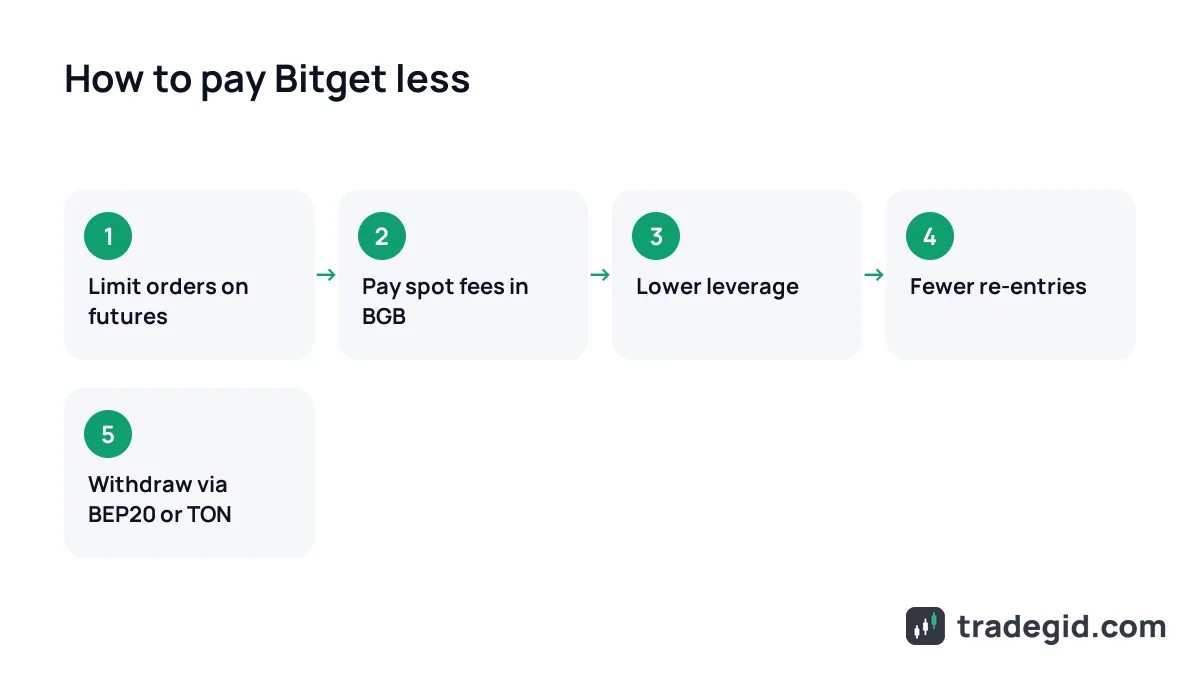
- Limit orders on futures. 0.02% instead of 0.06% is the biggest saving available from day one.
- Pay spot fees in BGB. 20% off spot, if you already hold BGB.
- Fewer trades. One planned trade is cheaper than five impulsive re-entries.
- Sensible leverage. Fees follow the position: 5x instead of 20x cuts entry fees by four.
- A cheap withdrawal network. BEP20, Polygon or TON instead of ERC20 or TRC20, if the receiver supports it.
- P2P instead of card purchases. Compare rates: a card partner's markup can be higher than P2P ads in INR, NGN or PHP.
The only honest way to cut Bitget fees is through your own choices: limit orders, BGB, lower leverage and the right network. No code or secret link changes that maths.
Bitget fees vs Binance, Bybit, OKX and Gate
| Exchange | Spot maker / taker | Futures maker / taker |
|---|---|---|
| Bitget | 0.1% / 0.1% | 0.02% / 0.06% |
| Binance | 0.1% / 0.1% | 0.02% / 0.05% |
| Bybit | 0.1% / 0.1% | 0.02% / 0.055% |
| OKX | 0.08% / 0.1% | 0.02% / 0.05% |
| Gate | 0.1% / 0.1% | 0.02% / 0.05% |
Bitget as of November 2026; the other exchanges from our reviews, checked in October 2026. Base tier without token or VIP discounts.
On spot there is almost no difference. On futures Bitget has the highest base taker fee of the five: 0.06% against 0.05% at Binance, OKX and Gate. A scalper hitting market orders dozens of times a day will feel it; a copy trader or someone working with limit orders will not. Full breakdowns: Binance fees, Bybit fees, OKX fees and Gate fees.
If your country is not on Bitget's restricted list, you can open an account through the link.
Sign up on BitgetBGGAPKEJThe code can only be entered during sign-up.