

Gate.io fees: spot, futures, withdrawals and how to pay less
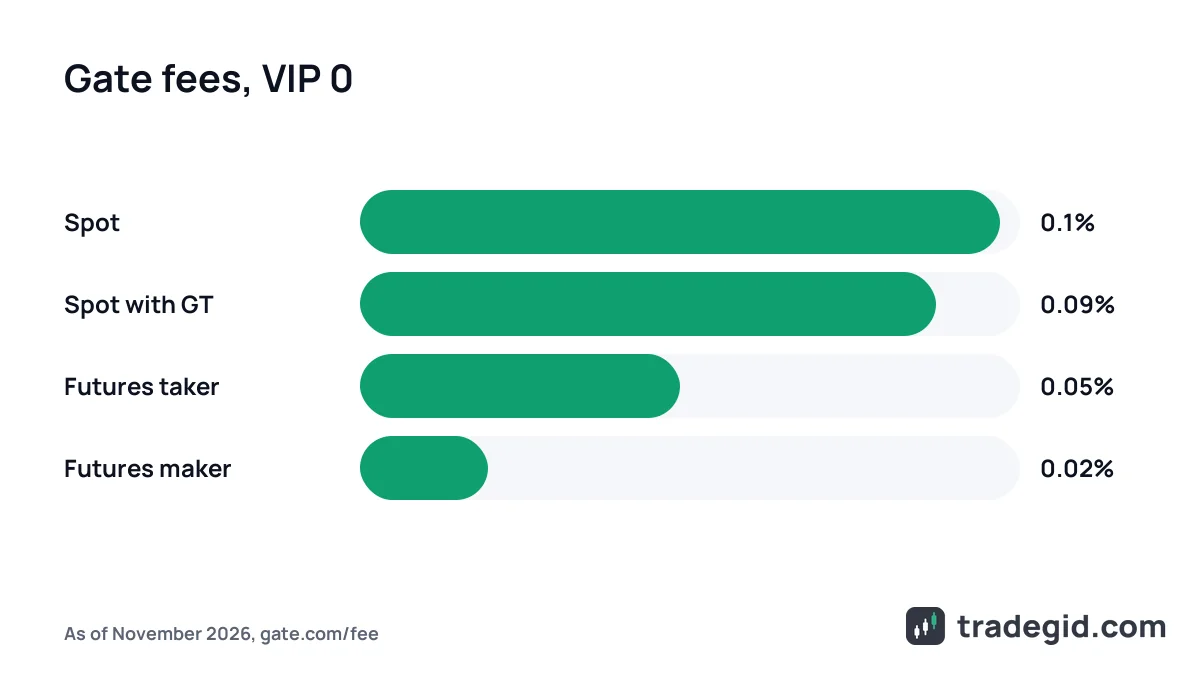
Gate's base spot trading fee is 0.1% for both maker and taker, or 0.09% if you pay in GT. USDT perpetual futures cost 0.02% maker and 0.05% taker. Crypto deposits are free, withdrawals cost a fixed amount per network, and P2P carries no platform fee (as of November 2026).
Contents
Gate fees at a glance
These are the rates for a regular account without VIP status (VIP 0). I checked them against Gate's official announcements and the gate.com fee page on 1 November 2026. Your personal rate appears on the same page once you log in.
| Market | Maker | Taker | Notes |
|---|---|---|---|
| Spot | 0.1% | 0.1% | Same for limit and market orders |
| Spot paid in GT | 0.09% | 0.09% | Turn on GT fee deduction |
| USDC/USDT pair | 0% | 0% | Volume does not count toward VIP |
| USDT perpetual futures | 0.02% | 0.05% | Plus funding while the position is open |
| TradFi perpetuals (stocks, metals, indices) | 0.02% | 0.05% | Separate schedule since 1 September 2026 |
| Options | 0.02% | 0.028% | Cut in February 2026 |
| Trenches (onchain tokens) | 0.5% | 0.5% | Flat rate, down from 0.8% in October 2026 |
| P2P | 0 | 0 | You only pay the seller's spread |
| Crypto deposit | – | – | Free; the sender pays the network fee |
| Crypto withdrawal | – | – | Fixed amount per coin and network |
As of November 2026. Sources: Gate announcements of 19.01.2024 (spot), 25.03.2026 (changes from 09.04.2026) and 26.08.2026 (TradFi), Gate's fee calculation article of 15.09.2026, gate.com/fee. Rates change, so check gate.com/fee.
Gate spot trading fees: 0.1% or 0.2%?
The right number is 0.1%. That is what Gate charges both makers and takers at VIP 0. The rate dates from 29 January 2024, when Gate cut spot fees across the board, in places by half. In March 2026 Gate announced a new schedule effective 9 April 2026, but it left VIP 0–9 untouched and only changed rates for VIP 10 and above.
So why do so many reviews say 0.2%? Three reasons: articles written before 2024; Gate's public API, whose trading pair description still carries a fee field of 0.2 that scrapers read as the live rate; and the help centre of Gate TR, a separate Turkish company, whose example uses 0.2%. None of this applies to global gate.com.
The fee is charged on the trade value: price × quantity × rate. Buy 2 ETH at 2,000 USDT and you pay 0.1% of 4,000 USDT, which is 4 USDT. Partial fills pay only on the filled part.
Gate maker and taker fees on spot
A maker places a limit order and waits in the order book; a taker hits an existing price with a market order. Many exchanges charge makers less, but on Gate spot at VIP 0 both pay 0.1%. On spot, limit orders save you slippage, not fees.
GT fee discount
GT is Gate's own token. Turn on GT fee deduction and keep GT in your spot account, and the spot rate drops from 0.1% to 0.09%, a 10% discount. It applies at VIP 0–9; from VIP 10 the GT rate equals the normal rate.
I buy just enough GT to cover a few months of fees, not as an investment. GT's price moves, and a 10% drop in the token wipes out more than you saved.
Gate futures trading fees
On USDT perpetual futures Gate charges 0.02% maker and 0.05% taker at VIP 0. The key detail: the fee is charged on position size, not on your margin. A 5,000 USDT position opened with 500 USDT of margin at 10x pays fees on 5,000.
Here limit orders do save real money: maker is 2.5 times cheaper than taker. Since 1 September 2026, perpetuals on stocks, metals and indices (TradFi) have their own schedule, but at VIP 0 it is the same 0.02% and 0.05%.
Funding interval on Gate
On top of the trading fee you pay or receive funding, a payment between longs and shorts. Gate does not keep it, but it comes out of your position. According to Gate's API on 1 November 2026, BTC, ETH, SOL and XRP settle funding every 8 hours, while 421 of 1,070 USDT contracts settle every 4 hours. Since April 2026 Gate can shorten the interval to 1 hour when the rate hits its cap.
Gate withdrawal fees and deposits
Depositing crypto to Gate is free; the sender pays the network fee. Withdrawals cost a fixed amount that depends on the coin and network. Gate recalculates it with network load, sometimes several times a day, so the exact figure is only shown in the withdrawal window before you confirm.
| Network | Minimum withdrawal | What to watch |
|---|---|---|
| Tron (TRC20) | 10 USDT | Common for P2P, but a higher minimum than other networks |
| BNB Smart Chain (BEP20) | 1 USDT | Make sure the receiving wallet or exchange supports BEP20 |
| Ethereum (ERC20) | 1 USDT | Fee follows Ethereum gas and is usually the highest |
| Solana | 1 USDT | Addresses differ from EVM networks, double-check the network |
| TON | 1 USDT | Sending to an exchange needs a memo (comment) |
| Arbitrum One, Polygon | 1 USDT | Handy for wallet transfers, check the receiver supports them |
Minimums from Gate's public API, as of November 2026. Gate shows the withdrawal fee itself in the withdrawal window; it is fixed per network and moves with network load.
A fixed fee hurts small amounts. Gate's own example: with a 1 USDT fee, withdrawing 20 USDT costs you 5%, withdrawing 1,000 USDT costs 0.1%. Withdraw less often and in larger amounts.
Between two Gate accounts you can move funds with Gate Code and skip the onchain fee. A Gate Code works like a bearer cheque, so only send it to someone you trust.
P2P, Convert and other charges
- P2P. Gate advertises zero platform fees. Your real cost is the seller's rate, so compare it with the market price before you trade. How to pick a seller is covered in our P2P section.
- Convert. Gate's menu lists 0% fees, but the conversion rate includes a spread. For larger amounts a normal spot order is often cheaper.
- Trenches. Onchain tokens from your exchange account cost 0.5% per trade at every VIP level, five times the spot rate.
- Gate Card. Card fees depend on your country; check the card section in your account. I could not verify them for every region, so no numbers here.
- Listing fee. Gate agrees listing terms with projects privately; this does not affect traders.
On P2P and Convert the hidden cost sits in the rate, not the fee. The most expensive trading on Gate is Trenches at 0.5% per trade.
Gate VIP fee tiers
VIP 1 needs just one of three things: at least 60,000 USD of trading volume over 30 days, an average of 50 GT held over 14 days, or 2,000 USD in assets. Volume is weighted: spot, Convert and stocks count in full, futures at 40%, options at 20%. Your tier updates automatically about every 6 hours.
| Tier | Maker / taker | Paid in GT |
|---|---|---|
| VIP 0 | 0.1% / 0.1% | 0.09% / 0.09% |
| VIP 1 | 0.099% / 0.099% | 0.089% / 0.089% |
| VIP 5 | 0.09% / 0.095% | 0.081% / 0.085% |
| VIP 9 | 0.07% / 0.075% | 0.05% / 0.068% |
| VIP 10 | 0.04% / 0.058% | 0.04% / 0.058% |
| VIP 16 | 0% / 0.0175% | 0% / 0.0175% |
As of November 2026: Gate announcements of 19.01.2024 (VIP 0–9, unchanged) and 25.03.2026 (VIP 10–16, from 09.04.2026). VIP 1 criteria from Gate's VIP article, updated 15.10.2026. Higher-tier thresholds are on gate.com/fee.
To be honest about VIP 1: the difference from VIP 0 is a thousandth of a percent. It is not worth churning volume for. Rates only drop noticeably from VIP 5, which means the volume of an active trader with a large deposit.
How to lower your Gate trading fees
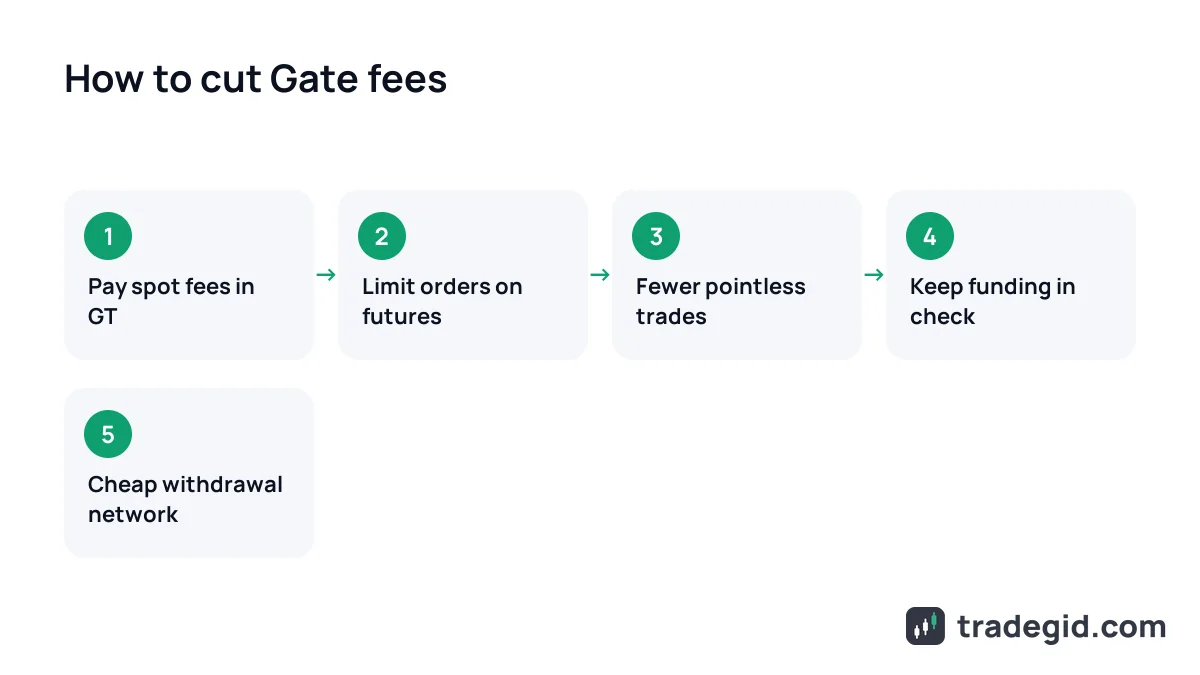
- Pay spot fees in GT: 10% off the rate at VIP 0.
- Use limit orders on futures: 0.02% maker versus 0.05% taker.
- Trade less, but with purpose. Twenty 50 USDT trades cost the same in fees as one 1,000 USDT trade, and usually do you less good.
- Watch funding when you hold a futures position for more than a day.
- Pick a cheap network for withdrawals and withdraw in one go rather than in pieces.
- Swap USDC to USDT on the USDC/USDT pair, which is fee-free.
- Do not chase VIP tiers with volume for its own sake: the extra trades cost more than the discount returns.
On spot the main saving is GT; on futures it is limit orders and keeping funding in check. The rest is discipline: fewer pointless trades and withdrawals.
Worked example: a month of trading on Gate in USDT
Two typical cases, 20 round trips a month: spot trades of 1,000 USDT and futures positions of 5,000 USDT (500 USDT margin at 10x).
| Scenario | Per trade (entry + exit) | Per month, 20 trades |
|---|---|---|
| Spot, 1,000 USDT at 0.1% | 2 USDT | 40 USDT |
| Spot, 1,000 USDT paid in GT at 0.09% | 1.8 USDT | 36 USDT |
| Futures, 5,000 USDT, taker 0.05% | 5 USDT | 100 USDT |
| Futures, 5,000 USDT, maker 0.02% | 2 USDT | 40 USDT |
VIP 0 rates as of November 2026, excluding funding and slippage.
A futures trader using market orders pays 100 USDT a month, which is 20% of a 500 USDT margin. Switching to limit orders saves 60 USDT. Hold the same position for three days at 0.01% funding every 8 hours and you add another 4.5 USDT (5,000 × 0.01% × 9 payments).
To compare with other exchanges, see our fee breakdowns for Binance, Bybit, OKX and Bitget. Base rates are close; the differences hide in token discounts, funding intervals and withdrawal costs.
Who can use Gate
Everything above applies to global gate.com. Under clause 2.5 of its user agreement, it is closed to residents of India, the Philippines, Indonesia, Pakistan, Vietnam, the US, the UK and about 25 other countries. Nigeria, Kenya, South Africa and Brazil are not named in the list as of November 2026. The details are in our Gate review, and the account setup in the Gate sign-up guide.
If your country is not on Gate's restricted list, you can sign up through the link below.
Sign up on GateUVRGV1FXThe code can only be entered during sign-up.