

How to store crypto safely: exchange, hot wallet or cold wallet
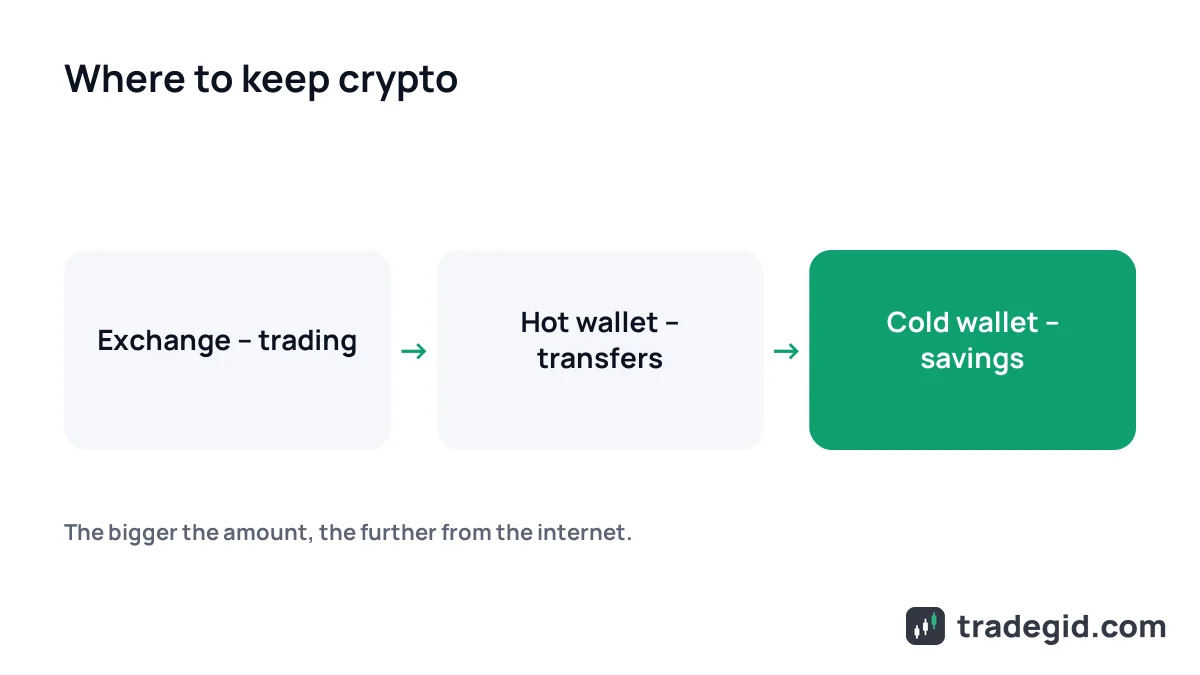
You can store crypto in three places: on an exchange, in a hot wallet app (MetaMask, Trust Wallet, TronLink) or in a cold hardware wallet (Ledger, Trezor, Tangem). Long-term savings are safest in a cold wallet, trading money can sit on an exchange with 2FA turned on, and small amounts for transfers fit a hot wallet. The core rule: never keep everything in one place.
Contents
- Where to store crypto: the three options
- Is it safe to keep crypto on an exchange?
- Hot wallet: what it is and who it suits
- Cold wallet: how to store crypto offline
- How much to keep where: don't put all your eggs in one basket
- Where to hold crypto in India, Nigeria and the Philippines
- Where a beginner should start
Where to store crypto: the three options
Your coins live on the blockchain. "Storing" them means controlling the private key – the secret code that signs transfers. The real question is who holds it: you or a company.
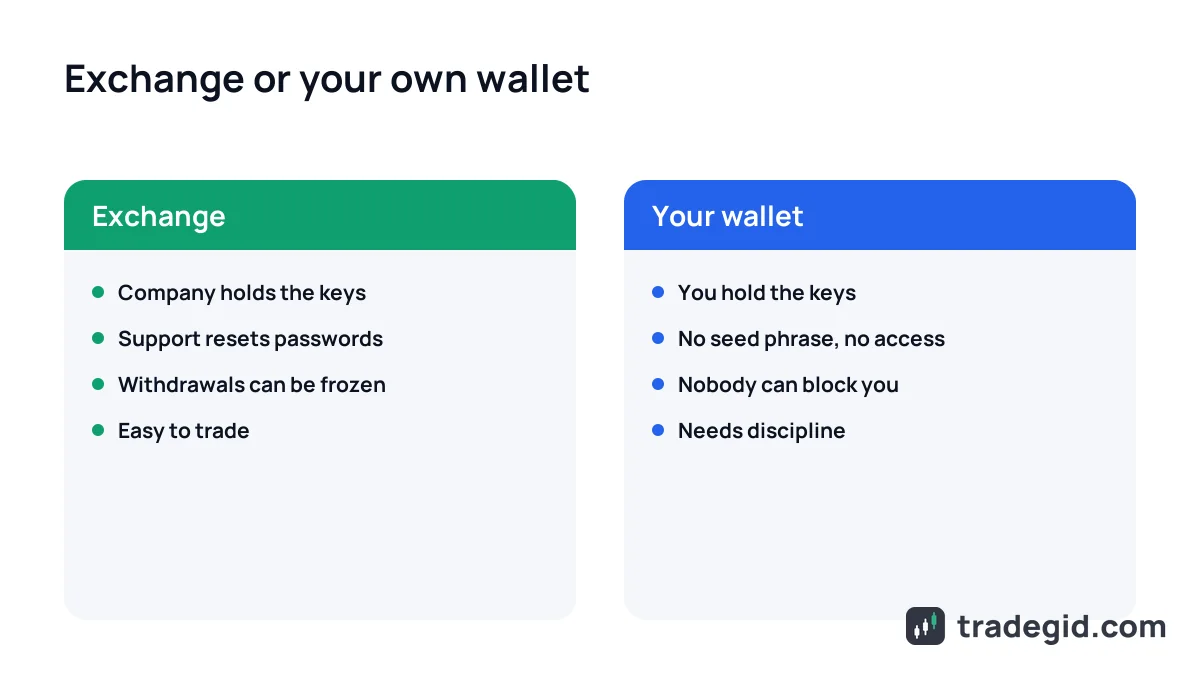
If the exchange holds the key, that is custodial storage: you see a balance, the exchange controls the coins. If you hold it, that is self-custody: you are your own bank, and the only one who can lose access. Hence the saying: not your keys, not your coins.
- Exchange (Bybit, OKX, Gate, Bitget, Binance, Coinbase, Kraken) – the exchange holds the keys, you log in with a password and 2FA.
- Hot wallet – a phone app or browser extension: MetaMask, Trust Wallet, TronLink. You hold the keys, the device is online.
- Cold wallet – usually a hardware wallet: Ledger, Trezor, Tangem, SafePal, Keystone. The key stays in a secure chip offline.
The further the key is from the internet, the safer and less convenient it gets. Experienced holders use all three, each for its own job.
| Factor | Exchange | Hot wallet | Cold wallet |
|---|---|---|---|
| Who holds the keys | The exchange | You, on your phone or browser | You, on a separate device |
| Cost | Free | Free | Roughly $55 to $400 per device |
| Main risk | Exchange hack or collapse, account freeze | Malware, phishing site, leaked seed phrase | Lost seed phrase, fake device |
| Forgot your password | Support can restore access | Only the seed phrase helps | Only the seed phrase or a backup card |
| Best for | Trading, P2P, cashing out | Small amounts, transfers, DeFi | Long-term savings |
Data as of November 2026. Device prices from official manufacturer stores, before shipping and taxes.
New accounts via the link: tasks worth up to 250 USDT; 25% off spot fees paid in MNT.
Sign up on BybitJ8NKMGNew accounts via the link are enrolled in the OKX New User Bonus program automatically.
Sign up on OKXK2FMEIJ3New accounts: a welcome package worth up to 135 USDT for tasks; lower fees paid in GT.
Sign up on GateUVRGV1FX20% off spot fees paid in BGB; new-user rewards in the Reward Center.
Sign up on BitgetBGGAPKEJIs it safe to keep crypto on an exchange?
Short answer: fine for trading money with proper account security, not for your whole savings. Exchanges keep coins from millions of users in shared wallets, which makes them a prime target. The freshest example is Binance.
Late on 29 October 2026 (UTC), attackers drained about $6.3 billion in crypto from Binance hot wallets – the largest exchange hack on record. On 31 October the FBI attributed it to the North Korean group TraderTraitor. Binance said customer funds are safe and that it covers the losses itself, including from its SAFU fund. Withdrawals were paused and reopened in phases from 1 November, network by network, and on 2 November Binance published a new proof-of-reserves snapshot for ten assets.
It is not the first time: Bybit lost over $1.5 billion in ETH in February 2025, Bitget around $388 million in September 2026. All covered the losses, but while they dealt with the breach, customers could not move their coins. The same logic applies to Coinbase, Kraken or any custodial platform.
Proof of reserves: what it is and where to check
Proof of reserves is a report where an exchange shows that its wallets hold at least as many coins as its customers' balances. Large exchanges publish one roughly every month and let you confirm your own balance is included through a Merkle tree.
- Look for the Proof of Reserves page in the exchange footer, for example on Binance or OKX.
- Check the reserve ratio for your coin: 100% or more means customer coins are covered.
- Verify your own balance in the report – it takes a couple of minutes.
- It is a snapshot on one date: it does not show company debts and is not a full audit.
Regular proof of reserves is a good sign, not insurance: it confirms reserves on the snapshot date, not protection from tomorrow's hack.
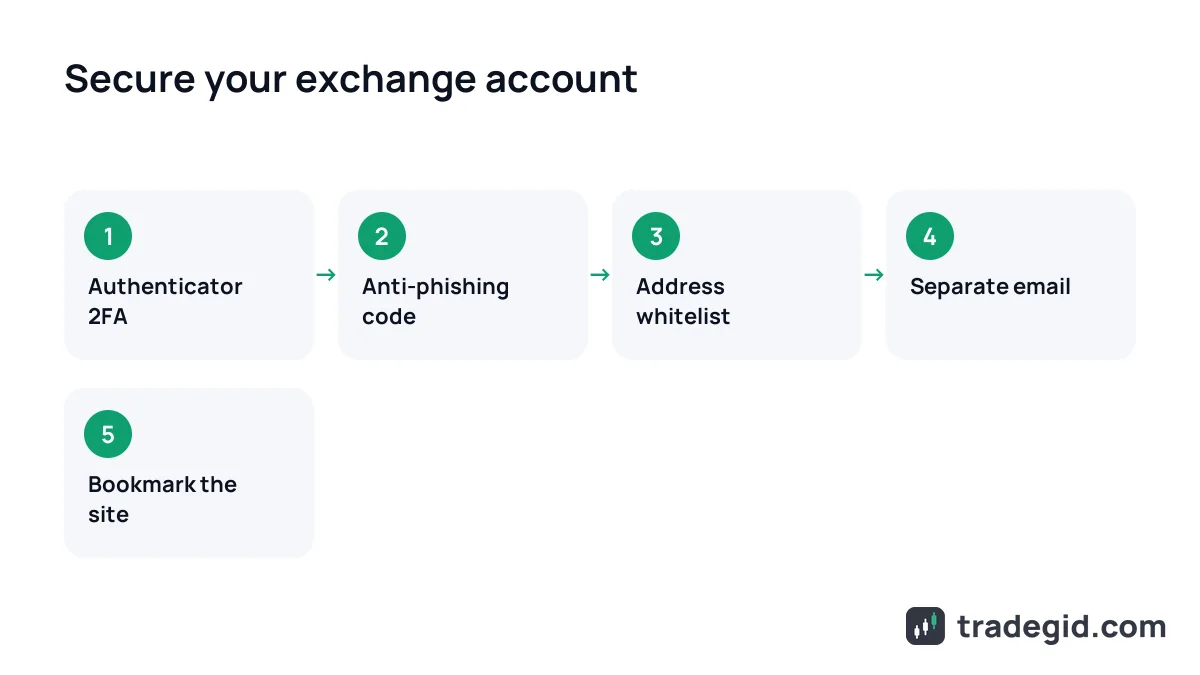
How to secure your exchange account
Most people lose money not to an exchange hack but to a hacked account: a leaked password, a phishing email, a SIM swap. These settings exist on every major exchange and take 10 minutes.
- 2FA with an authenticator appGoogle Authenticator or similar instead of SMS. Write the backup key on paper.
- Anti-phishing codeYour own word that appears in every email from the exchange. No code – fake email.
- Withdrawal address whitelistWithdrawals only to saved addresses. Bybit can also lock new addresses for 24 hours.
- Separate email and passwordAn email used only for exchanges, a unique password, 2FA on the email too.
- Official site onlyUse a bookmark or the official app, never links from ads or chats.
2FA plus a whitelist block most account-theft scenarios: even with your password, an attacker cannot send coins to their own address.
Hot wallet: what it is and who it suits
A hot wallet is an app that keeps your key on an internet-connected device. When you create it, it shows a seed phrase of 12 or 24 words that restores access on any phone. What those words are and how to keep them is covered in our seed phrase guide.
Popular examples: MetaMask for Ethereum and compatible networks, plus Solana and Bitcoin; Trust Wallet, with 100+ blockchains including TRON and Bitcoin; TronLink for TRON, handy for USDT on TRC20. Some exchanges have separate self-custody apps, such as Bitget Wallet – that is not your exchange balance.
Pros
- Free and set up in five minutes
- Nobody can freeze your withdrawals or close your account
- Works for DeFi, NFTs and transfers at any time
Cons
- Malware or a fake extension can steal the key
- Lose the seed phrase and the phone – the coins are gone
- Signing a malicious contract can hand over your coins
Treat a hot wallet like the cash in your pocket: keep what you can afford to lose and move the rest to cold storage.
Cold wallet: how to store crypto offline
A cold wallet means the private key never lands on an internet-connected device. In practice that is a hardware wallet with a secure chip. Your phone or computer prepares the transfer, and the device signs it – after you check the address and amount on its own screen.
Hardware wallets for beginners: Ledger, Trezor, Tangem and others
| Device | Price | What stands out |
|---|---|---|
| Tangem (2-card set) | $54.90 | NFC card, can run without a seed phrase: the backup is the second card |
| Trezor Safe 3 | $59 | EAL6+ secure chip, open-source |
| Ledger Nano S Plus | $59–69 | Cheapest Ledger, USB connection |
| SafePal S1 Pro | $89.99 | No cables or Bluetooth, signs via QR codes |
| Ledger Nano X | $99 | Bluetooth for phone use |
| Ledger Flex / Ledger Stax | $249 / $399 | Large touchscreen |
US official store prices on 04.11.2026, before shipping and taxes; promotions happen. Check Keystone 3 Pro (also QR-based) on the maker's site.
A basic device protects the key as well as the pricey models – you pay extra for the screen. Holding XRP or another specific coin? Check the maker's supported coin list first.
Can you store crypto on a USB flash drive?
A regular pendrive is not a cold wallet. A key file on it can be stolen the moment you plug it into an infected computer, and flash drives fail. A hardware wallet only looks like a USB stick: the key cannot be copied out of it. For offline storage without a device, write the seed phrase on paper or a metal plate.
How to move crypto to a cold wallet
- Set up the device in the maker's official app and write the seed phrase on paper.
- Add the coin and network you need, for example USDT on TRC20 or BTC.
- Copy the receive address and compare it with the address on the device screen.
- On the exchange, add that address to your whitelist and pick the same network.
- Send a small test amount, wait for it to arrive, then send the rest.
Two habits prevent most mistakes: checking the address on the device screen and sending a test transfer before a large one.
How much to keep where: don't put all your eggs in one basket
I have traded since 2020 and keep money in three places. Even without hacks, exchanges pause withdrawals of single coins for network upgrades, and if you need the money right then, you wait. So my exchange balance is only what I plan to trade in the next few days.
| Amount | Storage setup | Why |
|---|---|---|
| Under $100–200 | Exchange with 2FA or a hot wallet | A cold wallet would cost about as much as the balance |
| $200–2,000 | Trading part on the exchange, the rest in a hot wallet | Splits exchange risk from phone risk |
| From $2,000 | Savings on a hardware wallet, working balance on the exchange | A $55–70 device pays for itself in peace of mind |
The author's rule of thumb, not a law: go by the amount you would hate to lose.
- Trading balance on two exchanges, not one.
- Savings on a cold wallet, seed phrase stored in two separate places.
- A separate hot wallet for DeFi and new tokens.
- Once a month: withdraw profits from the exchange and review security settings.
Spreading out does not make each place safer, but it makes sure one mistake or one hack cannot take everything.
Where to hold crypto in India, Nigeria and the Philippines
Exchange access can change overnight – one more reason to keep savings in your own wallet. As of November 2026, OKX is on India's restricted list, while Bybit is registered with India's FIU. In the Philippines, the SEC named Bybit an unlicensed platform in 2025 and new sign-ups stopped in November 2025. Details are in our Bybit and OKX reviews.
Never sign up with a country you do not live in: exchanges freeze funds for that. Hardware wallets may cost more locally due to import duty, but buy only from the maker or an authorised reseller.
Where a beginner should start
Simple order: an exchange with security on, a first purchase, a hot wallet and a small test transfer to it. When savings reach an amount you would hate to lose, get a hardware wallet. We walk through it step by step in our webinar for beginners. More basics are in the Beginners section, and P2P traps in our P2P scams guide.
New accounts via the link: tasks worth up to 250 USDT; 25% off spot fees paid in MNT.
Sign up on BybitJ8NKMGNew accounts via the link are enrolled in the OKX New User Bonus program automatically.
Sign up on OKXK2FMEIJ3New accounts: a welcome package worth up to 135 USDT for tasks; lower fees paid in GT.
Sign up on GateUVRGV1FX20% off spot fees paid in BGB; new-user rewards in the Reward Center.
Sign up on BitgetBGGAPKEJ