

P2P crypto scams: fake payment proof, the triangle scam and how to avoid them
Almost every P2P crypto scam is after one of three things: getting you to release coins before the money really lands, making the money come from someone other than your counterparty, or pulling the trade off the exchange into a messenger. If you confirm every payment in your own bank or UPI app, match the sender's name to the name on the order and keep all chat inside the exchange, most scams simply fail. Below are the common patterns, a checklist to run before you release coins, and what to do if you've already been scammed.
Contents
- Can you get scammed on Binance P2P or any other P2P market?
- Fake payment proof and fake SMS alerts
- The P2P triangle scam
- Third-party payments: what the exchange rules say
- Other P2P scams: Telegram deals, fake support, cancellations and chargebacks
- How to avoid P2P scams: picking a counterparty
- What to do if you've been scammed on P2P
- Is P2P on Binance and other exchanges safe?
Can you get scammed on Binance P2P or any other P2P market?
Yes. P2P means people trade crypto with each other inside an exchange. The exchange locks the seller's coins in escrow (a temporary hold) while the buyer pays by bank transfer, UPI or e-wallet – a payment the exchange never sees. I've traded since 2020: the names of the tricks change, the goals don't – take your coins without paying, turn you into a pass-through for someone else's money, or get you out from under escrow.
| Scam | Red flag | How to protect yourself |
|---|---|---|
| Fake payment proof | A "receipt" in chat and pressure to release now | Check the credit in your own bank app only |
| Fake SMS alert | A "bank" SMS says you got paid, the app shows nothing | Ignore SMS and push alerts, log in yourself |
| Triangle scam | Money arrives from someone not named on the order | Don't release, refund the sender, appeal |
| Third-party payment | "My brother / my company will pay" | Only accept payment from the counterparty's KYC name |
| Off-platform deal | "DM me on Telegram, better rate" | Keep every message in the order chat |
| Fake support | "Exchange staff" asks you to release coins or share a code | Real support never asks you to release coins |
| Cancel after payment | "Technical issue, cancel and I'll pay again" | Never cancel a paid order, file an appeal |
| Wrong amount | Overpaid, asks you to send the difference to another account | Don't release, refund only to the sender via support |
| Chargeback | Pays with a reversible method like PayPal or a cheque | Accept only irreversible transfers from the counterparty |
| Too-good rate | Price far better than the market from a new account | Trade with merchants who have a history |
As of November 2026. Cross-checked against the P2P anti-scam guides from Binance, Bybit and OKX.
If you're new to P2P, start on a large exchange with escrow, merchant ratings and a working appeal process. Note that Binance has had no naira P2P since March 2024, so Nigerian users will find NGN on other exchanges.
New accounts via the link: tasks worth up to 250 USDT; 25% off spot fees paid in MNT.
Sign up on BybitJ8NKMGNew accounts via the link are enrolled in the OKX New User Bonus program automatically.
Sign up on OKXK2FMEIJ320% off spot fees paid in BGB; new-user rewards in the Reward Center.
Sign up on BitgetBGGAPKEJNew accounts: a welcome package worth up to 135 USDT for tasks; lower fees paid in GT.
Sign up on GateUVRGV1FXNew accounts get up to 100 USD in trading-fee vouchers after KYC.
Sign up on Binance58328288Fake payment proof and fake SMS alerts
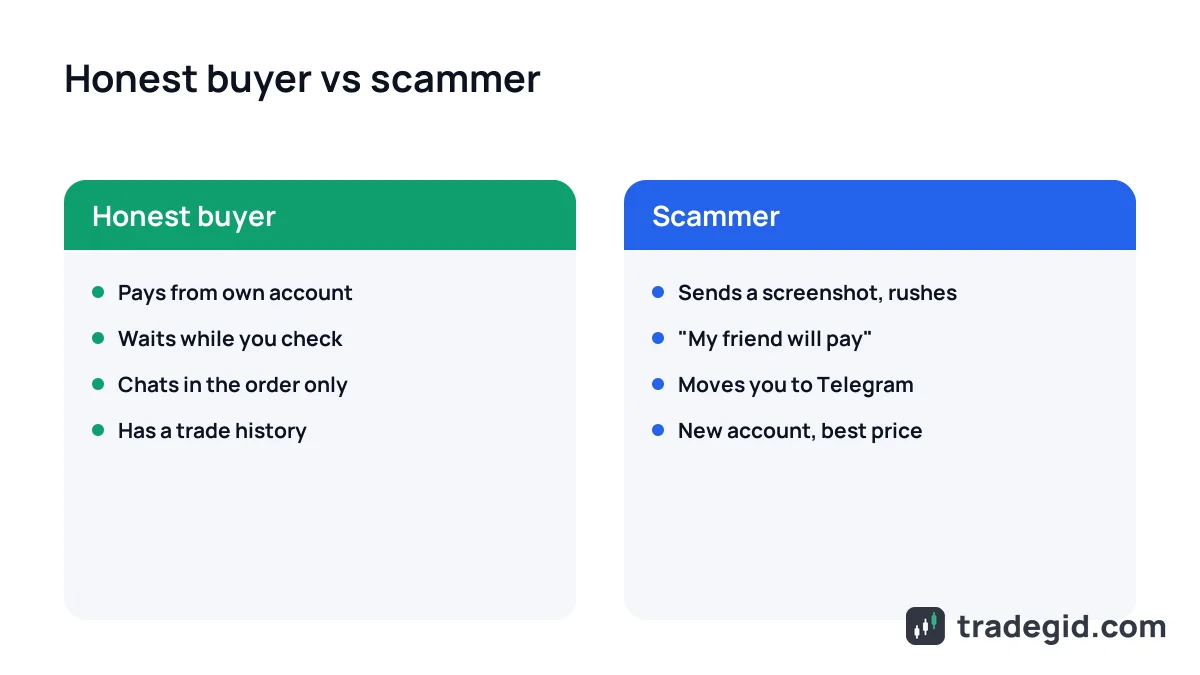
The buyer taps "Paid", drops a screenshot of a UPI or bank transfer and rushes you: "I'm in a hurry", "I'll leave bad feedback". Screenshots and SMS "credit alerts" take a minute to fake, and Binance, Bybit and OKX all say the same: check the account itself. Open your bank or e-wallet app, find the credit, exact amount, right sender name – only then release. An honest buyer will wait five minutes.
The P2P triangle scam
A triangle scam puts three parties into a two-party trade. The scammer opens a buy order with you, then gets a victim to pay for it – the victim thinks they're paying for a phone, a rental deposit or a "job fee" and sends money to your account. You see real money, release the USDT, and it goes to the scammer.
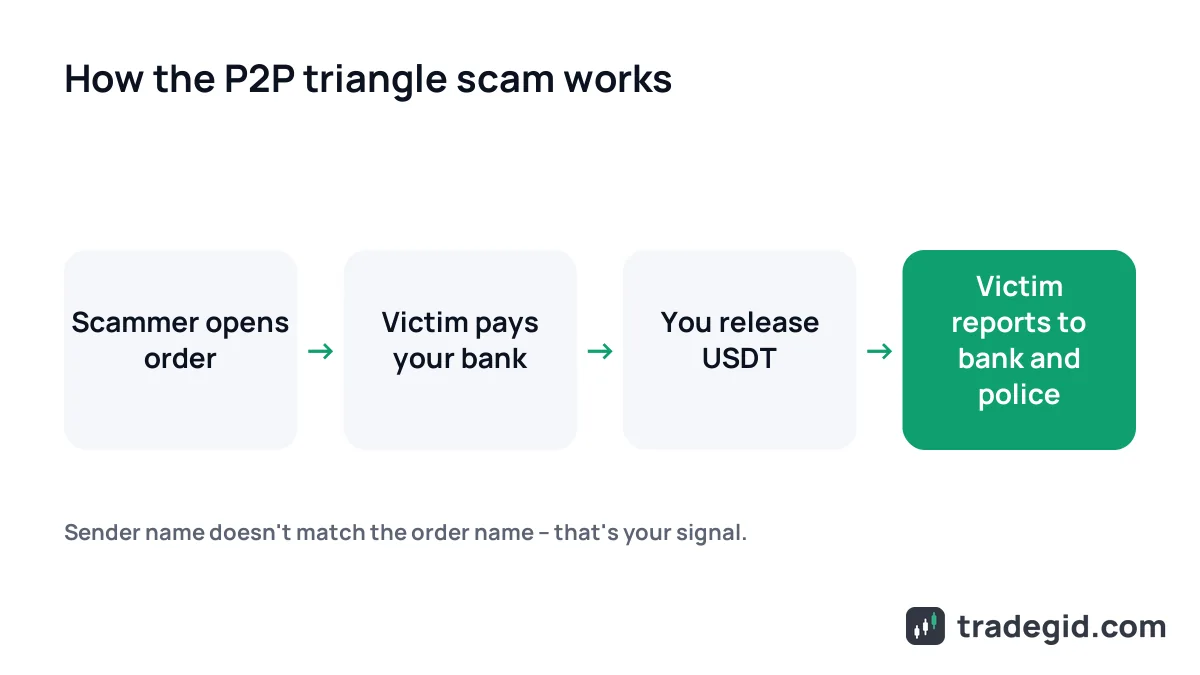
A day or two later the victim reports the fraud, and the statement shows your account, not the scammer's. You lose the coins, often have to return the money, and in India and elsewhere a single cyber-crime complaint against one incoming payment can get your whole account frozen.
Binance and Bybit also describe a variant where two members of one group open orders with the same seller and reuse one payment proof. Same fix: confirm each payment separately in your bank app.
What to do if money comes from the wrong person
- Don't releaseEven if the amount is right. The sender's name must match the buyer's verified name on the order.
- Say it in the order chatPayment came from a third party, I won't complete the trade, I'm refunding the sender.
- Refund the senderTo the exact account it came from – not to new details the buyer sends you. Keep the receipt.
- Cancel or appealIf the buyer refuses to cancel, open an appeal with your statement and refund receipt.
Never release on a mismatched name and never "refund" to a different account: the money goes back where it came from, with proof.
Third-party payments: what the exchange rules say
Binance's P2P User Transaction Policy is blunt: if a party used third-party payment details, that party bears the loss. Methods not in your own verified name aren't supported, and using one can suspend your P2P access for at least 7 days. Bybit and OKX apply the same rule. So "my cousin will pay" or "I'll split it across two friends' UPI IDs" is a no, even if the person seems honest.
Other P2P scams: Telegram deals, fake support, cancellations and chargebacks
- Off-platform deals. "Better rate" on Telegram or WhatsApp. No escrow, no appeal, and Binance says it isn't responsible for trades started off the platform.
- Man in the middle. A scammer on social media poses as a trader and hands you another user's details – you both end up in a triangle.
- Fake support and scam emails. Bybit never emails users to complete a trade or release funds; OKX support never threatens to freeze assets or asks you to release crypto.
- Appeal pressure. On Bybit, scammers push you to click Mutual Agreement, which closes the dispute their way. If in doubt, choose Negotiation Failed and upload proof.
- Cancel after payment. "Technical issue, please cancel" after the money moved. Don't – appeal.
- Chargebacks. PayPal, cards and cheques can be reversed after you release. OKX advises avoiding chargeback-enabled methods.
- Codes, QR logins and seed phrases. Nobody needs your 2FA codes, a QR login scan or your seed phrase. That's an account takeover.
Almost every one of these breaks against a single rule: chat, payment and dispute stay inside the order on the exchange, no exceptions for convenience.
How to avoid P2P scams: picking a counterparty
- A merchant with history. Hundreds of trades and 95%+ completion over 30 days. A new account at the top of the list with the best price is bait.
- Verified merchant badge. Exchanges give it after extra checks, and these traders rarely vanish.
- Price near the market. If it's far better than everyone else's, ask why someone is happy to lose money.
- Ad terms. "Any account is fine" or "contact me on Telegram" – skip.
- A separate account for P2P. If something goes wrong, that's the one that gets frozen, not your salary account.
Paying half a percent more to a proven merchant is the cheapest insurance on P2P.
What to do if you've been scammed on P2P
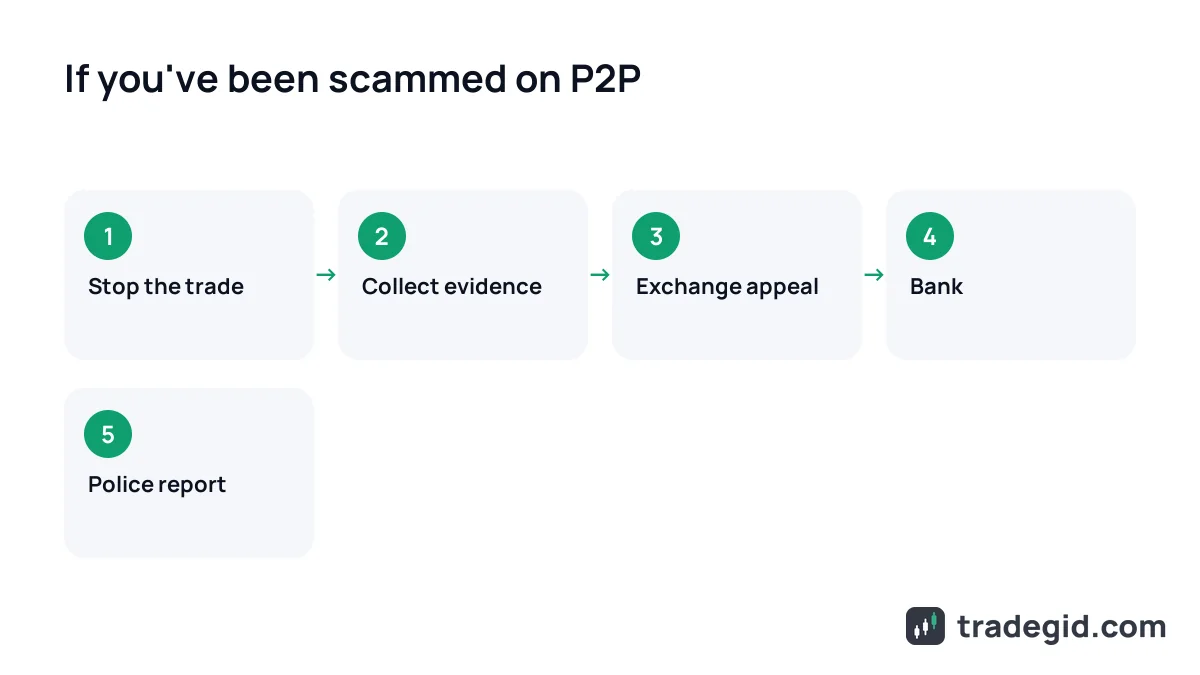
Move fast and in order. Bybit is honest about it: recovery isn't guaranteed, and off-platform trades are rarely recovered.
- StopNo more releases, no "top-up" payments, no links from the counterparty.
- Collect evidenceOrder number, counterparty username, bank statement, receipts, full chat screenshots including any messenger chats.
- Appeal on the order pageUpload everything uncropped. If the order is closed, contact support through the official chat.
- Call your bankIf you paid a scammer, ask for a recall. If your account was frozen, ask why and show your order history.
- Report to the policeIndia: helpline 1930 and cybercrime.gov.in. Nigeria: the NPF-NCCC e-reporting portal. Philippines: CICC hotline 1326.
An appeal in the first hours plus complete evidence is the only thing that genuinely improves your odds of getting money back or an account unfrozen.
| Where | When | What to attach |
|---|---|---|
| Exchange appeal | Immediately, while the order is open or just closed | Receipts, statement, full chat, order number |
| Your bank or e-wallet | You paid a scammer or your account was frozen | Transfer reference, order history, exchange statement |
| Police / cyber-crime unit | You lost money or coins, or were pulled into a triangle | All of the above plus counterparty details |
As of November 2026. Police contacts for India, Nigeria and the Philippines are in the steps above; elsewhere use your national cyber-crime channel.
Is P2P on Binance and other exchanges safe?
Safe enough if you follow the checks – escrow, merchant ratings and appeals exist only on large platforms, and the P2P trade is usually free for takers. Payment methods depend on your currency: UPI and IMPS for rupees, bank transfer and e-wallets elsewhere. Next: the P2P guide, how to withdraw USDT to a bank account and how to store crypto. We walk through real suspicious orders in the beginner webinar.
New accounts via the link: tasks worth up to 250 USDT; 25% off spot fees paid in MNT.
Sign up on BybitJ8NKMGNew accounts via the link are enrolled in the OKX New User Bonus program automatically.
Sign up on OKXK2FMEIJ3New accounts: a welcome package worth up to 135 USDT for tasks; lower fees paid in GT.
Sign up on GateUVRGV1FXNew accounts get up to 100 USD in trading-fee vouchers after KYC.
Sign up on Binance58328288