

Crypto Trading Bots: Grid, DCA, Martingale and What a Beginner Should Pick
A trading bot is an exchange feature that places and cancels orders for you by rules you set. For a beginner the clearest option is a spot grid bot: it works in a sideways market, with no leverage and no liquidation. The most dangerous is a futures martingale bot. A bot does not create income out of nothing: it earns from price swings and loses when the market trends.
Contents
I've been running bots on exchanges since 2021, mostly on BTC and ETH. One thing I learned: a bot does not replace understanding the market, it only automates the scenario you picked. If the scenario is wrong, the bot loses money just as faithfully as it makes it in the right one.
Types of trading bots and how they differ
Exchanges name their bots differently, but there are five families by logic. Here is what each one does and when it breaks.
New accounts via the link: tasks worth up to 250 USDT; 25% off spot fees paid in MNT.
Sign up on BybitJ8NKMGNew accounts get up to 100 USD in trading-fee vouchers after KYC.
Sign up on Binance5832828820% off spot fees paid in BGB; new-user rewards in the Reward Center.
Sign up on BitgetBGGAPKEJNew accounts: a welcome package worth up to 135 USDT for tasks; lower fees paid in GT.
Sign up on GateUVRGV1FXNew accounts via the link are enrolled in the OKX New User Bonus program automatically.
Sign up on OKXK2FMEIJ3| Bot | What it does | Works when | Loses when |
|---|---|---|---|
| Spot grid | Places limit orders in a ladder inside a range: buy lower, sell higher | Sideways market with noticeable swings | Price drops below the range: coins are bought on every level and held at a loss |
| Futures grid | The same ladder on perpetual contracts, Long, Short or Neutral mode, with leverage | Sideways market, if you understand margin | A trend against the mode: liquidation and funding |
| DCA (recurring buy) | Buys a fixed amount on a schedule | Long-term accumulation of an asset | A long bear market: you keep buying a falling asset, there is no built-in take profit |
| Martingale (DCA with multipliers) | Buys more as price falls, each add is larger, closes the cycle at take profit | A drop followed by a bounce | A prolonged fall: the deposit goes into adds, and on futures you get liquidated |
| Rebalancing | Keeps set shares of 2-10 coins, adjusts by deviation threshold or by time | A portfolio of several coins that move differently | The whole market falls: rebalancing does not protect from drawdowns |
| TWAP | Splits a large order into parts over a set period | A large order in a thin market | It is an execution tool, not a profit strategy |
Logic based on the help centers of Binance, Bybit, Bitget and Gate.
The word DCA means different things on different exchanges. On Bybit the DCA bot is a plain recurring buy of a fixed amount. On Binance, Spot DCA is effectively a martingale: adds when price deviates 0.1% to 15%, with multipliers. Read the parameter descriptions before launching, not just the name.
When bots work and when they lose money
A bot is math without emotion. It does not care whether the market is panicking or euphoric, it runs the scheme. That is both its strength and its weakness.
- Works: a sideways market, when price has been moving in a channel for months and you know the edges in advance.
- Works: scheduled accumulation (DCA), if you planned to buy the asset in parts anyway.
- Loses: a strong downtrend. Grid and martingale keep buying all the way down and pile up paper losses.
- Loses: price leaving the range. Above it the bot has sold everything and idles, below it holds coins at a loss.
- Loses: a grid that is too tight. The 0.1% fee on each side of a trade eats the profit per step.
- Loses: leverage inside a bot. Futures grid and martingale add liquidation and funding.
A bot earns from swings and suffers in trends. Before switching one on, decide what you expect from the market: a channel or a move.
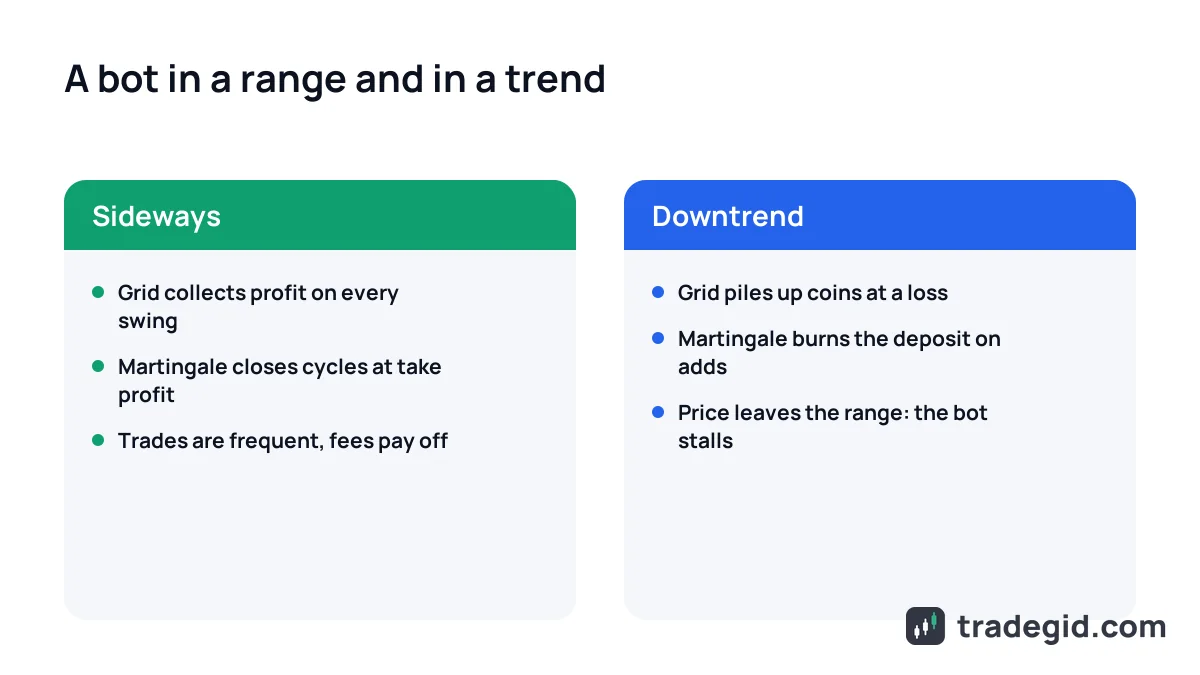
Grid bot: the beginner's foundation
A grid bot splits a price range into cells and places a pair of limit orders in each. Price drops one step, the bot buys; price rises one step, it sells. Each completed cycle leaves a small profit minus a double fee. The full breakdown, with a calculator and a simulator, is in the grid bot guide.
Each exchange has its own interface and its own limit on the number of grids. Step-by-step spot grid setup: Binance, Bybit, Bitget, Gate.
DCA and martingale: how much capital you really need
A martingale bot buys as price falls, and each next buy is larger than the last. That lowers the average price and lets the cycle close with a small gain after a shallow bounce. But the capital needed grows faster than it looks.
Take the default settings in the simulator below: a 20 USDT first order, five safety orders, a 2% step with a 1.2 multiplier, and each safety order 1.5 times bigger. The bot survives a drop of about 14.9%, and it needs roughly 284 USDT for that, 14 times the first order. To exit with 1.5% profit over the average price, you need a bounce of about 7.5% from the bottom. If price falls further, the money runs out.
The numbers in the simulator are arithmetic, not a forecast. The takeaway: the more aggressive the multiplier, the smaller the drop the bot can survive, and the higher the risk of ending up with a big position at a loss.
Bots on Binance, Bybit, Bitget and Gate
None of the four charges a separate fee for a bot: trades go through at regular trading fees. On spot that is 0.1% on Binance, Bybit, Bitget and Gate (details on the fee pages: Binance, Bybit, Bitget, Gate).
| Exchange | Spot grid | Other bots | Notes |
|---|---|---|---|
| Binance | 2-500 grids, arithmetic and geometric; up to 170 with Trailing Up | Futures Grid, Spot DCA, Futures DCA, Rebalancing, Funding Rate Arbitrage, TWAP, VP | Rebalancing: 2-10 coins, threshold 0.5-50% |
| Bybit | 2-200 grids, Trailing Up from 5 grids | Futures Grid (2-400 grids), DCA (up to 5 coins), Futures Martingale (up to 50x), Combo bots | MNT discount does not apply to bots. Up to 50 bots of each type |
| Bitget | Spot Grid and Spot Position Grid, RSI and BOLL triggers | Futures Grid, Spot and Futures Martingale (up to 5x), Smart Portfolio (up to 10 coins), TradingView signal bot, bot copy trading | Minimum amounts show in the bot form. Closed to residents of Russia, Belarus and Kazakhstan |
| Gate | 1-1000 grids, arithmetic and geometric | Infinite Grid, Futures Grid, Margin Grid, Spot and Futures Martingale, Smart Rebalance, arbitrage | Copying bots is free, 5% of profit goes to the author. India and the Philippines are on Gate's restricted list |
| OKX | Spot grid available, grid limits not checked | 11 bot types, including DCA, signal bot, smart portfolio, TWAP | Spot fee 0.08% / 0.10% |
Data for 03-08 Nov 2026 from exchange help centers. The bot set depends on your account region. Exchanges do not publish minimum amounts: they depend on the pair and the number of grids.
If you are still choosing an exchange, start with the reviews: Binance, Bybit, Bitget, Gate. Bonuses for all new users: Bybit – tasks with rewards up to 250 USDT; Binance – vouchers up to 100 USD for trading fees after KYC; Gate – a welcome pack up to 135 USDT for tasks. Check terms and deadlines in your account after you sign up.
We cover all 13 OKX bots separately, from spot grid to arbitrage: OKX trading bots, and the grid setup in the OKX spot grid guide.
Separate guides: signal bot and TradingView, arbitrage bot and funding rate arbitrage, TWAP and iceberg orders, and if you want to follow experienced traders – copy trading.
Two more popular types: the DCA and martingale bot and the futures grid – guides for Binance, Bybit, OKX, Bitget and Gate.
Which bot a beginner should pick
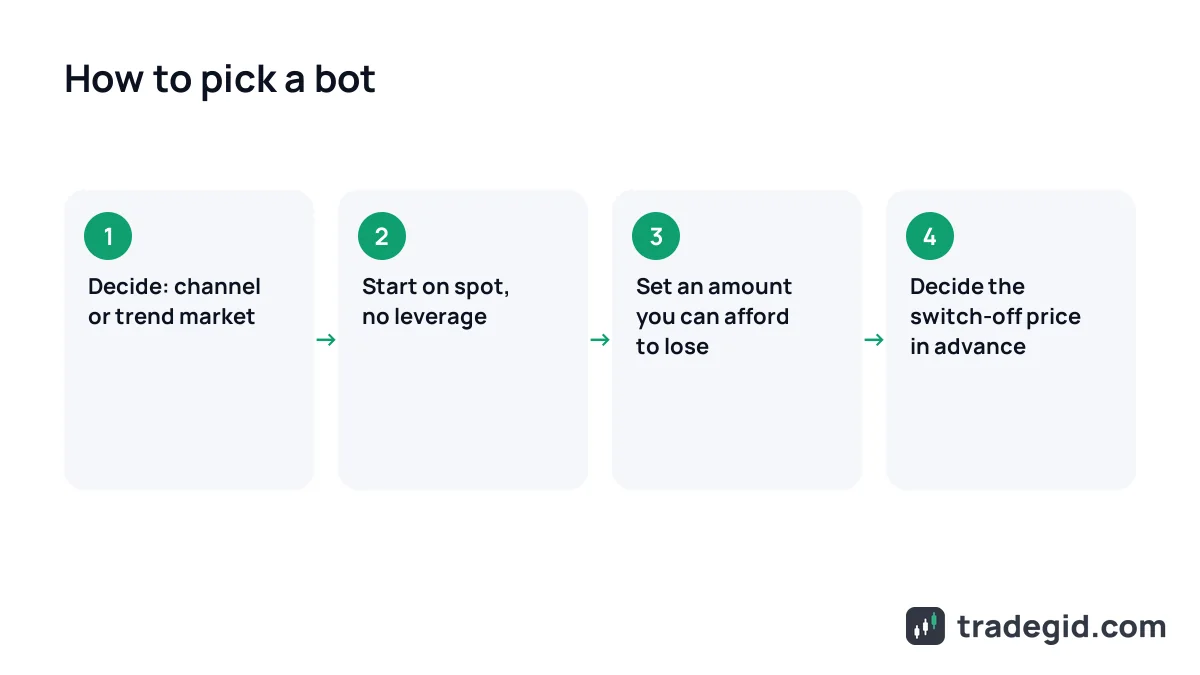
I would start with a spot grid on one liquid pair such as BTC/USDT, with a small amount you can afford to lose. Futures bots and martingale can wait until you understand the mechanics on spot. Compare the options by tab.
Risks of trading bots
- The app can show a positive Grid Profit while the overall result is negative because of unrealized loss.
- Cancelling a bot order by hand, or the exchange delisting the pair, ends the strategy.
- Copying other people's bots and AI parameters rely on past backtests, not a promise of future results.
- Taxes and the rules of your country remain your responsibility.
Watch Total P&L, not only Grid Profit, and decide in advance at what price you will switch the bot off.
New accounts via the link: tasks worth up to 250 USDT; 25% off spot fees paid in MNT.
Sign up on BybitJ8NKMGNew accounts get up to 100 USD in trading-fee vouchers after KYC.
Sign up on Binance5832828820% off spot fees paid in BGB; new-user rewards in the Reward Center.
Sign up on BitgetBGGAPKEJNew accounts: a welcome package worth up to 135 USDT for tasks; lower fees paid in GT.
Sign up on GateUVRGV1FXNew accounts via the link are enrolled in the OKX New User Bonus program automatically.
Sign up on OKXK2FMEIJ3In this section
- Grid botArithmetic vs geometric grid, range, number of grids, fees, a calculator and a simulator.
- DCA botRecurring buy vs martingale with safety orders, parameters, a capital simulator and risks on five exchanges.
- OKX bots13 OKX bots compared: market, settings, risks and what to pick as a beginner. Marketplace and copying.
- Signal botA TradingView alert becomes an order on the exchange: webhook, alert message, OKX setup and the risks.
- Arbitrage botFunding rate arbitrage in plain words: spot plus short perpetual, a worked example, one-click bots and risks.
- TWAP and icebergSlippage, the order book, iceberg and TWAP orders in plain words, with a diagram and OKX setup.