

Crypto arbitrage bot and funding rate arbitrage: how it works and what it really pays
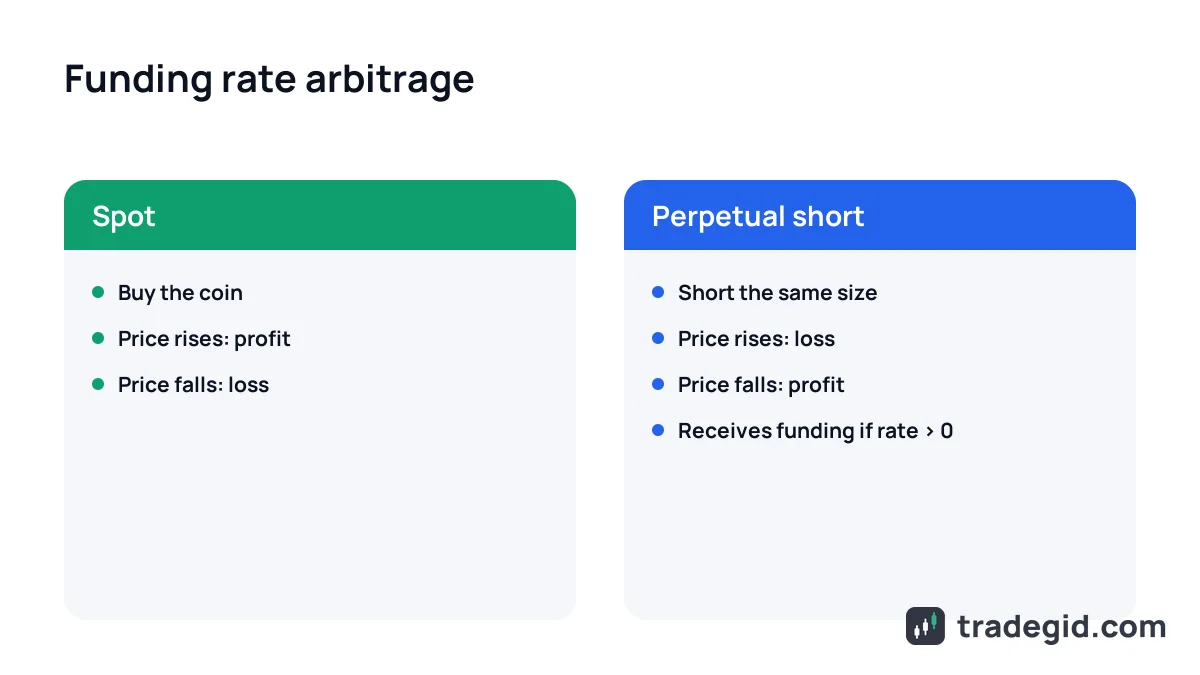
Funding rate arbitrage means holding a coin on spot and an equal short on the perpetual contract at the same time. Price moves cancel out, and you collect the funding payment while it is positive. Bots such as OKX Smart Arbitrage open both legs in one click. The income is small and not guaranteed: funding can turn negative, fees eat the first days, and the short leg can be liquidated in a sharp rally.
Contents
I run a small funding position when rates are healthy and close it when they fade. It is the closest thing in crypto to boring income, and that is exactly why it attracts exaggeration. Below is how it works with numbers, which parts a bot can automate, and where the money is actually lost.
Types of crypto arbitrage
"Arbitrage" covers several different things, and the risk differs a lot between them. The table sorts the main ones. The rest of this page is about the exchange-based ones; P2P is covered briefly at the end because it is a different business.
OKX has both Smart Arbitrage and Arbitrage bots. If your country is supported and you have no account yet, sign up through this link: the referral code is filled in for you and bots unlock after verification.
New accounts via the link are enrolled in the OKX New User Bonus program automatically.
Sign up on OKXK2FMEIJ3The code can only be entered during sign-up.
| Type | How it earns | Can a bot do it? | Main catch |
|---|---|---|---|
| Between exchanges | Buy where the price is lower, sell where it is higher | Only with fast own software and funds on both exchanges | Gaps close in seconds; fees, withdrawal time and slippage eat the spread |
| Spot and futures (basis, cash-and-carry) | Buy spot, short a dated future, collect the price gap at expiry | Yes, OKX Arbitrage bot has a spread mode | Capital is locked; the gap can widen before it narrows |
| Funding rate arbitrage | Spot long plus perpetual short, collect funding | Yes, in one click on OKX, Binance, Bybit | Funding can turn negative; short leg liquidation |
| P2P chains | Buy USDT at one price, sell at another via P2P | No, it is manual | Bank blocks, scams, tax questions |
My own classification, based on how exchanges describe their arbitrage tools. Check each product page for the current rules.
How funding rate arbitrage works
A perpetual contract has no expiry, so exchanges keep its price close to spot with a periodic payment between longs and shorts: the funding rate. When the rate is positive, longs pay shorts, usually every 8 hours on major exchanges. In a bull market the rate is often positive, because more people want to be long.
So you buy the coin on spot and open a short of the same size on the perpetual. If the price rises, the spot gains and the short loses about the same. If it falls, the reverse. What does not cancel is the funding that the short receives. That is the whole trade. It is called delta-neutral because your net exposure to the price is close to zero.
A worked example with made-up numbers
These numbers are hypothetical, chosen to be easy to follow. Say you buy 5,000 USDT of BTC on spot and open a 5,000 USDT short on the perpetual at 1x, so you tie up about 10,000 USDT in total. Funding is 0.01% per 8 hours on the 5,000 USDT position. Round-trip fees are about 0.3% of 5,000 USDT, which is 15 USDT: this is the level-1 retail fee on OKX (spot 0.1% each way, perpetual 0.05% each way), and your tier may differ.
| Scenario | Funding per 8 h | Funding in 30 days | After 15 USDT fees |
|---|---|---|---|
| Healthy positive funding | +0.01% | +45 USDT | +30 USDT |
| Weak funding | +0.005% | +22.5 USDT | +7.5 USDT |
| Funding near zero | 0% | 0 USDT | -15 USDT |
| Funding turns negative | -0.01% | -45 USDT | -60 USDT |
Conditional figures to show the mechanics, not a forecast. Real funding changes every period. Use your exchange's actual fee tier.
In the good scenario you earn 30 USDT net on about 10,000 USDT of capital in a month, which is 0.3%. It takes roughly ten days just to pay back the fees. In the bad scenario the same position loses. This is why I call it small and conditional income, not a salary. Try your own rate and size below.
Where to run it in one click
- OKX Smart Arbitrage. Buys the coin on spot and shorts the same size on the perpetual. Smart mode picks the strategy and manages take profit, stop loss and adjustments; Custom mode lets you choose the pair yourself.
- OKX Arbitrage bot. Two modes: spread arbitrage between two markets (for example spot and a future) and funding rate arbitrage, with cross or isolated margin.
- Binance Funding Rate Arbitrage Bot. Looks at the 3-day cumulative funding rate and opens a positive carry or reverse carry position. It needs Trading Bots to be activated, supports up to 10 strategies, and has liquidation risk if spot and futures diverge sharply.
- Bybit Arbitrage. Opens equal spot and perpetual orders in opposite directions, ranks pairs by funding rate and rebalances the legs. According to Bybit's help it is currently available only in Cross Margin mode in the app.
OKX, Binance and Bybit all have a ready tool for funding arbitrage, so you do not need your own code. Read the product page before launch, because minimums, supported pairs and margin modes differ and change.
I did not verify an equivalent product on Bitget or Gate, so I do not list them here. On OKX, funds sent to Smart Arbitrage are separated from your main trading account, so monitor that position separately. OKX also warns that stopping the strategy sells the coin at market price. The overview of all bots is in the OKX bots guide, and the other bot types are in the bots section.
Risks and why the income is small
- Funding changes sign. In a falling market shorts can start paying longs. You then pay to hold the position.
- Fees. Four trades (open and close both legs) cost around 0.3% at base tiers. A week of normal funding can go just on that.
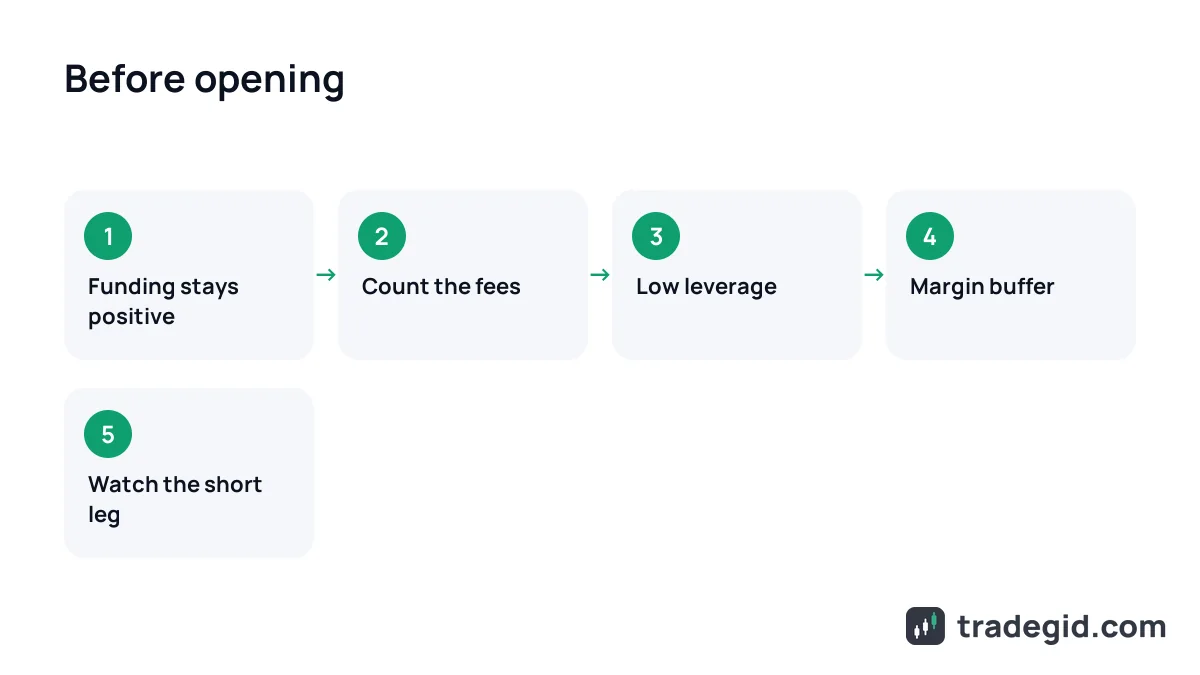
- Liquidation of the short. In a sharp rally the short loses on margin faster than the spot gains in your account. Keep the leverage low and a margin buffer. Check the price with the liquidation calculator.
- Basis change. The gap between spot and perpetual can widen between entry and exit and cost more than funding paid.
- Slippage and delay. Opening two legs in a thin market gives worse prices than the screen showed.
- Auto-deleveraging and delisting. In extreme volatility an exchange can reduce positions, and a delisted coin closes the strategy automatically.
Funding arbitrage is not risk-free: it swaps price risk for funding, margin and execution risk. Small size, low leverage and a margin buffer matter more than picking the highest funding rate.
P2P arbitrage and "chains": a short warning
P2P arbitrage means buying USDT from one person at one price and selling it to another at a higher price through the exchange's P2P market. It is manual work, not a bot, and it has little in common with the exchange arbitrage above. The spread is usually a fraction of a percent, and it is taken by bank fees, delays and the risk of a frozen card.
Around it there is a lot of noise: paid courses, "mentors", chats selling ready "chains" and offers to rent your card. Many are scams, and some schemes make you a link in a money-laundering chain. Banks can block accounts for transfers from third parties, and in many countries income from trading has to be reported. Read how P2P scams work and the P2P overview before the first deal.
New accounts via the link are enrolled in the OKX New User Bonus program automatically.
Sign up on OKXK2FMEIJ3New accounts get up to 100 USD in trading-fee vouchers after KYC.
Sign up on Binance58328288New accounts via the link: tasks worth up to 250 USDT; 25% off spot fees paid in MNT.
Sign up on BybitJ8NKMG