

Crypto Copy Trading: How It Works, How to Pick a Trader, What Can Go Wrong
Copy trading means the exchange automatically repeats a chosen trader's orders on your account in proportion to the amount you allocate. You pay normal trading fees and hand the trader 10 to 30% of your net profit, while the losses, liquidations on leverage included, are entirely yours. It can work, but most people lose money because they pick a trader by a flashy two-week return.
Contents
- How copy trading works on an exchange
- Copy trading on Binance, Bybit, OKX, Bitget and Gate
- How to choose a trader to copy
- What copy trading costs: a worked example
- The main risks of copy trading
- Is copy trading worth it or a scam?
- Which exchange suits a beginner
- Checklist: are you ready to copy a trader?
- Where to start
How copy trading works on an exchange
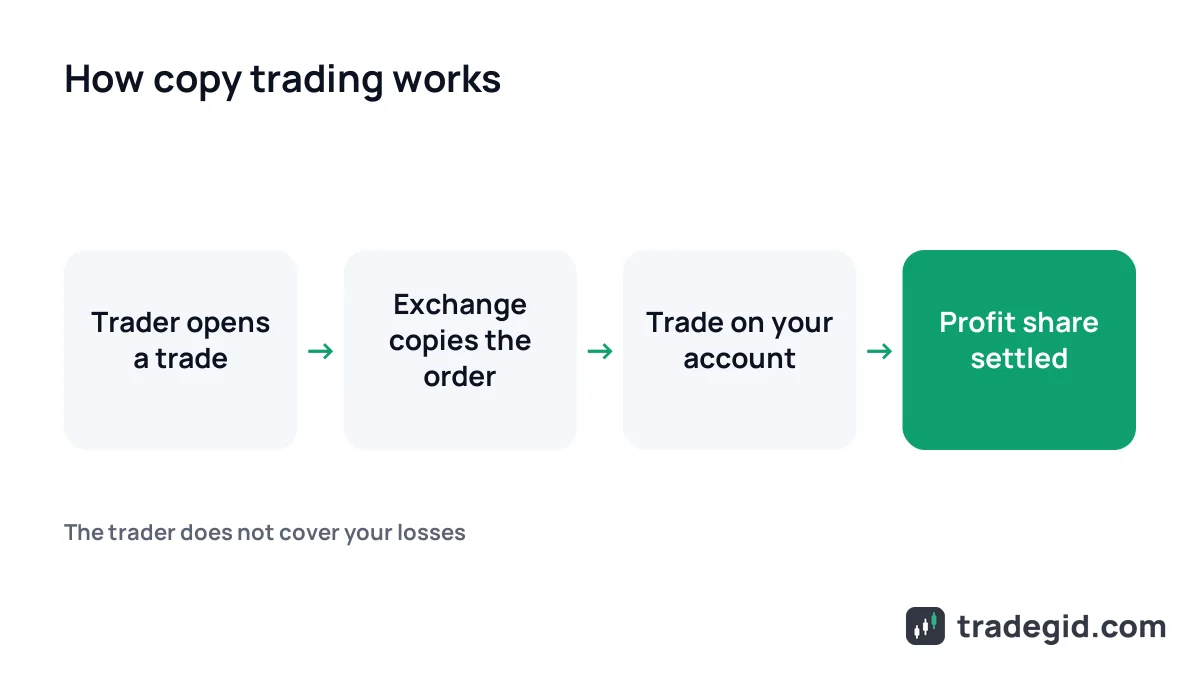
The scheme is the same on every major exchange. A trader (Bybit calls them a Master Trader, Bitget an Elite Trader, OKX and Binance a Lead Trader) opens a position on their own account. The exchange sends a copy of the order to every follower at once and sizes it from your settings: the same share of your balance the trader uses, or a fixed margin per order.
Only trades opened after you subscribe are copied. The trader's old positions do not move to you. Your money never goes to the trader: it stays on your own exchange account, and you get it back by stopping the copy.
- The exchange gets its usual trading fee on every copied trade. On futures it is charged on the full position, not on your margin.
- The trader gets a share of your net profit. If you are down for the settlement period, they get nothing.
- No subscription. Major exchanges do not charge for copying. If someone asks you to pay for "access to a trader", it is not exchange copy trading.
- Netting. On OKX the share is calculated on the weekly result after fees: wins and losses inside the period offset each other, and settlement waits until you have no open copied positions.
You pay twice: the exchange on every trade and the trader on profit. With frequent leveraged trading, fees can cost more than the trader's share.
New accounts via the link: tasks worth up to 250 USDT; 25% off spot fees paid in MNT.
Sign up on BybitJ8NKMGNew accounts via the link are enrolled in the OKX New User Bonus program automatically.
Sign up on OKXK2FMEIJ3New accounts get up to 100 USD in trading-fee vouchers after KYC.
Sign up on Binance58328288New accounts: a welcome package worth up to 135 USDT for tasks; lower fees paid in GT.
Sign up on GateUVRGV1FXCopy trading is not offered everywhere. Each exchange publishes its own restricted-country list, and the product can be switched off for your residence even when the exchange itself works. Binance has also closed copy trading for EU users since 2024, so if you live in the EU check the European version of each exchange first.
Copy trading on Binance, Bybit, OKX, Bitget and Gate
Terms differ a lot. Some exchanges copy futures only, some have spot, and the trader's cut is either tied to their level or set by the trader. Here is what the exchanges' own help pages confirm.
| Exchange | What you can copy | Minimum | Trader's share | Settlement |
|---|---|---|---|---|
| Binance | USDⓈ-M futures and spot | Futures from 10 USDT; spot 10 or 100 USDT depending on mode | Futures up to 30%, spot 10% | Spot weekly |
| Bybit | Classic – USDT perpetuals; Pro – closed product with subscription windows | Shown in the copy form | Classic 10–15% by master level, Pro 0–30% | Weekly, Monday 03:00 UTC |
| OKX | Futures and spot | Futures from 10 USDT per order; spot depends on the coin | Up to 30%, depends on trader level | Weekly, Monday 00:00 (UTC+8) |
| Bitget | Futures and spot; grid bot copying is separate | Shown at confirmation | 10–20% by trader level | Per exchange rules, see help page |
| Gate | Futures; some traders offer spot | Set by the trader, from 10 USDT | Trader sets it within their level | Every 7 days |
Data as of November 2026 from the exchanges' help pages: Binance Futures, Binance spot, Bybit, OKX, Bitget, Gate. A specific trader's share and minimum are shown on their profile.
| Country | Binance | Bybit | OKX | Bitget | Gate |
|---|---|---|---|---|---|
| India | Available | Available | Restricted | New sign-ups paused | Not available |
| Nigeria | Limited | Available | Reported back; check P2P | Available | Check in the app |
| Philippines | Blocked | Blocked | Regulator warning | Regulator warning | Not available |
Access and the copy trading tab are two separate questions: confirm both in the app for your country of residence after sign-up. Details are in each exchange review.
Step by step for each exchange: copy trading on Bybit, Bitget, Binance, OKX and Gate. They cover settings, fees and how to stop copying.
How to choose a trader to copy
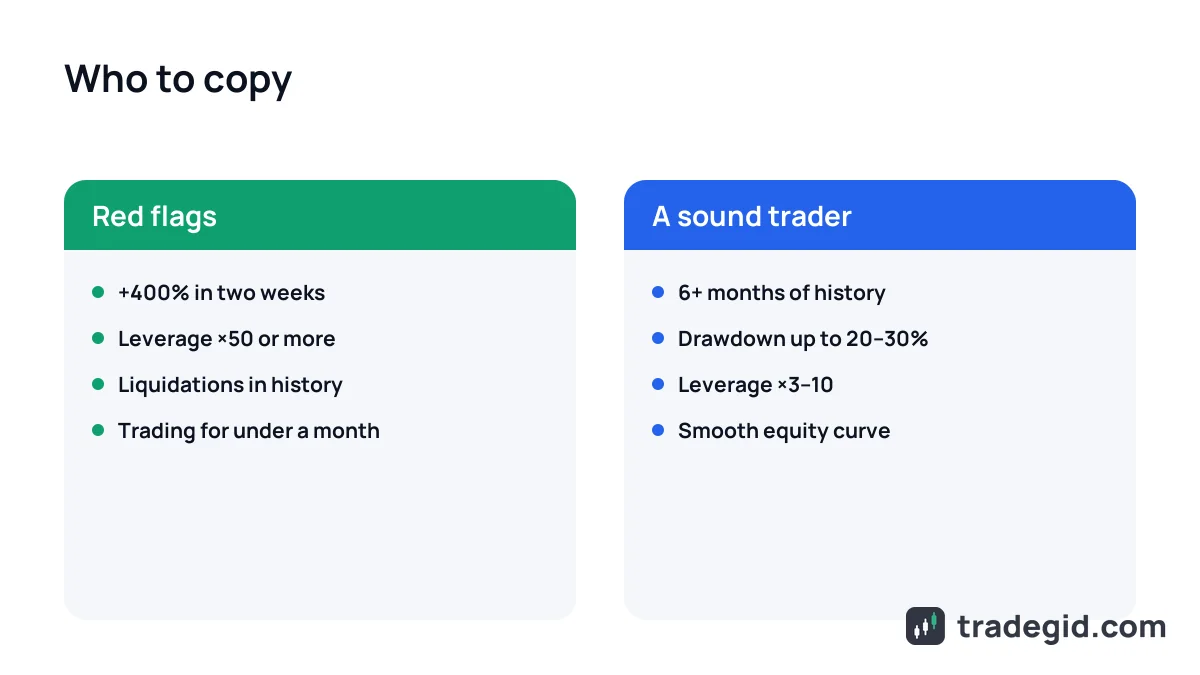
Every exchange sorts its trader ranking by return by default, and that is the trap. The top is almost always someone who caught one lucky move on heavy leverage over a couple of weeks. This is the order in which I read a profile:
- Track record – at least six months on this exchange. The trader should have lived through at least one serious market correction.
- Maximum drawdown. If it was 60% once, it will happen again; the only question is whether you can sit through it with real money.
- Average leverage and liquidations in the trade history. A couple of liquidations in six months is a reason to walk away.
- The equity curve. Steady growth beats a single jump: if all the profit came from one trade, that is luck, not a system.
- Win rate without context means little. A 95% win rate often means the trader skips stops and averages down on losers.
- Assets under management (AUM) and follower count. A huge pool means more slippage for followers who enter after the trader. A tiny one means little proof that the strategy works.
- Profit share. The gap between 10% and 30% adds up over time, especially on modest returns.
Look at track record, drawdown and leverage, not at last week's ROI. A trader who grows slowly for six months with no liquidations is safer than a ranking star.
What copy trading costs: a worked example
Say you allocate 1,000 USDT to a futures trader with a 15% share. In a week the positions make 130 USDT and fees on entry and exit come to 30 USDT, a normal figure for an active trader at ×10. Net profit is 100 USDT, the trader gets 15 USDT and you keep 85. The numbers are illustrative, not a forecast.
The next week closes at minus 60 USDT. The trader gets nothing, but does not cover the loss either. Each exchange handles carried-over losses its own way, so read the settlement rules in that exchange's help page.
The main risks of copy trading
- Leverage and liquidation. Your position can be liquidated before the trader's: they have more margin on the account, you have only the amount you allocated. Bybit says so in its help centre.
- Slippage and missed trades. You enter slightly after the trader at a worse price, and if the price moves past the allowed deviation the trade is not copied at all. On OKX spot, for example, your buy price cannot differ from the trader's by more than 0.5%.
- Style drift. A trader with a good record hits a losing streak, starts chasing it with bigger leverage and wipes out followers.
- Exchange risk. Funds sit on a centralised exchange, not in your own wallet. Do not keep a large sum there with or without copy trading.
- Country restrictions. Access rules change: in October 2026 Bitget closed to Russia, Belarus and Kazakhstan and affected users had to stop copying in a hurry.
Copy trading does not remove risk, it hands decisions to someone else. A stop loss on the whole copy and a small allocation are the only protection that is up to you.
Is copy trading worth it or a scam?
The mechanism on major exchanges is real: trades are copied and trader history is visible. The scams are third-party "copy services" in messengers that ask you to send funds to someone else's wallet, and paid channels selling "signals from a top trader". Reddit threads praising a specific trader are not evidence either.
MEXC, BingX, KuCoin and WhiteBIT also offer copy trading, but we do not review them here. The rules for choosing a trader and the risks on this page apply there too.
Which exchange suits a beginner
Start with what your country allows. If spot is clearer to you than futures, look at spot copy trading: there is no leverage and no liquidation, though you can still lose money. For platform details see the reviews of Bybit, OKX, Binance, Bitget and Gate. If you are new to exchanges entirely, a small P2P purchase of USDT is the usual way in.
Checklist: are you ready to copy a trader?
Where to start
Start with the minimum amount and one trader who passes the track-record and drawdown filter. After a month compare your actual result with their chart: the gap from slippage and fees tells you a lot. Before that, it helps to understand leverage and liquidation, and if you prefer automation by your own rules, look at trading bots.
New accounts via the link: tasks worth up to 250 USDT; 25% off spot fees paid in MNT.
Sign up on BybitJ8NKMGNew accounts via the link are enrolled in the OKX New User Bonus program automatically.
Sign up on OKXK2FMEIJ3New accounts get up to 100 USD in trading-fee vouchers after KYC.
Sign up on Binance58328288New accounts: a welcome package worth up to 135 USDT for tasks; lower fees paid in GT.
Sign up on GateUVRGV1FXIn this section
- BinanceWhere to find Copy Trading on Binance, the minimum, what the lead trader takes, which countries work and how to stop copying.
- BybitWhere to find Copy Trading on Bybit, the minimum amount, what the master trader takes, and how to stop copying and withdraw.
- BitgetWhere to find copy trading on Bitget, the minimum amount, how much the lead trader keeps and how to stop copying.
- OKXWhere to find OKX copy trading, how much you need, what the lead trader takes and how to stop copying.
- GateWhere to find copy trading on Gate, which settings you control, how profit sharing works and how to stop copying.