

OKX Futures Grid Bot: Setup, Leverage and Liquidation Explained
You create an OKX futures grid bot at Trade > Trading bots > Futures grid: pick a contract and the Manual mode, set the direction, range, number of grids, leverage and amount, then start the bot. There is no separate bot fee, and when the price leaves the range the open position stays exposed to liquidation. Below are the steps, the math in numbers and why 2-3x leverage is enough for a beginner.
Contents
- How a futures grid works and why it is riskier than a spot grid
- Steps 1-3: sign-up, KYC and USDT in the futures wallet
- How to create a futures grid on OKX: web and app
- Long, short or neutral: which mode to pick
- Grid parameters: what they do and what a beginner should set
- Liquidation: why 2-3x leverage is enough for a beginner
- Profit per grid: a worked example
- OKX futures grid fees and funding
- For new users
- Common beginner mistakes
- Other exchanges and bots
The futures grid bot needs an OKX account. Signing up through this link opens the form with the referral code filled in, and bots unlock after verification.
New accounts via the link are enrolled in the OKX New User Bonus program automatically.
Sign up on OKXK2FMEIJ3The code can only be entered during sign-up.
How a futures grid works and why it is riskier than a spot grid
A futures grid splits the range between a lower and an upper price into grid levels and places limit orders on a perpetual contract. In long mode the bot buys dips and sells bounces, in short mode it does the opposite. The money works with leverage, so each trade pair earns more than on spot, but you get something spot does not have: a liquidation price.
On spot, a price below the range gives you a paper loss on a coin you can simply hold. On futures the position sits on margin: if the price moves far enough against it, the exchange closes the position by force and the bot's margin is gone. The worst case is losing the whole amount you put into the bot. The general idea of the grid is in the grid bot guide for beginners.
Steps 1-3: sign-up, KYC and USDT in the futures wallet
- Sign up through the referral linkSign up on OKX: pick your country of residence, enter your email or phone, check that the referral code is filled in, confirm the code and set a password. Details: the registration guide.
- Verification (KYC)In your profile open Verification > Individual account, enter your details, photograph your document and pass the face check. Enter your real country, it must match your documents. Then turn on 2FA under Security.
- Fund the trading account with USDTAssets > Deposit, pick USDT and the network: the network on the sender and receiver side must match. Make the first transfer a test one. If your USDT sits in another account, move it to the trading account with the Transfer button: the bot takes its margin from there.
You need an account, a finished KYC and USDT in the wallet the bot takes margin from, otherwise the create button will not work.
How to create a futures grid on OKX: web and app
The path on the web is Trade > Trading bots > Futures grid, and the app has the same route. You can create a bot two ways: intelligent creation (OKX fills in parameters from market history) or manual creation, which has a "Fill in Recommended Parameters" button. Names come from the OKX help pages; the form shows the exact limits for grids and leverage.
Long, short or neutral: which mode to pick
| Mode | What the bot does | When it fits | Main risk |
|---|---|---|---|
| Long | Buys below the current price, sells above; holds only long positions | Sideways market or slow rise | A drop below the range: paper loss and liquidation |
| Short | Sells above the price, buys back below; holds only short positions | Sideways market or slow decline | A rise above the range: the short gets liquidated |
| Neutral | Orders both above and below the current price; the bot can hold both long and short | A clear range with no direction | A sharp move either way, plus funding |
Mode names and logic follow the exchange help pages. The columns "When it fits" and "Main risk" are my own notes, not exchange rules.
A beginner is better off starting with a long grid on BTC or ETH: there is one danger, a drop, and you can see it on the chart. Neutral mode looks universal, but it can be liquidated on both sides, and positions in opposite directions pay and receive funding. More on directions: long and short, and on funding: the funding rate.
Grid parameters: what they do and what a beginner should set
| Parameter | What it does | What a beginner should set |
|---|---|---|
| Contract | A perpetual future, for example BTC-USDT | BTC or ETH |
| Long / Short / Neutral | Bot direction | Long for the first runs |
| Lower and upper price | Levels where the bot trades | Sideways range of the last 2-3 weeks with a 3-5% buffer |
| Number of grids | How many orders in the range; the form shows the limit | 10-30 |
| Leverage | Leverage, the maximum depends on the contract | 2-3x |
| Amount (Investment) | The bot's margin in USDT | 5-10% of the deposit |
| Automatically reserve margin | Part of the funds stays as a buffer against liquidation | Leave on |
| Open position on creation | Open a position right away (on by default) | Turn off if you do not want a market entry |
| TP / SL | Close by last traded price or by PnL | SL just below the range and above the liquidation price |
| Trailing up / down | Shifts the grid with the price, with a maximum number of shifts | Turn off |
Source: the OKX help pages on the futures grid bot. The column "What a beginner should set" is my own experience, not exchange rules. OKX does not publish the maximum grids and leverage in its help pages, so take them from the bot form.
Liquidation: why 2-3x leverage is enough for a beginner
The liquidation price is the level where the position's margin stops covering the loss and the exchange closes the position by force. The higher the leverage, the closer that price sits to your entry. A rough estimate for a long: entry price minus margin divided by position size in coins. The real price is a bit closer to entry, because the exchange takes maintenance margin, fees and funding into account.
Take a coin at 100 USDT, a long grid of 90-110 and 1,000 USDT of margin. We count the worst case: the grid has already bought the whole position around 100. Here is what different leverage does:
| Leverage | Position size | Price drop to liquidation | Liquidation price (rough) |
|---|---|---|---|
| 2x | 2,000 USDT | about 50% | about 50 |
| 3x | 3,000 USDT | about 33% | about 67 |
| 5x | 5,000 USDT | about 20% | about 80 |
| 10x | 10,000 USDT | about 10% | about 90 |
| 20x | 20,000 USDT | about 5% | about 95 |
A teaching estimate without maintenance margin, fees and funding: on the exchange, liquidation comes a little earlier. Check your own price in the bot form and in the liquidation calculator.
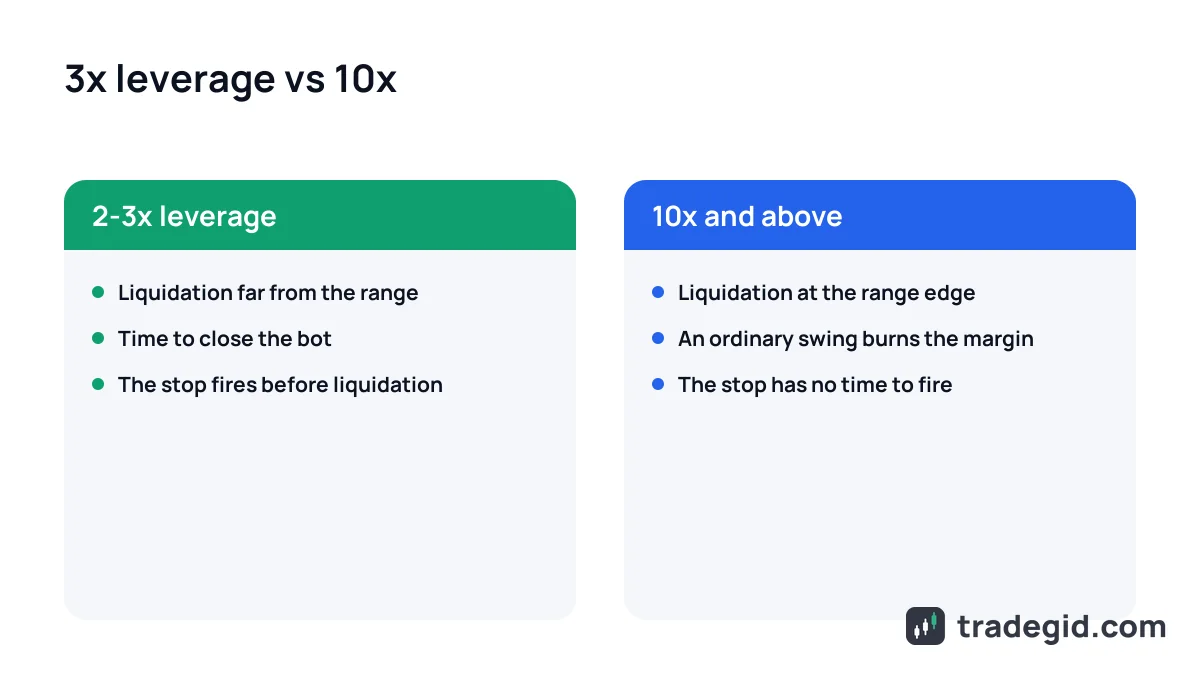
At 10x, liquidation sits at the lower edge of the 90 range: a move out of the grid downward burns the bot almost at once. At 20x it is inside the range, and the bot will not even live to its own stop-loss. At 3x the price has to fall by a third, so you have time to close the bot by hand. The general principles are in the guides on liquidation and leverage.
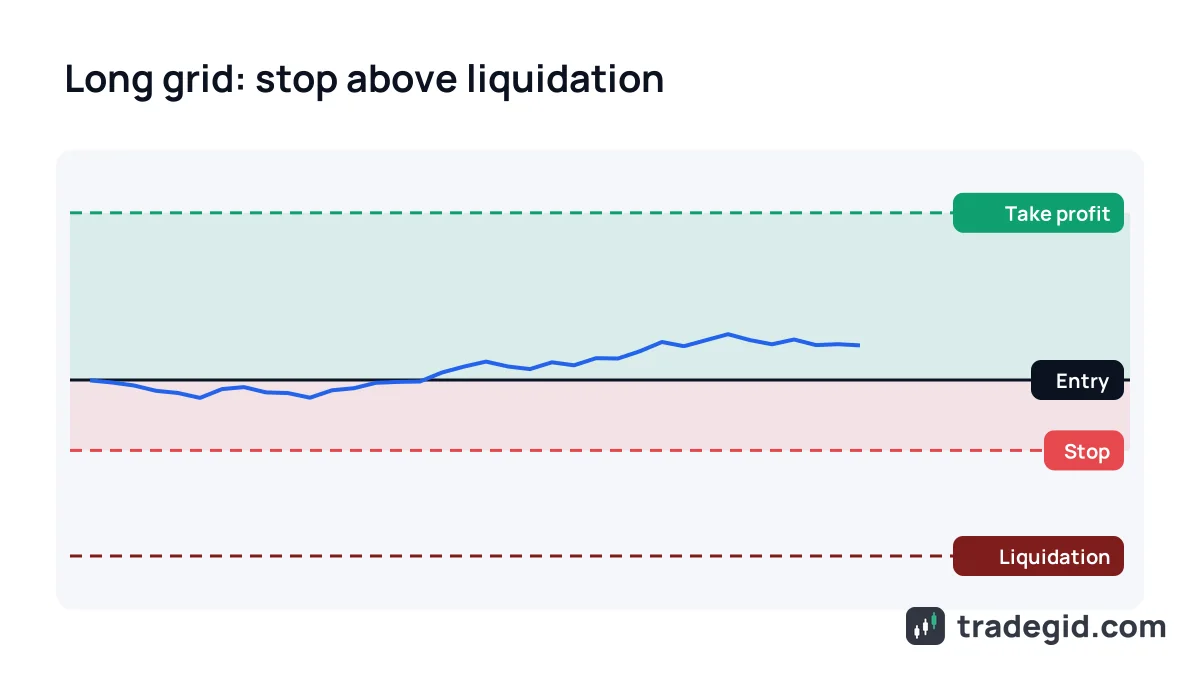
A worked example: 3x leverage, a position of up to 3,000 USDT, margin of 1,000 USDT. The price falls from 100 to 90, that is 10%: a paper loss of about 300 USDT, or 30% of margin. A stop-loss at 88 closes the bot with a loss of about 360 USDT (36% of margin): painful, but 640 USDT is left. Without a stop, and with a fall to around 67, the bot gets liquidated and you lose about 1,000 USDT.
OKX shows an Est. Liquidation Price, which is an estimate: it changes with reserved margin, added margin and pending orders. If the price leaves the range, the bot stops working, and the open position keeps a floating loss and liquidation risk. That is why OKX advises setting a reasonable stop-loss.
- Use 2-3x leverage: liquidation needs a drop of a third or more, while at 10x and above the liquidation price is at the lower edge of the range.
- Put the stop-loss just below the range and always above the liquidation price, so the stop fires before the forced close.
- Put no more than 5-10% of your deposit into one bot: even a total loss of its margin does not wreck the account.
- Re-check the liquidation price after every change of leverage, range or margin, not only at creation.
- Do not add margin to a falling bot "to push liquidation away": that grows the loss instead of saving the position.
My order: 2-3x leverage, stop above liquidation, a small share of the deposit. If the liquidation price sits at the edge of the range, the leverage is too high.
Profit per grid: a worked example
Range 90-110, 20 grids, 1,000 USDT of margin and 3x leverage: the bot holds up to 3,000 USDT of position. The step is 1 USDT, about 1%, and each order is 150 USDT of position. A buy-sell pair earns about 1.5 USDT before fees.
The bot's limit orders pay a maker fee of 0.02% on each side, about 0.06 USDT per pair. That leaves about 1.4 USDT per grid while the price moves inside the range. If a stop hits at market, the fee is a taker fee, and funding is added or subtracted separately. Change the numbers in the calculator.
OKX futures grid fees and funding
OKX charges no separate fee for the bot: futures fees apply, and the grid's limit orders go at the maker rate. The taker rate applies in fast moves and on a stop, and rates depend on your VIP level. Funding is included in Unpaired PnL.
| Item | Rate | Comment |
|---|---|---|
| Bot subscription | 0 | Free |
| Futures, maker | 0.02% | The grid's limit orders |
| Futures, taker | 0.05% | Fast move, stop at market |
| Forced liquidation | At the taker rate | The rate of your tier, on top of losing the margin |
| Funding | Floating | Rate x position size, included in Unpaired PnL |
| Per-order fees | Visible per order | Details > History; there is no total fee summary |
Data for November 2026, the global okx.com platform, see OKX fees. A VIP downgrade can make a grid unprofitable. OKX Europe has different rates.
For new users
As the exchange itself puts it: rewards for all new users. OKX runs a new-user bonus program with tasks. Amounts and conditions depend on your country and change, so check them in your account after you sign in.
- New accounts that sign up through a referral link join the new-user rewards program: tasks such as a deposit and a first trade. Look under My rewards and the Campaign center.
- In the My vouchers tab of the trading bots section you will see vouchers if any were issued to you.
- For tasks, funding with a USDT transfer from another wallet or exchange is simplest: an external transfer counts, an internal one does not.
There is no fixed "everyone gets N dollars" bonus: the task list shows only in your own account. Do not take more risk than planned for a reward.
If you do not have an OKX account yet, sign up through the link, finish KYC and start with a small amount and 2-3x leverage.
New accounts via the link are enrolled in the OKX New User Bonus program automatically.
Sign up on OKXK2FMEIJ3The code can only be entered during sign-up.
Common beginner mistakes
- 10x or more leverage "to go faster". Liquidation lands at the edge of the range, and an ordinary swing burns the bot.
- No stop-loss. Without one the bot keeps piling up a losing position until liquidation.
- A range that is too narrow. The price leaves it in a couple of days, the bot stops and the position stays open.
- A long in a clear downtrend, a short in an uptrend. A grid earns on swings, not on a move against you.
- Too many grids on a small margin. The order falls below the exchange minimum or the step is smaller than the fee: the bot does not start or earns nothing.
- Forgetting funding. In a long with a positive rate you pay every few hours, and a week adds up to a noticeable sum.
- Launching and not looking. The bot does not move its own range: check it at least once a day.
Almost all losses on a futures grid come from leverage, a missing stop and a forgotten bot, not from a "bad strategy".
Other exchanges and bots
The grid principle and the risks are covered in the general guide: grid bot for beginners. The spot version with no liquidation is in the OKX spot grid manual, the exchange's other bots are in the OKX bots overview, and for other exchanges there are Binance and Bybit.
New accounts via the link are enrolled in the OKX New User Bonus program automatically.
Sign up on OKXK2FMEIJ3New accounts get up to 100 USD in trading-fee vouchers after KYC.
Sign up on Binance58328288New accounts via the link: tasks worth up to 250 USDT; 25% off spot fees paid in MNT.
Sign up on BybitJ8NKMG