

OKX trading bots: all 13 bots, their risks and who each one is for
OKX has 13 trading bots: spot and futures grid, two DCA bots, recurring buy, signal bot, smart portfolio, long-short portfolio, smart arbitrage, pendulum, arbitrage, iceberg and TWAP. A beginner only needs two of them: the spot grid bot and recurring buy. The rest involve leverage or advanced order logic. Bots carry no separate fee, you pay normal trading fees.
Contents
- All 13 OKX bots: market, risk and beginner fit
- How to pick a bot for the market you have
- Grid bots: spot and futures
- DCA bots and recurring buy
- Portfolio bots and arbitrage
- Signal bot with TradingView, TWAP and iceberg
- Bot marketplace and copying
- Fees and the link with OKX Earn
- Which bot a beginner should take
- OKX bot risks: where money gets lost
I have run grid bots on OKX since 2021, mostly on BTC and ETH in sideways markets. A bot does not predict anything: it places limit orders in a ladder and collects the difference between them. If you know when that works and when it does not, it is a useful tool. If you do not, the bot will calmly buy the coin all the way down.
All 13 OKX bots: market, risk and beginner fit
Every bot sits under Trade → Trading bots on the website. The page has tabs for Overview, My vouchers, Dashboard and Lead trader, then sections for popular bots, copy trading, TradFi, the Bot marketplace and the Signal marketplace. Filters at the top group bots by market view: bullish, bearish, range-bound and sideways.
| Bot | Market | Main risk | Beginner? |
|---|---|---|---|
| Spot grid bot | Spot, no leverage | Downtrend: you end up holding a coin at a loss | Yes, first bot |
| Futures grid bot | Perpetual futures, leverage | Liquidation of the bot's margin | No |
| Futures DCA bot | Futures, leverage | Growing order size and liquidation | No |
| Spot DCA bot | Spot | Buying more through a long decline | With caution |
| Recurring buy | Spot | Ordinary price risk of the coin | Yes |
| Signal bot | Depends on setup | A bad strategy loses without emotion | No |
| Smart portfolio | Spot | Whole-portfolio drawdown, rebalancing fees | Yes, after you hold |
| Long-short portfolio with auto-rebalancing | Long and short positions (derivatives) | Leverage and bad pair selection | No |
| Smart arbitrage | Spot + perpetual contract | Funding turns negative, short-leg risk | No |
| Pendulum | Two currencies | No reversal comes, position stays red | No |
| Arbitrage | Spot, perpetual, futures | Leverage and price gaps | No |
| Iceberg | Execution of large orders | Slippage in thin markets | Not needed |
| TWAP bot | Execution over time | Price drifts while the bot slices the order | Not needed |
Data for November 2026 from okx.com/trading-bot and the OKX help article on trading bots. Which bots you see depends on your region. The Risk and Beginner columns are my own view, not OKX advice.
From that list a beginner needs two bots: the spot grid for sideways markets and recurring buy for people who simply stack BTC on a schedule. I would leave futures bots alone until you have opened at least ten trades by hand with leverage.
If your country is supported and you do not have an OKX account yet, sign up through this link: the referral code is filled in for you and bots unlock after verification.
New accounts via the link are enrolled in the OKX New User Bonus program automatically.
Sign up on OKXK2FMEIJ3The code can only be entered during sign-up.
How to pick a bot for the market you have
Grid bots: spot and futures
Spot grid bot
What it does. Splits a price range into grids and places limit orders: buys below the price, sells above. Market. Spot, no leverage, best in a sideways market. Settings. Lower and upper price, grid count (up to 1,000), arithmetic or geometric spacing, investment, stop-loss and take-profit, trailing up/down, and Smart Earn Allocation for idle funds. Risks. Price falls and you hold a coin at a loss; price rises and you miss the move. Who it is for. The first bot for a beginner. The step-by-step setup is in the OKX spot grid guide.
Futures grid bot
What it does. The same ladder on perpetual contracts. Market. Futures with leverage, with a variant that uses crypto as margin. Settings. Long, short or neutral mode, range and grid count (editable while running), leverage. Risks. Leverage amplifies gains and losses, and a sharp move can wipe the bot's whole margin. Who it is for. People who understand liquidation. Check the estimated liquidation price in the liquidation calculator before you start. I keep grids at 2-3x at most.
DCA bots and recurring buy
The martingale logic is simple. The bot opens a first position, adds safety orders every time price drops by a set step, often with a volume multiplier, and closes the cycle at take-profit. The danger is that size grows faster than it feels. Try it on the simulator: change the multiplier and the number of safety orders and see how much capital is needed and how deep a drop it survives.
Spot DCA bot
What it does. Buys an asset in steps and sells at take-profit. Market. Spot. Settings. Entry by a technical indicator, size of the first and safety orders, step between orders, take-profit, optional continuous cycles. Risks. A long decline: money goes into safety orders and the bounce to take-profit may never come. Who it is for. People who want to hold the coin anyway and can sit through a drawdown. I would cap the multiplier.
Futures DCA bot
What it does. Averages a position on futures, with long and short able to run at the same time. Market. Perpetual contracts with leverage. Settings. Direction, leverage, volume multiplier, step, take-profit. Risks. Martingale plus leverage: liquidation arrives before the last safety order. Who it is for. Experienced traders. I do not recommend it to beginners.
Recurring buy
What it does. Buys up to 20 coins on a schedule and averages your entry. Market. Spot. Settings. Interval, coins and amounts, funding from your USDT balance or a card. Risks. It does not protect you from the coin falling, it only removes the urge to time the entry. Who it is for. Long-term BTC and ETH accumulators.
Portfolio bots and arbitrage
Smart portfolio
What it does. Holds target weights across up to 10 coins and pulls them back: sells what grew, buys what lagged. Market. Spot. Settings. Target weights, rebalancing on a schedule or when a weight drifts past a threshold. Risks. If the whole market falls, the whole portfolio falls, and every rebalance costs fees. Who it is for. People who already hold a basket of several coins.
Long-short portfolio with auto-rebalancing
What it does. A new bot that builds a basket of long and short positions and rebalances it on its own. Market. Derivatives, so leverage and liquidation apply. Settings and limits. OKX keeps updating the description, so read the bot card and the help article before launch. Risks. Bad pair selection, leverage, funding. Who it is for. Experienced traders who have shorted before.
Smart arbitrage and arbitrage
What they do. Hold offsetting positions: the coin on spot and a short on the perpetual. Income comes mostly from funding, and the coin's price is neutralised. Market. Spot and perpetuals (arbitrage adds expiry futures, with funding-rate and spread modes). Settings. Smart arbitrage has a Smart mode where the system picks, and a Custom mode where you do. Risks. Funding can turn negative, and the short leg can be liquidated in a sharp rally. Who they are for. People who understand funding. Rarely a first bot.
Pendulum
What it does. According to OKX it trades reversals in two currencies at once. Market. Choppy or sideways. Risks. If the reversal never comes, both legs stay at a loss. Who it is for. Experienced users. A regular spot grid is easier to understand, and the pendulum parameters are shown on the bot card.
Signal bot with TradingView, TWAP and iceberg
Signal bot and TradingView
The signal bot executes signals: your own TradingView alerts or signals from providers. The flow: create a signal in OKX and copy the webhook URL and message template, paste them into a TradingView alert, then create the bot with a pair, leverage and margin. Webhooks need a paid TradingView plan. See the TradingView plans and the TradingView overview on this site. The bot only executes: a losing strategy stays a losing strategy.
TWAP bot and iceberg
These are execution tools, not strategies. TWAP spreads a trade over a set time so it does not move the price. Iceberg slices a large order into pieces with a slippage tolerance and a variable or ratio slice size. If you trade a few thousand dollars you do not need them. They matter to someone whose own order moves a thin market.
Bot marketplace and copying
The Bot marketplace lists ready-made strategies from other users. Each card shows an Estimated APR, assets under management (AUM) and the number of followers. You will also find grid bots on tokenized stocks (the kind people search for as okx_stocks_bot), metals and pre-IPO assets. Copy trading sections copy a trader's deals, not a bot.
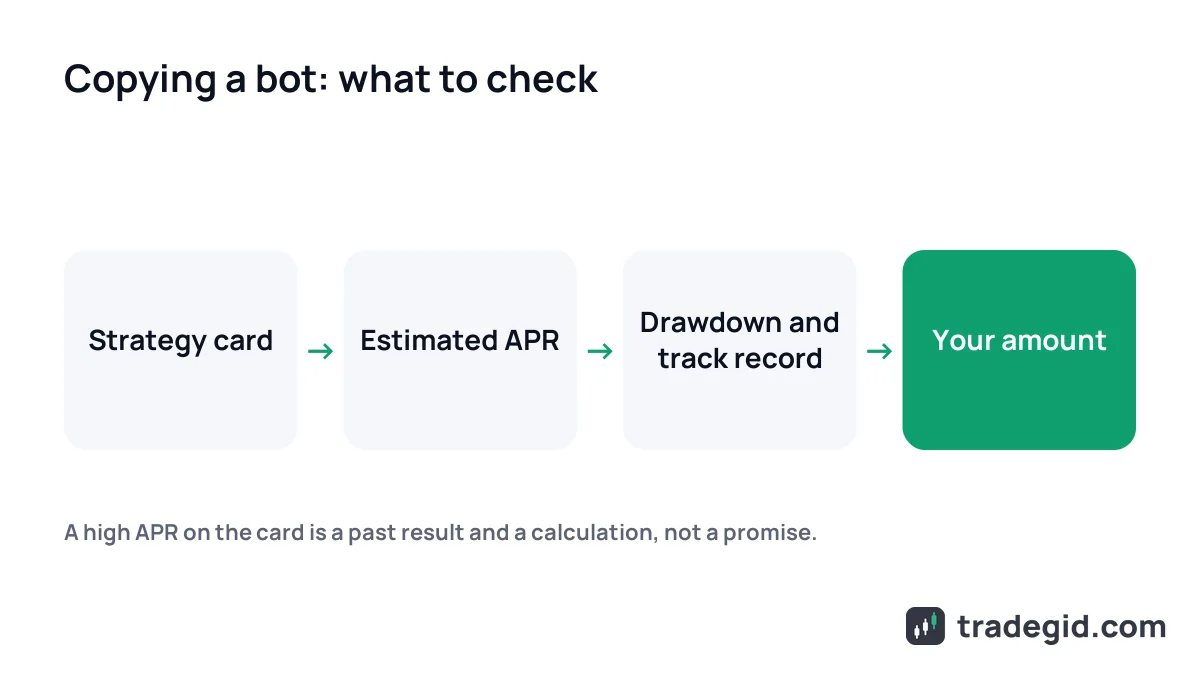
- Estimated APR is calculated from past data and backtests. For some strategies it runs into the hundreds of percent, which does not mean you will get the same.
- Check drawdown and track record before returns: one lucky month in a sideways market proves nothing.
- Stock and metal strategies trade tokens, including nights and weekends, and liquidity is thinner. More in what xStocks are.
- Copying a bot costs money: part of the profit goes to the author, and the share is shown on the card.
- The money stays yours, and so does the loss from a bad strategy.
The marketplace saves setup time but removes no market risk. Start with a small amount and see how the strategy handles a drawdown.
The Spot and Futures copy trading sections and the Lead trader tab are separate: there you follow a trader. There is also Smart Picks with ready templates for BTC, ETH and SOL (Swing Grid, HODL Grid, Grid Sniper, Smart Arbitrage). Those are the same bots with pre-filled parameters, so the risks are the same.
Fees and the link with OKX Earn
| Item | Rate | Comment |
|---|---|---|
| Bot subscription | 0 | No separate fee for bots |
| Spot, maker / taker | 0.08% / 0.10% | Base Regular user tier |
| Futures, maker / taker | 0.02% / 0.05% | Charged on full position size, not margin |
| Funding | contract rate | For futures and arbitrage bots |
| Copying a strategy | share of profit to the author | The share is shown on the card |
Data for November 2026, from the OKX help article and our OKX fees page. Check your own tier in your account.
The spot grid can park idle money in Simple Earn (the Smart Earn Allocation setting): funds outside the active zone of the grid earn interest. Rates as of November 2026 for USDT there are roughly 3-4% a year, they change every day, so check the Earn section of the exchange and our OKX Earn guide. That is not bot income, it is a separate product.
Separate guides: signal bot and TradingView, arbitrage bot and funding rate arbitrage, TWAP and iceberg orders, and if you want to follow experienced traders – copy trading.
Which bot a beginner should take
- Complete verification and fund the account with a small amount you can afford to lose.
- Start with a spot grid on BTC/USDT or ETH/USDT. Steps are in the setup guide, the general principle in the grid bot guide.
- For accumulation, switch on recurring buy instead of guessing the entry.
- Leave futures bots, arbitrage and pendulum for later, and read about margin first.
- Copy strategies only after checking drawdown and track record.
The order is simple: spot grid, then accumulation, then anything with leverage, and only once liquidation risk makes sense to you.
OKX bot risks: where money gets lost
- Downtrend. Price drops below the lower bound, the bot stops trading and you hold the coin at a loss.
- Uptrend. Price rises above the range, everything is sold and you earn less than simple holding.
- Grids too tight. A 0.2% step with 0.08% fees on each side leaves crumbs.
- Leverage. In futures bots a sharp dump liquidates the whole margin.
- AI parameters. A suggestion built on history knows nothing about news or a change of regime.
- A pretty APR. A calculation from the past guarantees nothing.
The main bot risk is not the fee, it is trend and leverage. Start with money whose loss you can absorb, and compare the bot's result with plain holding.
To compare OKX with other exchanges, see the guides for Bybit, Binance, Bitget and Gate. The overview is in the trading bots section.
New accounts via the link are enrolled in the OKX New User Bonus program automatically.
Sign up on OKXK2FMEIJ3New accounts via the link: tasks worth up to 250 USDT; 25% off spot fees paid in MNT.
Sign up on BybitJ8NKMG