

DCA Bot and Martingale: What It Is, How to Set It Up and How Much Money You Need
A DCA bot buys an asset in portions. Some bots do it on a schedule with the same amount each time, others add to the position as price falls with growing order sizes, which is martingale. The second kind lowers your average price, but the capital it needs grows faster than it looks, and on futures it adds liquidation risk.
Contents
On exchanges the word DCA (dollar-cost averaging) covers two different bots. On Bybit and in OKX's "Recurring buy", it is a purchase of a fixed amount every N hours. On Binance Spot DCA, and in the bots from Bitget and Gate, it is martingale with safety orders. Mixing them up is expensive: one quietly accumulates, the other can pour your whole deposit into the market.
New accounts via the link: tasks worth up to 250 USDT; 25% off spot fees paid in MNT.
Sign up on BybitJ8NKMGNew accounts get up to 100 USD in trading-fee vouchers after KYC.
Sign up on Binance58328288New accounts via the link are enrolled in the OKX New User Bonus program automatically.
Sign up on OKXK2FMEIJ320% off spot fees paid in BGB; new-user rewards in the Reward Center.
Sign up on BitgetBGGAPKEJNew accounts: a welcome package worth up to 135 USDT for tasks; lower fees paid in GT.
Sign up on GateUVRGV1FXScheduled DCA vs a DCA bot with safety orders
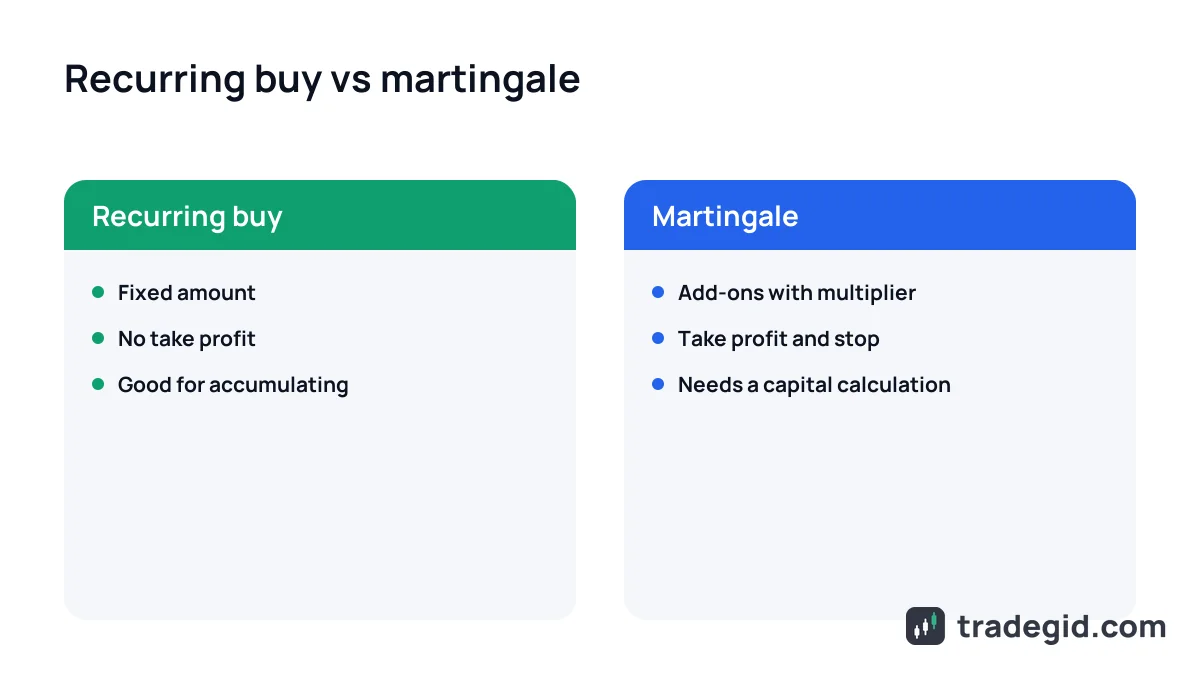
A recurring buy does not try to time the entry. You pick a coin, an amount and an interval, and the bot buys at market. A martingale bot works differently: it opens a first order, waits for price to drop by a set step and adds, usually more than the previous order. When price bounces to the take-profit above the average entry, the whole cycle closes and a new one starts.
| Parameter | Recurring buy | Martingale (DCA with safety orders) |
|---|---|---|
| What it does | Buys a fixed amount on a schedule | Adds on dips, closes the cycle at take profit |
| Where it is called that | Bybit DCA, OKX Recurring buy, Gate Auto-Invest | Binance Spot DCA, Bitget and Gate Martingale, OKX DCA bot |
| Needs a forecast | No | Yes: you need an idea of where the bounce comes |
| Main risk | You keep buying a falling asset, there is no take profit | Capital runs out before price bounces |
| Leverage | None, spot only | Spot or futures; futures can be liquidated |
| Who it fits | People stacking BTC or ETH for years | Experienced users who calculate drawdown depth in advance |
Product names from the Binance, Bybit, OKX, Bitget and Gate help centers, November 2026.
One more difference: scheduled DCA has no built-in take profit. You accumulate and decide yourself when to sell. Martingale has profit-taking built in, so it is closer to trading than to saving.
Parameters of a DCA bot with safety orders
Names differ, but the set is nearly the same everywhere. The examples below come from Binance Spot DCA and the martingale bots of Bitget and Gate.
| Parameter | Meaning | What to consider |
|---|---|---|
| Base order | The amount a cycle starts with | The smaller it is, the longer the deposit lasts |
| Safety orders (Max DCA) | How many add-ons the bot places | Each add-on reserves money in advance |
| Price deviation | How much price must fall before an add-on; Binance allows 0.1–15% | A tiny step burns through the add-ons fast |
| Volume multiplier | How much larger each add-on is; Gate allows 1 to 2 | A multiplier of 2 doubles the order every time |
| Step multiplier | Widens the gap between add-ons | Helps survive a deeper fall |
| Take profit (TP) | Profit above the average price at which the cycle closes | On Bybit the TP fills at market, so slippage is possible |
| Stop-loss or termination price | The level where the bot stops | Without it the bot buys until the money is gone |
How much money you need: the martingale simulator
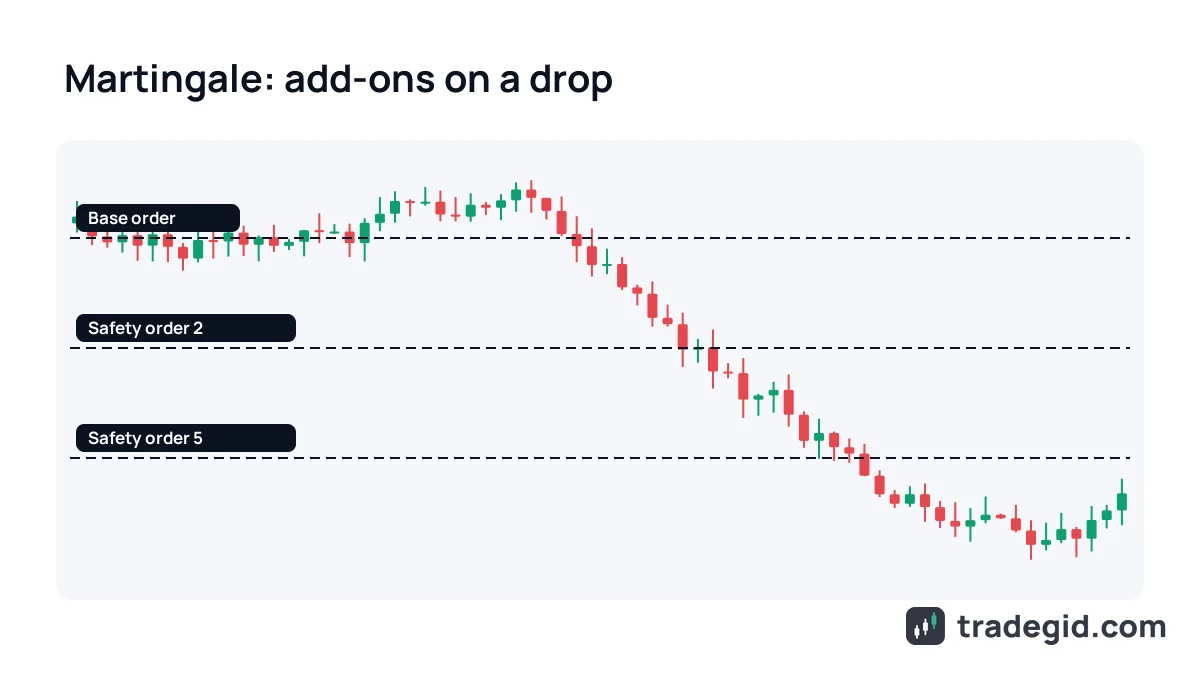
Take the default settings: a 20 USDT base order, five safety orders starting at 20 USDT, a 2% step with a 1.2 step multiplier and a 1.5 volume multiplier. The bot survives a drop of about 14.9% and spends around 284 USDT to do it, 14 times the first order. To close the cycle 1.5% above the average price, you need a bounce of about 7.5% from the bottom.
Now raise the volume multiplier to 2: for the same 14.9% drop you need about 640 USDT, and your average price sits 11.6% below the market. Lower the multiplier to 1 and 120 USDT is enough, but the bounce needed for the take profit grows to about 11%. The lesson: an aggressive multiplier buys deeper but eats the deposit.
Martingale on futures: why it is more dangerous
On spot, the worst case is being stuck with a coin at a loss. On futures the bot adds under leverage and margin grows with the position. If price keeps moving against you, the exchange force-closes everything: that is liquidation. The mechanics are covered on the liquidation page.
Gate's guide gives an example: with a multiplier of 2 and five add-ons, the position grows 32 times from the first order. Bybit allows up to 50x leverage on its futures martingale and Bitget up to 5x. The higher the leverage, the smaller the drop the bot survives.
Where the DCA bot is available on five exchanges
There is no separate fee for bots: trades use normal trading fees. On spot the base rate is 0.1% on Binance, Bybit, Bitget and Gate, and 0.08% or 0.10% on OKX depending on the order type. Step-by-step guides for each exchange sit on separate martingale pages.
| Exchange | Spot | Futures | Notes | Guide |
|---|---|---|---|---|
| Binance | Spot DCA (martingale), step 0.1–15%, fixed or trailing take profit | Futures DCA, long and short, up to 10 bots | Futures DCA is unavailable in some regions | Martingale on Binance |
| Bybit | DCA: recurring buy of up to 5 coins, interval from 10 minutes to 4 weeks | Futures Martingale, up to 50x leverage | Spot DCA is not martingale; Bybit EU offers only DCA and spot grid bots | Martingale on Bybit |
| OKX | Spot DCA bot and Recurring buy | Futures DCA bot | The set depends on your account region | Martingale on OKX |
| Bitget | Spot Martingale | Futures Martingale, up to 5x leverage | No pause, only Terminate | Martingale on Bitget |
| Gate | Spot Martingale, multiplier 1–2 | Futures Martingale | Stop-loss 0.1–99.99% and a start trigger; India and the Philippines are on Gate's restricted list | Martingale on Gate |
Data from exchange help centers, November 2026. The bot set depends on your account region; check limits in the bot form.
Who a DCA bot suits
Suits
- Recurring buy: people stacking BTC or ETH for years who do not want to pick entries.
- Spot martingale: people ready to hold the coin if no bounce comes.
- People who calculate capital and drawdown depth in the simulator first.
- People who set a stop or termination price.
Does not suit
- Futures martingale for a beginner: liquidation comes faster than it looks.
- People investing their last money who cannot survive a drawdown.
- People counting on a "guaranteed" bounce.
- People using an aggressive multiplier for a quick take profit.
Recurring buy fits nearly anyone on spot; martingale fits only someone who calculated the worst case beforehand.
How to set up a DCA bot safely
- Sign up and complete KYCFor example on Bybit or on OKX. Bybit bots need KYC Standard or higher.
- Start on spotLeave futures martingale for later, until you have opened at least ten trades by hand with leverage.
- Calculate capital in the simulatorEnter the parameters from the bot form into the simulator above and see how deep a fall your money covers. For BTC I plan for a drop deeper than the worst of the past year.
- Allocate a separate amountGive the bot only money you can freeze for weeks. Never put the whole deposit into one bot.
- Set a stop-loss or termination priceWithout one the bot keeps buying until funds run out. Keep the take profit within 1–3% of the average price so the cycle closes on a small bounce.
- Launch and watch for a week or twoCheck My Bots to see how many add-ons are used. If more than half are gone, do not top up blindly: that is the same martingale, done by hand.
A safe setup starts with calculating the worst case, not with picking a nice-looking coin.
DCA bot vs grid bot
A grid bot earns from swings inside a channel and needs a sideways market. A DCA bot earns from a bounce after a fall and builds a position. For the grid details, see the grid bot guide. The bots section gives the overall picture.
New accounts via the link: tasks worth up to 250 USDT; 25% off spot fees paid in MNT.
Sign up on BybitJ8NKMGNew accounts get up to 100 USD in trading-fee vouchers after KYC.
Sign up on Binance58328288New accounts via the link are enrolled in the OKX New User Bonus program automatically.
Sign up on OKXK2FMEIJ320% off spot fees paid in BGB; new-user rewards in the Reward Center.
Sign up on BitgetBGGAPKEJNew accounts: a welcome package worth up to 135 USDT for tasks; lower fees paid in GT.
Sign up on GateUVRGV1FX