

Crypto Earn and USDT Staking: How Exchange Yield Really Works
Exchange Earn pays you for leaving coins with the exchange: it lends them out, stakes them on-chain or uses them in structured products. On USDT you mostly get lending yield in flexible or locked savings, not real staking. Right now the base USDT rates on the big four run from about 3% to 7%, the 10%+ numbers are promos on a limited amount, and none of it is a bank deposit.
Contents
- What crypto Earn is and where the yield comes from
- Flexible, locked, staking, Dual Investment: side by side
- APR vs APY and why the headline rate lies
- USDT rates: base and promo are different things
- New-user offers: what exchanges themselves advertise
- Launchpool: what it means and how it pays
- Dual Investment: the product that can swap your coins
- Earn risks: what can go wrong
- Earn by region: India, Nigeria, Philippines, EU
- Earn guides by exchange
I've traded since 2020, and between trades my USDT sits in flexible Earn instead of doing nothing. What I don't do is chase a banner without reading which product it is. Below is how each type of Earn works and what the four exchanges I cover here show on their Earn pages.
What crypto Earn is and where the yield comes from
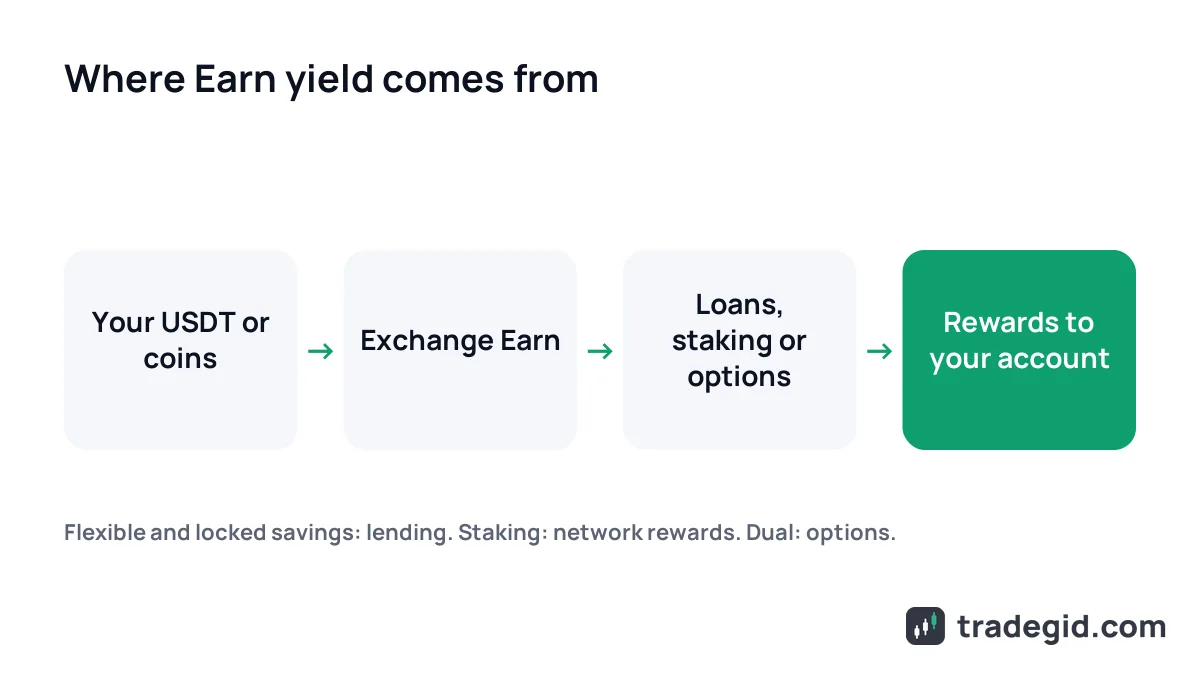
"Crypto savings account" is a marketing phrase. The exchange takes your coins and does one of a few things with them, and the source of the yield decides the risk. Bybit says it plainly: flexible savings yield comes from its loan activities.
- Flexible savings – coins are lent to margin and loan users; you can redeem any time. This is what "USDT staking" usually means on an exchange.
- Locked (fixed) savings – same idea, but for a fixed term at a rate set in advance; early exit costs you the rewards.
- Staking – the exchange stakes proof-of-stake coins like ETH or SOL on-chain and passes on the network rewards minus a fee.
- Launchpool and airdrops – you lock BNB, MNT, USDT or other coins and receive new project tokens instead of interest.
- Dual Investment (Dual Asset) – a short options-based product: a high rate in exchange for the risk of being converted into another coin.
The first three keep your coin count intact; the last two pay in other tokens or can change which coin you hold. That split matters more than any APR.
New accounts get up to 100 USD in trading-fee vouchers after KYC.
Sign up on Binance58328288New accounts via the link: tasks worth up to 250 USDT; 25% off spot fees paid in MNT.
Sign up on BybitJ8NKMG20% off spot fees paid in BGB; new-user rewards in the Reward Center.
Sign up on BitgetBGGAPKEJNew accounts: a welcome package worth up to 135 USDT for tasks; lower fees paid in GT.
Sign up on GateUVRGV1FXInvited new users get a surprise reward of 5-200 $ after depositing and trading at least 200 $ (in eligible regions).
Sign up on Krakenkypj2dhkOKX has its own lineup: Simple Earn, On-chain Earn, Dual Investment, Flash Earn and BTC Yield+ – all covered in our OKX Earn guide.
We also cover Launchpool and airdrops, ETH and SOL staking and dual investment separately.
Flexible, locked, staking, Dual Investment: side by side
| Product | How you're paid | Getting money out | Coin amount protected? | Main risk |
|---|---|---|---|---|
| Flexible savings | Floating APR, accrued every minute (Binance) or hourly (Bybit) | Any time, usually instant | Yes, in coins | Exchange risk, rate drops |
| Locked / fixed savings | Fixed APR for the term, paid daily or at maturity | At maturity; early exit forfeits rewards | Yes, in coins | Money stuck for the term |
| Staking (ETH, SOL) | Network rewards minus the exchange's fee | Depends on the network's unbonding time | Mostly, but the coin's price moves | Coin price, protocol and validator risk |
| Launchpool | New project tokens, accrued hourly | Unstake any time | Yes, in staked coins | Reward token may drop hard after listing |
| Dual Investment | High APR for 1 to a few days | Only at settlement | No | You may end up in the other coin at a worse price |
Based on Binance and Bybit help center articles, data as of November 2026. Exact terms differ by exchange and product.
APR vs APY and why the headline rate lies
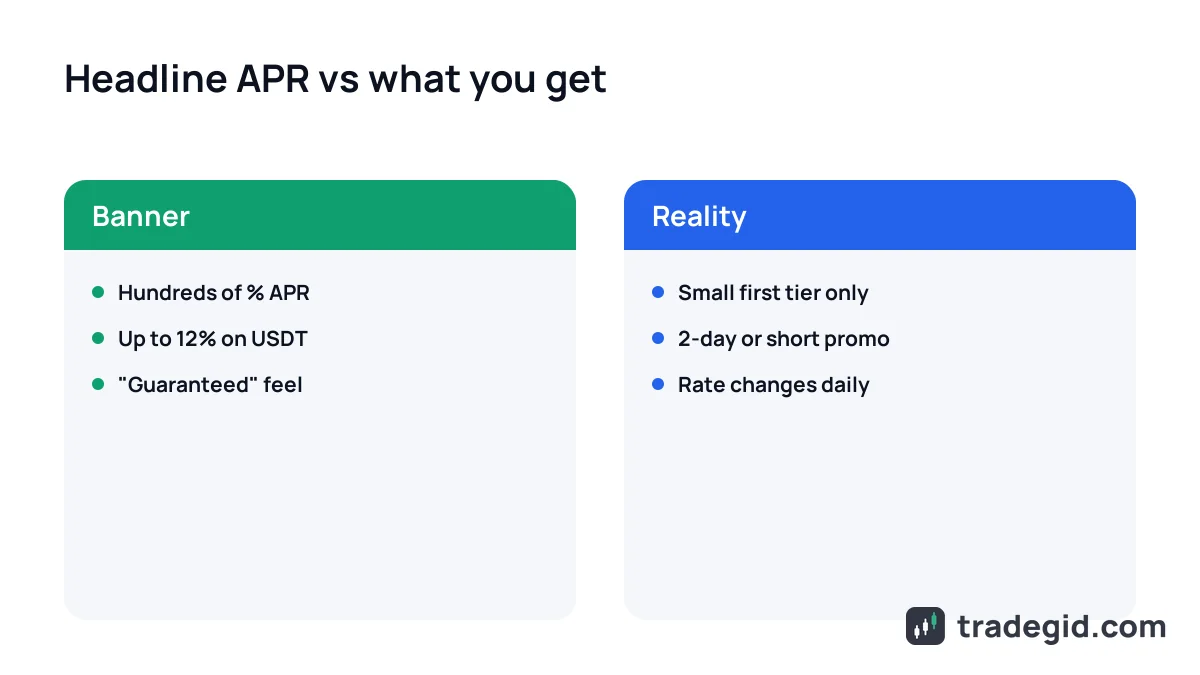
Exchanges quote APR – a simple annual rate. APY includes compounding. At 5% APR with daily compounding you get about 5.13% APY. The gap is small at low rates and grows at high ones. Binance adds flexible rewards to your Earn balance every minute, so it compounds by design; check each product's terms for the others.
The bigger trap is tiered APR. The top rate usually covers only the first few hundred dollars. Binance's own FAQ example has a 5% bonus on the first 500 coins and the normal real-time rate on the rest. Binance's USDT line shows a range of roughly 3% to 12%, and the top of it is the "Max" with the bonus tier, valid only up to a limited amount.
USDT rates: base and promo are different things
I opened the Earn page of each exchange. Rates as of November 2026; they change every day, so check the live numbers in the exchange's Earn section. That is why the table shows ranges, not exact values. Promos (campaigns, bonus tiers, new-user products) are always listed apart from base rates, because they cover a limited amount or time.
| Exchange | Base rate on the page | Promo or bonus tier (limited) | Where to see it |
|---|---|---|---|
| Binance | From 3% (Fixed 90 days); BFUSD Flexible about 6% | Up to 12% Flexible with Bonus Tiered APR; campaign "up to 10% APR", end date not shown | Earn > Simple Earn |
| Bybit | Flexible about 7%; Fixed 7 days about 2% | Banner "up to 10% APR and share 38M WLFI"; APR Booster vouchers | Earn > Easy Earn |
| Bitget | Flexible from 4%; VIP about 3% | Top of the 4–7% range is a boosted rate on a limited amount | Finance > Savings |
| Gate | About 8% already includes a promo markup; clean base not shown separately | Tags "Event" and "Bonus"; about 9% for 7 days for VIP2-14 | Earn > Simple Earn |
Rates as of November 2026; they change every day, so check the live numbers in the exchange's Earn section. The full table with new-user offers is on the USDT rates page, updated weekly.
Full breakdown with the new-user column and how to read each line: USDT staking rates comparison. Guides per exchange: Binance, Bybit, Bitget, Gate.
Is USDT staking real staking?
No. USDT isn't a proof-of-stake coin, so "USDT staking" on an exchange, or in a Ledger or Trust Wallet app, is lending. Real staking is for coins like ETH or SOL: Binance stakes ETH from 0.0001 ETH and keeps 10% of the rewards.
New-user offers: what exchanges themselves advertise
Exchanges run offers "for all new users", and I list only those I could see. Binance: vouchers up to 100 USD for trading fees after KYC (not for Russia) and a fee discount when paying in BNB. Bybit: tasks with rewards up to 250 USDT and a spot fee discount when paying in MNT. Bitget: a spot fee discount when paying in BGB and bonuses in Reward Center. Gate: a welcome pack of up to 135 USDT for tasks and a discount when paying in GT. Conditions change, so read them after you register.
New-user Earn products come and go. Bybit has given new accounts a product with a very high rate for 2–3 days and a capped amount, so check whether it exists after sign-up. The math shows why such a number is bait: 300 USDT for two days at 500% APR is about 8 USDT.
Launchpool: what it means and how it pays
A launchpool is a pool where you lock coins for a few days and receive a new token around its listing. On Binance you lock BNB; BNB already in Simple Earn counts automatically, and rewards are calculated hourly. Bybit's Launchpool takes MNT, USDT, USDC or project tokens.
The reward is a token, not USDT. I've seen pool tokens lose half their value in the first week of trading, so I count a launchpool as a free option, not income.
Dual Investment: the product that can swap your coins
Dual Investment on Binance and Dual Asset on Bybit look like savings with a huge APR. They aren't. You pick a target price and date. With Buy Low in USDT: if the price ends below the target, your USDT buys the coin at the target price. With Sell High in BTC: if the price ends above the target, you're sold out into USDT. You can't cancel early.
Example with round numbers: 1,000 USDT, Buy Low BTC at 60,000. If BTC settles at 55,000, you get about 0.0167 BTC worth roughly 917 USDT at that moment. The interest rarely covers that. Use it only for a coin you actually want to buy at that price.
Earn risks: what can go wrong
- It's not a bank deposit. No deposit insurance; if the exchange fails or freezes withdrawals, Earn balances are stuck with everything else.
- The rate is discretionary. Binance says APR may change and isn't a forecast of returns. Flexible rates can halve in a week.
- Lock-ups bite. Early exit from a locked product costs the rewards; Binance can take up to 72 hours to return funds.
- Redemption limits. Exchanges can set daily redemption limits.
- Conversion risk. Dual Investment and similar products can leave you holding a different coin.
- Region rules change. Exchanges switch products off by country, sometimes with a few days' notice.
Keep in Earn only what you'd keep on that exchange anyway. The yield doesn't change the exchange risk; it just pays you a little for taking it.
Earn by region: India, Nigeria, Philippines, EU
Access depends on the country you live in, not your passport, and the product list differs per exchange. Bitget is closed to Russia, Belarus and Kazakhstan. In the EU, Binance and Bitget have no MiCA licence and don't take new EU clients, while Bybit and Gate redirect EU residents to their European versions with fewer products. Check the restricted-country list of the exchange before you deposit.
Tax: in India crypto gains are taxed at 30% with 1% TDS on transfers. How Earn rewards are classified is a question for your CA, not for an exchange banner.
Earn guides by exchange
- Binance Earn – Simple Earn, ETH and SOL staking, Launchpool and HODLer Airdrops, Dual Investment.
- Bybit Earn – Easy Earn, Auto-Earn, On-Chain Earn, Dual Asset, Launchpool.
- Bitget Earn – flexible and fixed savings, Launchpool.
- Gate Earn – Simple Earn, staking, Launchpool.
Pick the guide for the exchange you already use: moving money just for 1% more APR rarely pays after withdrawal fees.
New accounts via the link: tasks worth up to 250 USDT; 25% off spot fees paid in MNT.
Sign up on BybitJ8NKMGNew accounts get up to 100 USD in trading-fee vouchers after KYC.
Sign up on Binance5832828820% off spot fees paid in BGB; new-user rewards in the Reward Center.
Sign up on BitgetBGGAPKEJNew accounts: a welcome package worth up to 135 USDT for tasks; lower fees paid in GT.
Sign up on GateUVRGV1FXInvited new users get a surprise reward of 5-200 $ after depositing and trading at least 200 $ (in eligible regions).
Sign up on Krakenkypj2dhkIn this section
- Earn on BinanceSimple Earn, staking, Launchpool and Dual Investment: rates, steps and withdrawal.
- Earn on BybitEasy Earn, On-Chain and Dual Asset: rates, steps and withdrawal to Funding.
- OKX EarnSimple and On-chain Earn, Dual Investment, Flash Earn: rate ranges, steps and withdrawal.
- USDT ratesBase and promo USDT rates on Binance, Bybit, Bitget and Gate, with new-user offers and where to check live numbers.
- Bitget EarnSimple Earn, Cash Plus, staking and Dual Investment on Bitget: rates, how to subscribe and redeem.
- StakingLiquid staking of ETH and SOL on Binance, Bybit, Bitget, Gate and OKX: tokens, rate ranges, withdrawals, risks.
- Gate EarnSimple Earn, staking, Launchpool and Dual Investment on Gate: rates, how to subscribe and redeem.
- Launchpool and airdropsLaunchpool, HODLer Airdrops, PoolX, CandyDrop and Jumpstart: what they are, what they pay and the risks.
- Dual InvestmentDual Investment: Buy Low and Sell High in numbers, APR and risks on 5 exchanges.