

Staking ETH and SOL on Exchanges: How It Works, Rates and How to Withdraw
Exchange staking means you hand over ETH or SOL, the exchange delegates it to network validators and pays you a share of the rewards. Rates as of November 2026 are roughly 2–4% a year for ETH and 4–7% for SOL, and none of it is guaranteed. Most exchanges give you a liquid token in return (WBETH, BNSOL, GTETH, BGSOL) that you can sell without waiting in the network's exit queue.
Contents
When I pick a staking product, I ignore the APR on the banner and look at three things: which token I get, how fast I can leave, and how much the exchange keeps from the rewards. Here is how that looks on Binance, Bybit, Bitget, Gate and OKX.
New accounts via the link: tasks worth up to 250 USDT; 25% off spot fees paid in MNT.
Sign up on BybitJ8NKMGNew accounts get up to 100 USD in trading-fee vouchers after KYC.
Sign up on Binance58328288New accounts: a welcome package worth up to 135 USDT for tasks; lower fees paid in GT.
Sign up on GateUVRGV1FX20% off spot fees paid in BGB; new-user rewards in the Reward Center.
Sign up on BitgetBGGAPKEJNew accounts via the link are enrolled in the OKX New User Bonus program automatically.
Sign up on OKXK2FMEIJ3Invited new users get a surprise reward of 5-200 $ after depositing and trading at least 200 $ (in eligible regions).
Sign up on Krakenkypj2dhkAvailable products depend on the country of residence you give during KYC. Gate lists India and the Philippines among its restricted regions, so check your country before you deposit anything.
What staking is and how it differs from mining
Staking works on Proof-of-Stake networks such as Ethereum and Solana. A validator locks coins as collateral, confirms blocks and earns a reward. Mining burns electricity and hardware instead. For you the difference is simple: staking needs no equipment, but your coins are locked in the network for a while.
Running your own Ethereum validator takes 32 ETH and a server to maintain. That is why almost everyone goes through an exchange: it runs the nodes, and you receive a share of the rewards minus a service fee.
Liquid staking: what WBETH, BNSOL and GTETH are
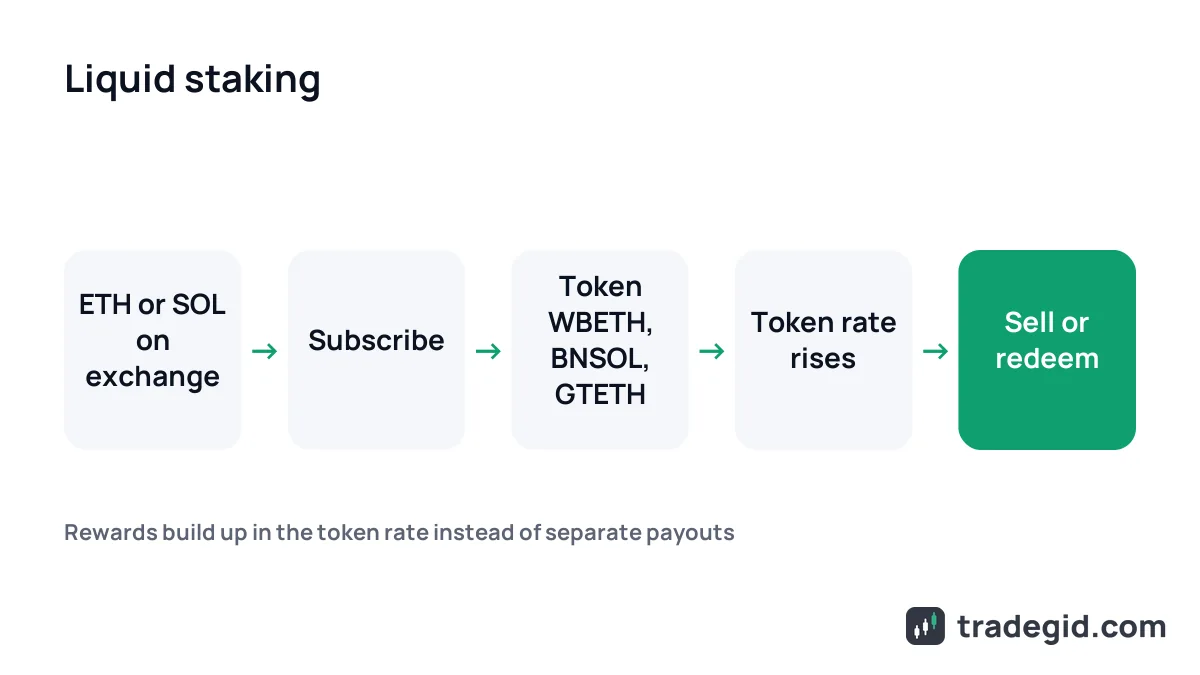
Liquid staking means the exchange gives you a receipt for your staked coins. On Binance you deposit ETH and get WBETH: 1 WBETH equals 1 staked ETH plus accumulated rewards. The reward does not arrive as separate payouts. It builds up in the token's exchange rate against ETH.
You can sell that token on the spot market or use it as collateral or margin on the same exchange. That is the main convenience: you can exit in minutes instead of waiting weeks for the network to unbond. The price is a small risk that the token trades slightly below ETH or SOL.
Tokens, rates and terms by exchange
Rates as of November 2026 change every day, so check the Earn section of the exchange for current numbers. The ranges below are base staking for ETH and SOL without bonus promos: a temporary Bonus APR is added on top and disappears.
| Exchange | Tokens and product | Rate (per year) | Fee | How to exit |
|---|---|---|---|---|
| Binance | ETH Staking → WBETH; SOL Staking → BNSOL | ETH 2–4%, SOL 3–5% | 10% of ETH rewards (reference, can change) | Sell WBETH or BNSOL on spot right away, or redeem: ETH has a daily quota, SOL takes up to 4 days |
| Bybit | On-Chain Earn: mETH, stETH (ETH), bbSOL (SOL) | about 3–7% depending on the coin | Bybit service fee plus protocol fees, shown on the product page | Request any time, funds arrive after the unbonding period; cannot be cancelled |
| Bitget | On-chain Earn and On-chain Elite: BGSOL (SOL) | SOL about 5–7% | BGSOL: 0.1% | Standard redemption at the network's unbonding time, free, or Express in about 10 minutes with 10% of income withheld |
| Gate | Tokenized Staking: GTETH (ETH), SOL, BTC | ETH about 4%, SOL about 7% (with Bonus) | GTETH: 6% of income, VIP discounts | GTETH back to ETH any time, credited instantly |
| OKX | On-chain Earn: SOL, TRX, DOT, ADA and others | SOL about 5% | Depends on the product, see its card | Redemption request, timing set by the protocol |
Data for November 2026 from official pages and help centers. On OKX, On-chain Earn stakes in the network or protocol and there is no liquid token in this table. On Bybit and Bitget, minimums and unbonding times per coin appear only on the product page.
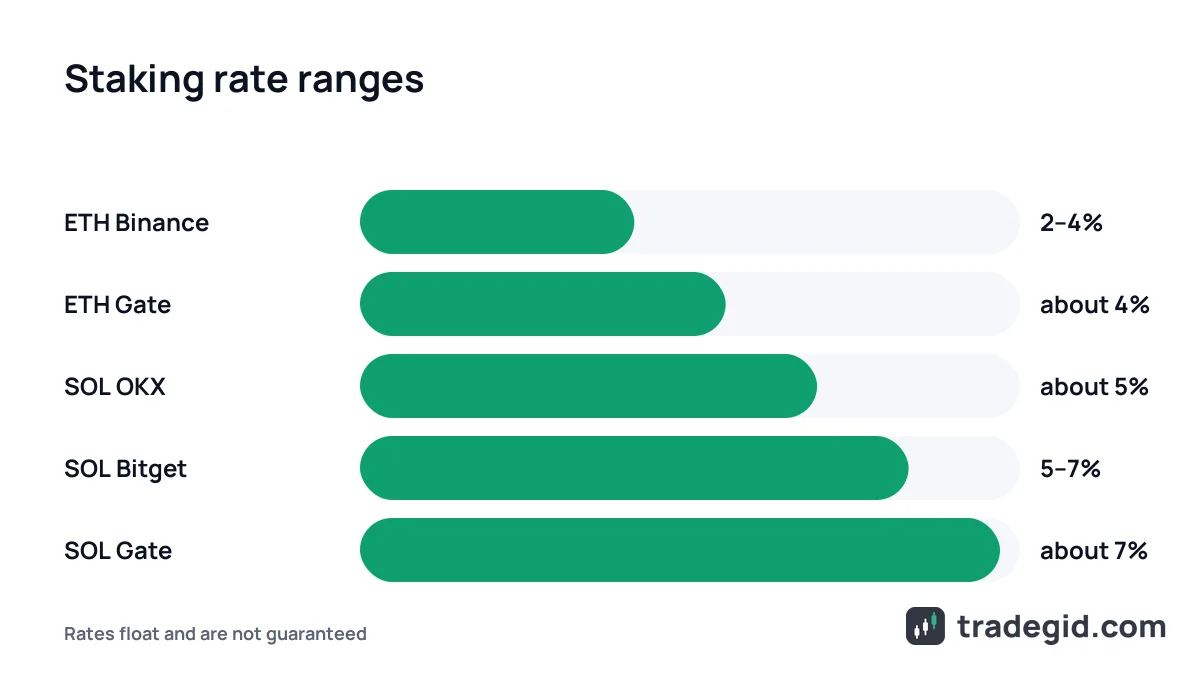
The ETH and SOL gap is easy to explain: Solana has higher network inflation and a higher reward, but its price swings more. A 4–7% range against 2–4% does not make SOL the better deal. If the coin drops 20%, the yield will not cover it.
At 4% on 1,000 USDT worth of ETH you collect about 40 USDT in coin over a year. The calculator does not subtract the exchange fee on rewards, so the real figure is a bit lower. And the price move of the coin over that year can matter more than any rate.
How to stake ETH or SOL step by step
- Sign up on an exchangeFor example on Bybit or on Binance. After registering, look at the rewards and tasks section: exchanges run offers for all new users, and the terms are shown in each offer.
- Complete KYCWithout verification, On-Chain Earn and staking are often locked. The country of residence in KYC decides which products you see.
- Buy or deposit ETH or SOLBuy with USDT on spot or by card, or deposit coins from a wallet. Choose the withdrawal network carefully: ETH and SOL run on different networks.
- Open the staking sectionBinance: Earn → ETH Staking or SOL Staking. Bybit: Earn → On-Chain Earn. Bitget: Earn → On-chain Earn. Gate: Earn → Staking. OKX: Grow → Earn → On-chain Earn.
- Pick a product and an amountRead the minimum, the fee and the exit terms. If you can choose between flexible and fixed terms, take flexible the first time.
- Confirm and check the tokenAfter subscribing, WBETH, BNSOL, GTETH or an Earn position shows up in your assets. Rewards start within a day or two.
The whole route takes about ten minutes; KYC usually takes longer than the staking itself.
How to withdraw from staking
There are two ways out: sell the token on spot or redeem it under the product's rules. The first is fast but happens at the market price. The second gives the exact rate but may take time.
| Method | Speed | Price | What to watch |
|---|---|---|---|
| Sell the token on spot (WBETH/ETH, BNSOL/SOL, etc.) | Minutes | Market price: a small discount to ETH or SOL is possible | Order book depth; the discount widens on stress days |
| Redemption (redeem, unstake) | From instant (GTETH) to a few days (BNSOL) and weeks if the network has a queue | Token rate, no discount | Requests usually cannot be cancelled; no rewards during unbonding |
| Express redemption (Bitget) | About 10 minutes | With 10% of income withheld | Daily limit applies |
WBETH on Binance has a daily operations pause from about 23:45 to 00:15 UTC while the rate updates. If you plan to exit at that hour, allow for the window.
Staking risks on an exchange
What is convenient
- No need for 32 ETH or your own server: the exchange runs the nodes.
- A liquid token sells on spot and can serve as collateral.
- Rewards build up in the coin without manual steps.
- Entry is a fraction of an ETH or SOL.
What is dangerous
- You earn in ETH or SOL, so a price drop eats the yield.
- Token discount (WBETH, BNSOL, mETH) to ETH or SOL on stress days.
- Slashing: a validator breaks the rules and part of the collateral is burned. Exchanges say they cover it, but that is the platform's word.
- Exchange risk: staked coins stay with the platform.
- Unbonding and queues on exit, and requests cannot be cancelled.
Exchange staking adds three risks on top of the coin's price: token discount, validator failure and the platform itself.
USDT and Bitcoin staking: what it really is
USDT and BTC cannot be staked in the classic sense because they have no Proof-of-Stake. When an exchange says "USDT staking", it usually means lending through Simple Earn, a locked product or a DeFi protocol, not validator rewards. Compare USDT rates across exchanges on the USDT rates page.
Bitcoin works the same way: "BTC staking" on an exchange is usually Simple Earn at a fraction of a percent (up to 1%), and sometimes a receipt-token product such as BGBTC on Bitget. The mechanics and risks differ from ETH and SOL. For an overview of all products, see the Earn section.
Wallet staking (Trust Wallet, Ledger) vs an exchange
Wallets such as Trust Wallet or Ledger let you stake without giving your keys to an exchange. That removes platform risk but adds work: network fees, choosing a validator, manual withdrawals. For a first small amount an exchange is simpler. For long-term holdings and larger sums, it is worth learning the wallet route.
New accounts via the link: tasks worth up to 250 USDT; 25% off spot fees paid in MNT.
Sign up on BybitJ8NKMGNew accounts get up to 100 USD in trading-fee vouchers after KYC.
Sign up on Binance58328288New accounts: a welcome package worth up to 135 USDT for tasks; lower fees paid in GT.
Sign up on GateUVRGV1FXNew accounts via the link are enrolled in the OKX New User Bonus program automatically.
Sign up on OKXK2FMEIJ320% off spot fees paid in BGB; new-user rewards in the Reward Center.
Sign up on BitgetBGGAPKEJInvited new users get a surprise reward of 5-200 $ after depositing and trading at least 200 $ (in eligible regions).
Sign up on Krakenkypj2dhk